
Online American Roulette in UK Casinos: Rules
 Available in GB
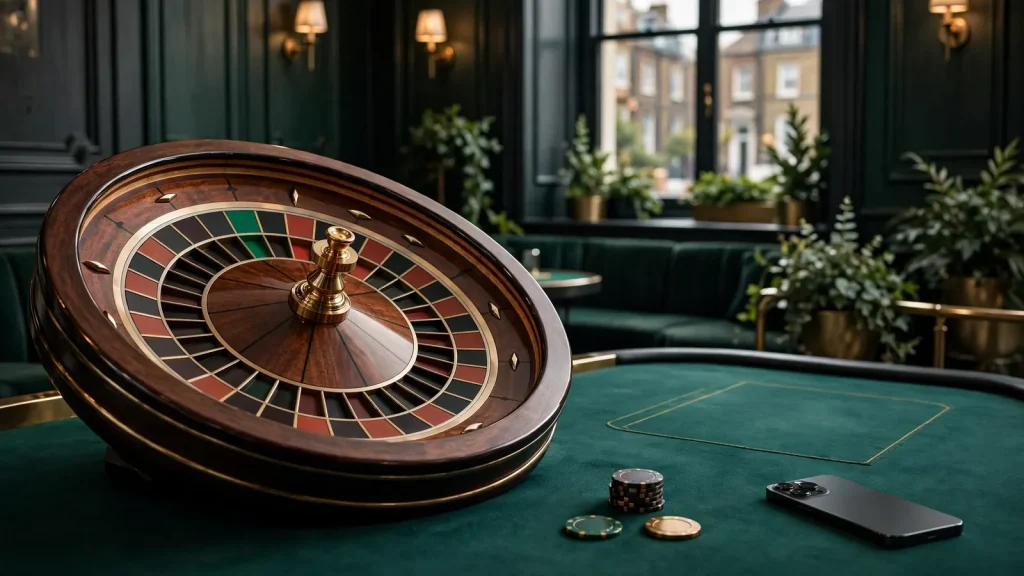
American roulette adds a 00 pocket to the familiar wheel, affecting the outcomes behind every bet and how its layout is read.
American Roulette’s Extra Green Pocket
American roulette is a casino roulette variant distinguished by one small-looking addition: the double-zero, marked 00. It is not a second label for the ordinary zero, nor a decorative feature of the game’s presentation. It is an extra numbered outcome, included on both the wheel and the betting layout. That changes the shape of the game before a wager has even been considered.
Roulette depends on a compact social contract. A ball is set in motion, a result arrives, and the table’s rules determine which selections match it. The elegance is partly visual and partly administrative: many possible choices are gathered around one event. American roulette retains that familiar structure, but adds a result that European-style descriptions of the game do not imply. The difference is easy to overlook in an online lobby, where several roulette titles may sit side by side beneath similar graphics. The name matters because it signals that the game has an additional 00 outcome.
For the player, that extra outcome is not merely a detail to memorise. It is part of the field against which every selection is made. A wager is placed in a game whose possible results include both zero and double-zero; the latter is not an occasional bonus feature or a special round. It belongs to the ordinary sequence of play. The practical consequence is that American roulette has a different underlying structure from a version with only a single zero, even where the interface, animation and table ritual seem reassuringly familiar.
When choosing an online casino for American roulette in the UK, payout timing is one practical detail to consider. The list below records the available payout-speed information for each operator.
1. SlotoSport
Payout speed: 1-3 business days SlotoSport has a stated payout speed of 1–3 business days.
2. NightLuck
Payout speed: 1-3 business days NightLuck has a stated payout speed of 1–3 business days.
3. Britsino
Payout speed: 1-3 business days Britsino has a stated payout speed of 1–3 business days.
4. Dieselwin
Payout speed: 1-3 business days Dieselwin has a stated payout speed of 1–3 business days.
5. SpinFormula
Payout speed: 1-3 business days SpinFormula has a stated payout speed of 1–3 business days.
6. Revery Play
Payout speed: 1-3 business days Revery Play has a stated payout speed of 1–3 business days.
7. Amunbet
Payout speed: 1-3 business days Amunbet has a stated payout speed of 1–3 business days.
8. Jetsetspins
Payout speed: 1-3 business days Jetsetspins has a stated payout speed of 1–3 business days.
9. x3bet
Payout speed: 1-3 business days x3bet has a stated payout speed of 1–3 business days.
10. NightWin
Payout speed: 1-3 business days NightWin has a stated payout speed of 1–3 business days.
This is why an online American roulette casino should be understood as offering a particular ruleset, not simply a roulette game with an American-themed name. A digital display can make variants look nearly interchangeable: the same spinning motion, the same ball, the same moment of suspense. Yet the game’s identity rests on its available outcomes, not on the colour palette or the sound design. The 00 is the useful clue. Its presence tells what version is being played.
The extra pocket also gives the game a slightly different character. Roulette’s suspense often comes from the gap between a broad choice and a single result. Add another possible result and the uncertainty is plainly greater, though the table may not look dramatically different to someone glancing at it. The game’s central event remains simple; the conditions surrounding that event have shifted. That is the kind of alteration casinos have long made compelling: a familiar ceremony, adjusted at one decisive point.
Online play can obscure that distinction because software presents the game as a seamless product. A title may be selected from a menu, then opened directly at a table. The transition asks little of the player and announces little beyond the game name. In a live setting, the physical arrangement may make the variant more legible; in a digital one, the rules and displayed layout carry more of the burden. Either way, the double-zero is a structural feature, not an aesthetic flourish.
Live Casino Lightning Roulette UK: How Play Works
The term “American” can also tempt a reader to think in terms of theme or provenance. Here its useful meaning is narrower: it identifies a roulette format with 00 included alongside zero. That distinction should be kept separate from questions about whether a particular casino offers the game, whether it is streamed or computer-generated, or how its bets are paid. Those are different parts of the experience. The variant itself is defined by the additional outcome.
There is a quiet lesson in the way roulette is packaged for online casinos. Familiarity encourages the eye to skim; a recognisable table can feel like the same game wherever it appears. But one added symbol changes the rules that sit beneath the spectacle. The difference is small on screen and substantial in definition. A double-zero is still only two characters. It carries the whole distinction.
What Makes an American Roulette Casino Worth Comparing
“Best” is a verdict, not a feature of a roulette table. For American roulette, a useful comparison starts with a simpler question: does the casino actually offer the game, and can its rules be understood before play begins? A polished lobby or a prominent casino banner cannot answer either point on its own. Availability, clarity and the terms surrounding play are more meaningful measures than an unsupported league table.
Comparing American Roulette Casinos
- Verify that American roulette is listed as a distinct game in the catalogue
- Locate the specific game rules and paytable before placing a wager
- Check if the game is accessible in the desired format and time
- Confirm that the promotional offer applies specifically to American roulette
- Review the wagering contribution percentage for the game
The first check is whether American roulette appears as a distinct game in the casino’s catalogue. A general roulette heading may cover several versions, so the name should be specific enough to establish that the American format is available. That detail matters because a casino can offer roulette without offering every roulette variant. A comparison based only on broad category labels risks treating unlike games as interchangeable.
Availability can also be conditional. A title may appear in a lobby but not be accessible in every format or at every time. The relevant question is not whether a casino uses the word “roulette” in its promotional copy, but whether the actual game listing and its information identify American roulette. This is a modest standard, but modest standards are useful where marketing language is designed to make a catalogue seem larger than it is.
Rules before reputation
Once the game is present, its rules and paytable deserve more attention than the casino’s claims about atmosphere. The rules explain how wagers are accepted and settled; the paytable sets out the return attached to the available bet types. These should be visible and legible before a wager is placed, rather than scattered across general help pages or left to inference.
The same applies to the range of bets. Someone comparing inside and outside bets needs to know that the game’s own rules describe the options actually offered and how each is treated. A familiar label is not a substitute for a clear rule. Nor should a casino’s general roulette information be assumed to apply to every version it lists. Where a table’s specific rules or paytable are hard to locate, that is a practical weakness in the offer, not a minor editorial quibble.
French Roulette Online Casinos in the UK
Clarity is especially important because the word “American” identifies a variant, not a complete set of table conditions. The name alone does not tell a player everything about the available wagers or the way a particular game presents them. Comparing casinos therefore means checking the information attached to the individual game, not relying on a generic description or a photograph of a roulette table.
A sound comparison also separates facts from praise. Claims such as “premium” or “top” do not reveal whether the game is available, whether its rules are accessible, or whether a promotion can be used with it. A casino may present a strong-looking offer while leaving the relevant conditions elsewhere. The paperwork is part of the product.
Promotions are a separate calculation
Promotions should be assessed independently from the roulette game itself. A welcome offer may look generous in a headline but be limited to particular games, or carry wagering conditions that make it unsuitable for roulette play. The important details are whether the offer applies to American roulette, how roulette contributes to any wagering requirement, and whether other restrictions affect the value of the promotion.
A specialist review has described UK welcome offers as predominantly slot free spins that cannot be used at live tables. That is a report about offers reviewed, not a permanent rule for every casino. The terms of an individual promotion remain decisive. Likewise, live games may count for only a small share of wagering requirements; one stated example is a 10% weighting. A low contribution can mean that roulette play does little to satisfy the requirement, even when the promotion appears to include casino games broadly.
Do
- Treat promotional terms as a separate contract
- Distinguish between game eligibility and wagering contribution
- Confirm the specific game variant in the listing
Don’t
- Assume a general “roulette” heading includes the American version
- Rely on marketing adjectives like “premium” or “top”
- Mistake a bright banner for a full description of terms
It is worth distinguishing eligibility from contribution. A game might be permitted under an offer while contributing only partially towards its wagering conditions. Conversely, a promotion may exclude a game altogether. Those are different restrictions, and the wording should make clear which applies. If the terms do not name American roulette or explain how the relevant game category is treated, the headline offer cannot settle the question.
The comparison, then, is not a hunt for a single “best American roulette casino”. It is a reading exercise: confirm the game is listed, inspect the game-specific rules and paytable, then examine any promotion as a separate contract with its own conditions. That approach does not produce a universal winner. It produces a more useful account of what each casino is actually offering—and avoids mistaking a bright banner for a fair description.
The Human Pace of Live American Roulette
Live American roulette brings the casino floor to a screen, but it does not make the game move at the speed of software. A studio camera shows a human dealer, the physical wheel and the table as events unfold in real time. Bets are entered through an on-screen interface during the available betting window; the dealer then closes betting and proceeds with the round. The stream gives the game a visible human centre, even though the player’s actions remain digital.
That distinction shapes the experience more than the word “live” might suggest. A computerized game can move from one result to the next with little ceremony. At a live table, the dealer’s actions, the timing of the stream and the shared rhythm of the table set the pace. The pause is part of the format. It may suit players who value seeing a real wheel and dealer, but it is less suited to anyone expecting rapid, uninterrupted rounds.
Live Dream Catcher Casino UK: How It Works
There is a practical trade-off. Live games tend to run more slowly than digital versions, and their minimum bets are higher. The precise entry point depends on the table, so the displayed limit matters more than a broad impression of what live play costs. A specialist review has described some live roulette and baccarat tables as starting at around 20p, while blackjack tables in the same account had higher starting limits. That is a report about particular tables, not a dependable market-wide price.
The stream also depends on a stable internet connection. A frozen image or delayed feed can make the moment of placing a bet feel uncertain, while the table continues according to its own schedule. This is not merely a matter of picture quality: the interface must communicate the betting window and the table’s progress clearly enough for online actions to keep pace with the live game. A weak connection can turn the format’s deliberate tempo into an irritating one.
The setting is designed to suggest a shared room, though each player sits apart from it. The dealer is present on screen; the other participants may be represented by activity at the table rather than conversation. The appeal lies partly in that small social fiction: a studio, a dealer, a wheel, and people joining remotely. Technology carries the room into private spaces, but cannot remove the conditions of the room—its pace, limits and rules.
In Britain, live dealer casinos may operate legally when they hold a UK Gambling Commission licence. That regulatory condition belongs to the operator, not to the appearance of the stream. A convincing studio presentation is not itself evidence of licensing. Before play, the table’s minimum and rules should be visible, and any spending limit should be set in advance. The format remains gambling, however polished the camera work.
In Britain, live dealer casinos must hold a UK Gambling Commission licence to operate legally, regardless of the studio’s presentation quality.
Live American roulette is therefore less a shortcut to a spinning wheel than a particular arrangement of time and attention. The dealer supplies a human pace; the player supplies a reliable connection and accepts the table’s conditions. A slower rhythm, a higher entry point and a visible host are not incidental decorations. They are the substance of live play.
How Roulette Bets Resolve—and What the Edge Means
A roulette bet is a prediction about where the ball will come to rest. When the result matches the selection, the bet wins; when it does not, it loses. That simple rule sits beneath a range of choices, from naming one number to backing a broader category of outcomes. The selection determines which results count as a win, and the game’s paytable determines the payout attached to it.
That distinction matters when considering American roulette payouts. A winning straight-up bet and a winning bet on a wider category do not necessarily return the same amount. The payout is tied to the kind of selection made, not just to the fact that the ball has landed somewhere favourable. The table’s rules and paytable should therefore be read before play begins; a general description of roulette cannot supply the terms of a particular game.
The house edge describes the casino’s statistical advantage built into the game. For straight-up bets, the stated edge is 2.9%; for other bets, it is 2.7%. These figures are not a promise about what happens in an individual round. A bet can win or lose according to the result, while the edge concerns the game’s overall mathematics rather than a prediction of the next spin.
Crazy Time Live Casino Game Show in the UK
The difference between the two figures is modest, but it is meaningful: the edge is not identical across every bet type. Choosing a broader selection does not remove the casino’s advantage, and a larger payout for a narrower prediction does not make that prediction more likely to succeed. The payout and the chance of a winning result belong together, but they are not interchangeable measures.
For someone learning how to play American roulette, the practical sequence is uncomplicated: choose a permitted selection, place the stake, and wait for the ball’s result. The more consequential task is understanding what the selection covers and what the paytable says it returns. Familiarity with the mechanics does not change the underlying edge.
The appeal of the game may lie partly in this visible exchange between a prediction and a result. The ball supplies the event; the rules assign its financial meaning. Online, the same distinction applies when choosing to play American roulette online in the UK: the digital interface may make a selection look effortless, but it does not make every bet equivalent. Terms remain worth reading.
No staking pattern can turn the edge into a guarantee of profit or dictate where a later ball will land. Each result settles the selection made for that round; the long-run edge is a property of the game, not a forecast for an individual player. That is the quieter arithmetic behind the ceremony. The numbers do not negotiate.
This material is for entertainment purposes only, not gambling advice.
Understanding the House Edge
- The house edge for straight-up bets is 2.9% and 2.7% for other bets
- The edge is a statistical property of the game, not a prediction of the next spin
- No staking pattern can eliminate the long-run mathematical advantage of the casino
- Payouts are tied to the specific selection made, not just the fact of winning
Reading the American Roulette Table Layout
A roulette table layout is the marked surface on which bets are placed. In American roulette, its defining detail is not merely a different label or decoration: the layout includes a separate space for double zero, marked 00, alongside the zero space. That extra selection is visible before a bet is made.
The distinction matters because a bet is attached to the marking chosen on the table. A selection on 0 and a selection on 00 are not interchangeable; each refers to its own number. The American roulette table therefore gives the double zero a place in the betting arrangement, rather than leaving it as a feature known only to the person running the game.
This can make the layout look less familiar to someone accustomed to a version with a single zero. The eye has another green-marked number to account for, and the player’s choices are represented on the surface in a way that reflects that. The extra space is small in visual terms, but it changes what the layout offers. A table cannot quietly omit it and still present the same American format.
A useful way to read an American roulette casino table is to distinguish the marked choices from the broad idea of the game. The layout is not a prediction device, and the position of a number on the felt does not suggest where a ball will land. It is an interface: it shows which selection a wager refers to. The double-zero space is part of that interface, not a clue.
That distinction also helps when comparing screens or table designs. A digital table may arrange its markings differently from a physical-looking presentation, but the important question for this feature is whether 00 appears as its own betting selection. Decorative graphics and table colours are secondary. The label matters.
The same principle applies when a game is viewed on a smaller screen. The layout may be compressed, and some markings may be less prominent, but 0 and 00 should remain identifiable as separate choices. If the double-zero space is not immediately clear, the rules or information panel can explain the table’s format before any wager is placed. A clear layout reduces confusion; it does not alter the result of a spin.
Monopoly Live Casino UK: Format and Gameplay
There is a quiet history of administration in every betting surface. The marks turn a game into a set of choices that can be recorded, accepted and settled, and the extra 00 shows how the American version gives its additional number a place within that system. It is not an ornamental flourish. It is part of the table’s working grammar.
For anyone examining an American roulette table layout, the key visual check is therefore simple: find the separate 00 space, and keep it distinct from 0. Everything else on the surface serves the broader task of showing where a bet is directed. The layout makes the choice legible. It does not make it safer, cleverer or more likely to win.
The Wheel with Two Green Pockets
On an American roulette wheel, green marks two distinct pockets: 0 and 00. The European wheel has one green pocket, marked 0. That difference is visible before a ball is released, and it gives the two wheels separate identities even when their red and black numbers make them look familiar at a glance.
The double-zero wheel is not simply a European wheel with an extra mark painted on. Its defining feature is the inclusion of both zero and double zero among the pockets around the rim. The paired symbols are easy to recognise, but they are not interchangeable labels: each names its own pocket. A glance at the wheel, rather than at a screen’s surrounding graphics, is enough to distinguish the American arrangement from the European one.
Green has a peculiar role in roulette. Most of the numbered pockets are red or black; zero belongs to neither colour. On the American wheel, the same exception appears twice. The green spaces stand apart from the colour division that organises much of the wheel’s visual character. They interrupt its rhythm. There is no need to infer anything from that appearance about where a ball will land: the colour is a feature of the wheel, not a clue to its next result.
Live Blackjack at UK Online Casinos: How It Works
The contrast with European roulette is spare and exact. Its wheel has a single green zero. The American version adds the green 00 beside the familiar 0, making the difference legible in the wheel’s number set itself. This is why “double zero” is more than a nickname for an American-style game. It identifies a physical pocket that European roulette does not have.
A casino image can make the distinction less obvious than a real wheel. Interfaces may compress the wheel into a graphic, or place it alongside a table design that draws the eye elsewhere. The labels still matter: 0 and 00 are the reliable signs of the American wheel, while a single 0 identifies the European version. The green pockets are small details, but they carry the clearest visual distinction between the two.
There is also something revealing in the way roulette makes exceptions visible. Red and black create a broad, orderly pattern; green interrupts it, first once and, on the American wheel, again. The double-zero arrangement places that interruption twice around the same circular object. It is a modest design choice with a distinct effect on the game’s identity, rather than a decorative flourish.
For anyone comparing images of an American roulette casino wheel, the useful question is therefore simple: are both green pockets present, one marked 0 and the other 00? If so, the wheel has the American double-zero feature. If the only green pocket is 0, it is the European arrangement. No elaborate reading of the wheel is required. Two symbols settle the matter.
Real-Money Bets and the Odds Behind Them
For a single-number selection, American roulette gives a winning chance of one in thirty-eight. European roulette gives one in thirty-seven. The difference is a small fraction of the wheel’s possibilities, but it matters whenever money is staked: the American version makes a winning number less likely on each spin.
That comparison concerns the chance of matching one chosen number, not every kind of bet on the table. Roulette offers selections that cover different groups of numbers, so the likelihood of a win changes with the choice. A broader selection can cover more possible outcomes; a narrower one asks for a more specific result. Neither description says what a return will be, and odds alone cannot settle whether a real-money bet is suitable.
Attention American roulette makes a winning number less likely on each spin compared to European roulette due to the additional double-zero pocket.
The extra possibility in American roulette is not a quirk that can be avoided by choosing a different betting option. It belongs to the game’s pool of outcomes. A player selecting a number, or a group that does not include every pocket, still faces the possibility that the ball lands elsewhere. European roulette has fewer possible outcomes, which is why its single-number chance is one in thirty-seven rather than one in thirty-eight.
There is a cultural neatness to the comparison: the table may look familiar, yet the added possibility quietly changes the terms. The difference does not announce itself at the moment of staking. It appears in the arithmetic, repeated spin after spin, while the wheel remains impartial in the narrow mechanical sense.
For anyone considering American roulette for real money, the relevant question is not simply whether the game offers a preferred betting option. It is whether the chance attached to that selection is understood, and whether the stake fits a budget set in advance. A run of results does not make a later outcome due; past spins do not improve the odds of the next one.
The figures are probabilities, not a promise of how a session will unfold. A single spin may produce a win or a loss, while a longer run can still feel uneven and unpredictable. That is the distinction between a stated chance and an individual result: the first describes the game’s structure; the second is what happens on one occasion.
This is entertainment, not gambling advice. The extra fraction remains.
Deal or No Deal Casino UK: Game Format Explained
Finding American Roulette at a UK Casino
An online casino offering American roulette is one that makes the game available through its digital service. That sounds straightforward, but a title in a menu is not, by itself, a reliable guide to what is being offered. The game may be listed among casino games, grouped with other roulette options, or shown only after browsing the relevant part of the site. Availability can also vary between services, so no general claim about a particular operator follows from the game’s existence.
For people looking specifically for American roulette, the useful distinction is between a casino that carries roulette in general and one that actually provides this variant. A broad category label does not establish which version is available. The name of the game, where it appears in the casino’s catalogue and the rules shown before play together make the offer clearer. The central point is modest: the service must make American roulette available, not merely refer to roulette as a category.
There is also a legal condition. In the UK, a live-dealer casino may operate legally when it holds a licence from the UK Gambling Commission. Remote operators selling gambling to the British market are required to hold the relevant Gambling Commission licence, regardless of where the business is based. A familiar brand, polished presentation or prominent game listing does not replace that regulatory requirement. The licence is the threshold; the game catalogue is a separate matter.
This distinction reflects a broader feature of British gambling regulation: the rules follow the market being served, not simply the address of the company. An online service can be based elsewhere and still fall within the UK licensing framework when it offers gambling to British customers. For American roulette, then, “available at a UK casino” has two parts: the casino must actually offer the variant, and the operator must meet the licensing requirement that applies to the market.
Licensing
Remote operators selling gambling to the British market are required to hold a UK Gambling Commission licence to operate legally.
Neither condition says anything about the quality of the experience or whether the game suits a particular player. Those are separate questions. Availability is a fact about the catalogue; legality is a fact about the operator’s status. Keeping them apart avoids treating a game listing as proof of regulatory standing—or a licence as proof that every roulette variant is present.
The Casino Game: Physical Wheel or Random Number Generator
American roulette can be presented online in two different forms: live dealer roulette, where a human dealer spins a physical wheel, and computerized roulette, where a Random Number Generator (RNG) determines the result. The distinction is not in the name of the game but in how each spin is produced and shown.
In a live version, the wheel and ball are part of a real-world event, streamed from a studio. The dealer operates the wheel; the screen carries that activity into the online casino. Its appeal is partly social and visual: the game retains a visible human presence, even though bets are made through digital controls. The physical wheel is not a decorative backdrop. It is the mechanism producing the result.
Computerized roulette replaces that visible event with a software process. An RNG generates the outcome, and the game presents it on screen without a dealer spinning a physical wheel. The experience is more self-contained: the player sees a digital version of the game rather than a streamed studio. Both are casino games, but they offer different kinds of evidence to the eye—one shows a wheel in motion, the other displays the result of a computer-generated process.
That difference can shape the atmosphere. A live table makes the dealer and wheel part of the occasion; computerized play keeps attention on the interface. Neither format changes the basic identity of American roulette, but the format does affect what is happening behind the image. In one case, a physical object is spun. In the other, an RNG supplies the outcome.
Hi-Lo Casino UK: Rules, Formats and Licensing
For anyone comparing an online American roulette casino game, the format label is therefore useful, but limited. “Live” means a dealer and a physical wheel; “computerized” means an RNG rather than a wheel on camera. The label alone does not describe every feature of a game, and it is not a measure of how a particular spin will turn out. A spectacle, or a calculation.
How Many Pockets Are on an American Roulette Wheel?
An American roulette wheel has 38 pockets. Two are green: one marked 0 and another marked 00. The double zero is not an extra mark beside a pocket; it is a pocket in its own right, included in the wheel’s total.
That distinction makes the count easy to misread. The green spaces are sometimes treated as a single category when the wheel is described, but they are separate places where the ball can come to rest. Count both, and the total is thirty-eight.
The labels matter, too. A single zero and a double zero may look like variations on the same sign, but they identify different pockets. The wheel does not have one zero pocket with two possible labels. It has a 0 pocket and a 00 pocket.
For comparison, a European roulette wheel has one green pocket, marked 0. The American version’s additional green pocket is the reason its total is higher. The difference is small in appearance and exact in arithmetic: two green pockets rather than one, and 38 pockets altogether.
The count can be stated without confusing the wheel with the betting surface. A table layout may also show spaces for 0 and 00, but those are places to select a bet; they do not add to the number of pockets on the wheel. The wheel’s count refers to the separate compartments around its rim.
So, when the question is how many pockets are on an American roulette wheel, the direct answer is 38. The 0 and 00 are both part of that total, not alternatives to it. That is the defining detail behind the phrase “American roulette wheel with 38 pockets”: the double zero has its own pocket, and the count includes it.
How do you play live roulette?
Place bets using the on-screen interface while a human dealer spins a physical wheel in a live studio. You win when the ball lands on a number you selected.
How does the house edge change between games?
The stated house edge is 2.9% for straight-up bets and 2.7% for other roulette bets. American roulette has 38 possible outcomes, compared with 37 in European roulette.
How can you win live dealer roulette?
Select a number and win if the ball lands on it. No betting system can guarantee a win.
How do you choose a live dealer casino?
In the UK, choose a casino that holds a UK Gambling Commission licence. Check that it offers the specific roulette variant you want and makes the rules and paytable clear before you bet.
What are the different types of roulette you can play with a live dealer?
American roulette has both 0 and 00 pockets, while European roulette has a single 0. Live roulette uses a dealer and physical wheel; computerized roulette uses a random number generator.
Live Tables

Live casino UK: how streams, licences and bets work
A guide to remote casino play, UK licensing, table decisions, bonuses and the limits that...

Crazy Time Live Casino Game Show in the UK
A guide to the live format, casino access, practice play, wagering terms and UK licensing...

Deal or No Deal Casino UK: Game Format Explained
A look at the Banker-offer decision, online play mechanics and which bonus or return details...
French Roulette Online Casinos in the UK
A practical guide to zero rules, table formats, bet payouts and bonus terms, with the...

Hi-Lo Casino UK: Rules, Formats and Licensing
Hi-Lo turns each exposed card into a higher-or-lower decision, with formats differing in ties, card...

Live Baccarat Online Casinos in the UK: How It Works
Live baccarat combines a human dealer and a video stream with online betting, while table...

Live Blackjack at UK Online Casinos: How It Works
Live blackjack streams a human dealer in real time, bringing physical cards, table chat and...

Live Casino Lightning Roulette UK: How Play Works
A physical wheel and dealer give live roulette a visible rhythm, while the interface presents...

Live Dream Catcher Casino UK: How It Works
A camera shows a human dealer in a studio while an interface records bets, but...

Live Roulette UK with English-Speaking Dealers
A practical guide to physical wheels, table layouts, live-game costs and the limits of roulette...

Monopoly Live Casino UK: Format and Gameplay
Live casino play combines a studio stream, a human dealer and an on-screen interface for...

European Roulette at UK Online Casinos: Rules and Odds
Explore how the single-zero wheel affects risk, how online and live play differ, and what...