
French Roulette Online Casinos in the UK
 Available in GB
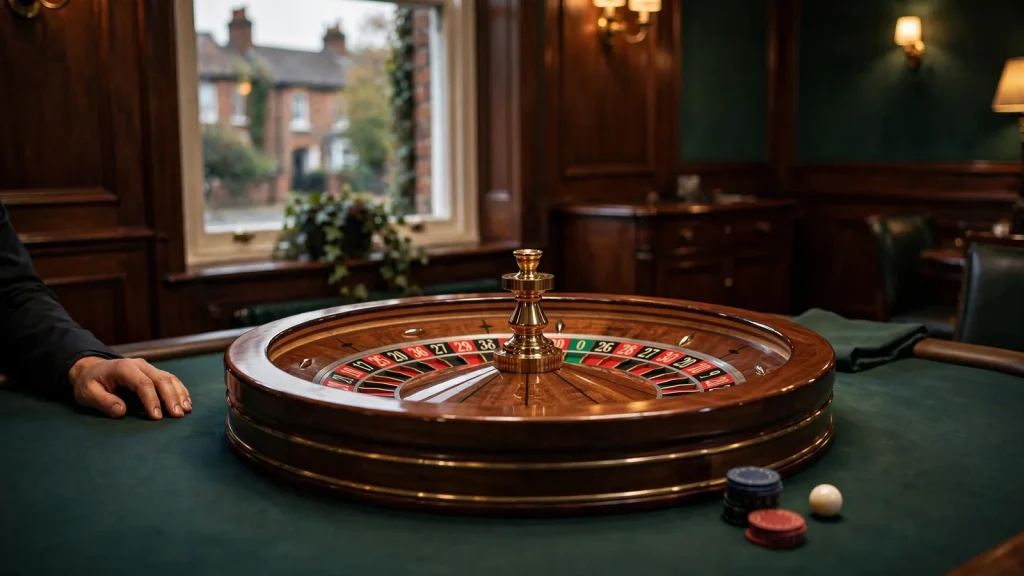
A practical guide to zero rules, table formats, bet payouts and bonus terms, with the differences between French, European and American roulette.
French Roulette’s Zero—and the Rule That Changes Its Cost
The zero is a small green interruption in a field otherwise divided between red and black, odd and even, low and high. In French roulette, it is also the pocket that gives the game its central tension: most bets seem to describe a neat division of the numbers, but the zero belongs to none of those divisions. When it appears, the house has an advantage. La Partage and En Prison are rules for softening what happens next.
The wheel has 37 pockets: the numbers from 1 to 36 and one zero. That single green pocket is enough to make the apparent balance of the table imperfect. A bet on red, for instance, covers a broad set of outcomes, but not every pocket. The zero falls outside it. Across European roulette, the house edge is 2.70%. The edge is not a prediction about the next spin, nor a promise about what a particular session will produce. It describes the game’s built-in advantage over repeated play.
That distinction matters because roulette presents chance in orderly clothes. The numbers sit in a grid; the wheel turns; bets are placed in categories that seem to divide the field sensibly. The layout lends itself to calculation, but it cannot make the zero disappear. A rule can alter the financial consequence of that pocket without changing the wheel or making any result more likely.
La Partage does exactly that for even-money bets. If the ball lands on zero, half of the stake on an eligible bet is returned rather than the whole stake being lost. On those bets, the house edge falls from the European roulette figure of 2.70% to 1.35%. The rule does not make red more likely, or odd more likely, or the next spin more knowable. It changes the cost of one particular interruption.
Hi-Lo Casino UK: Rules, Formats and Licensing
The name is French, and the rule carries something of the old table’s social theatre: a loss is not quite a loss, at least not in full. A portion is handed back. The gesture may look generous, but it is also exact mathematics. The casino retains an advantage; it is simply a smaller one on the bets covered by La Partage. The distinction is easy to miss when the table is viewed only as a picture of numbers and colours. It becomes clearer when the zero arrives.
En Prison offers another way of treating that same event. Rather than settling an eligible even-money bet as an immediate full loss, the rule can leave the wager held for a later decision under the table’s terms. The name suggests confinement, and the bet is, in a sense, neither free nor fully gone. The important point is not that the zero has been defeated. It has not. The rule changes how the wager is handled after it appears.
That qualification matters online. A game labelled French roulette may show the familiar single-zero wheel, but the label alone does not explain how the table treats a zero on even-money bets. La Partage and En Prison are not decorative names for the same feature: one returns part of a qualifying stake; the other keeps it in play according to the table’s stated rule. The displayed rules are therefore part of the game, not small print floating outside it.
French roulette has the lowest house edge among standard variants because of La Partage and En Prison. That advantage is attached to the rules, not to a special quality in the ball or a more kindly wheel. It also does not apply indiscriminately to every wager on the layout. La Partage’s reduced edge concerns even-money bets; it should not be mistaken for a general reduction across all possible bets.
La Partage and En Prison are distinct rules: one returns part of a qualifying stake, while the other keeps it in play according to the table’s stated rule.
There is a quiet contrast here between the table’s appearance and its accounting. The wheel is a machine for producing a single result, while the rules decide what that result means for a stake. Zero remains zero. But under one rule it returns part of an even-money wager, and under another it may keep the wager in suspense. The difference is not theatrical luck. It is procedure.
An online French roulette casino can therefore offer a game whose most important distinction is not visible in the wheel animation. The single zero establishes the familiar European structure; the table rules determine whether that pocket takes the full stake, returns part of it, or leaves an eligible bet unresolved for the moment. A sensible reading of French roulette begins there, with the small green pocket and the terms attached to it.
The wheel stays impartial. The table does the accounting.
What “Best” Means When the Wheel Is the Same
Choosing a UK casino for French roulette means checking the details that matter to your play, including how quickly withdrawals are processed. Use this list as a starting point when considering your options for 2026.
1. SlotoSport
Payout speed: 1-3 business days SlotoSport lists a payout speed of 1–3 business days, a useful detail to consider when choosing a casino for French roulette.
2. NightLuck
Payout speed: 1-3 business days NightLuck lists a payout speed of 1–3 business days, giving you a stated timeframe to factor into your casino choice.
3. Britsino
Payout speed: 1-3 business days Britsino lists a payout speed of 1–3 business days. This provides a clear point of reference when assessing it for French roulette.
4. Dieselwin
Payout speed: 1-3 business days Dieselwin lists a payout speed of 1–3 business days, which is worth bearing in mind when considering your options.
5. SpinFormula
Payout speed: 1-3 business days SpinFormula lists a payout speed of 1–3 business days, offering a stated withdrawal timeframe to consider.
6. Revery Play
Payout speed: 1-3 business days Revery Play lists a payout speed of 1–3 business days. This is the available detail to weigh when considering it for French roulette.
7. Amunbet
Payout speed: 1-3 business days Amunbet lists a payout speed of 1–3 business days, giving readers a practical detail to consider.
8. Jetsetspins
Payout speed: 1-3 business days Jetsetspins lists a payout speed of 1–3 business days. Its stated payout timing can help inform your choice.
9. x3bet
Payout speed: 1-3 business days x3bet lists a payout speed of 1–3 business days, a relevant detail for players considering French roulette.
10. NightWin
Payout speed: 1-3 business days NightWin lists a payout speed of 1–3 business days, providing a stated timeframe to keep in mind.
A French roulette table does not become better because its graphics are brighter or its lobby tile is larger. The useful comparison is quieter: which rules apply, what information is disclosed, what the table permits, and whether the surrounding account controls are easy to find. The wheel may look familiar across casinos; the terms attached to it still deserve inspection.
Start with the rules displayed for the specific game. The French label alone does not settle how a zero affects a wager. La Partage and En Prison are distinct rules, and a table should say clearly whether either applies and to which bets. That information belongs with the game’s rules, not hidden behind a general description of the casino. Where the interface offers several French tables, each one needs to be checked on its own terms.
Published RTP information is another useful point of comparison. It should be accessible before play, alongside the game rules, so that the stated return can be understood in context rather than inferred from a title or a familiar-looking layout. RTP is a theoretical measure across extended play, not a forecast of an individual session. If the figure is absent or difficult to locate, that is a disclosure problem, not a reason to guess.
Table limits matter for a different reason: they define the permitted stake range at that particular table. A clear listing lets a player distinguish between tables without relying on assumptions drawn from the word “French” or from the casino’s branding. The limits should be visible before a bet is placed, and changes between tables should be plainly signalled. A polished interface is of little help if the relevant conditions emerge only after entry.
Live Casino Lightning Roulette UK: How Play Works
The quality of the offer also includes what happens around the game. UKGC-licensed operators must provide account controls that support decisions made before a session becomes a matter of momentum. These include deposit limits and loss limits, as well as session-time reminders and reality checks. Cool-off periods and GamStop self-exclusion should also be available. The controls are not decorative extras: their accessibility matters, particularly when a casino presents many games in one continuous lobby.
There is a practical distinction between a control existing somewhere in an account menu and being easy to find and use. Account-level limit tools should be accessible, and new customers must be prompted to set a financial limit before making their first deposit. Operators must verify a customer’s age before allowing funds to be deposited into a gambling account. Those requirements say something about the framework around play: regulation is not only a licence displayed in small print, but also a set of obligations that shapes entry and continued access.
In Great Britain, the UK Gambling Commission is the sole regulator of online casino activity. Real-money operators serving the British market must hold the relevant UKGC licence. Checking the public register before depositing is a sensible way to confirm that the operator named on the site matches a current licence entry. A casino’s own claims are not a substitute for that check.
Do
- Check the UKGC public register to verify the operator’s licence
- Promptly set a financial limit before making the first deposit
- Use internal complaints processes or approved ADR services
Don’t
- Rely on a casino’s own claims as a substitute for a licence check
- Assume a polished interface guarantees relevant condition disclosure
- Trust the “French” label alone to determine how a zero affects a wager
A comparison should also take account of the route available if something goes wrong. UKGC licensees must provide an internal complaints process and access to an approved Alternative Dispute Resolution service. The existence of that route does not guarantee a particular outcome; it does mean there is a defined process beyond an informal exchange with customer support.
None of these criteria produces a universal winner. One table may present its rules and RTP clearly, while another may make account controls easier to reach; the relevant choice depends on what is being compared. The important point is that “best” is not a property bestowed by a casino’s own label. It is a judgement built from verifiable terms, readable information and safeguards that remain available beyond the roulette screen.
Less theatre. More disclosure.
The Live Wheel: A Studio, a Dealer and a Physical Ball
Live French roulette replaces a simulated spin with a scene: a real wheel in a studio, a human dealer and a physical ball dropping into a pocket. The camera carries that scene to a screen, while betting and account controls remain part of the online casino. The wheel is present; the room is not.
That distinction gives live play its particular texture. The dealer’s gestures mark the interval between one round and the next, and the ball’s movement is visible rather than generated as an animation. The studio turns a solitary screen into a broadcast of a shared ritual, though the other people in that ritual may be no more than names in a chat window. The theatre is real. Its audience is dispersed.
Live Baccarat Online Casinos in the UK: How It Works
French roulette in a live casino still depends on the table’s stated rules, not on the camera or the dealer’s manner. A French label alone does not establish which rules apply. The table information should identify them clearly, and the game’s published RTP information should be accessible when comparing UKGC-licensed operators. The stream shows how a round unfolds; it does not, by itself, explain the terms on which it is played.
There is also a regulatory boundary behind the studio lights. In Great Britain, remote gambling operators serving customers must hold the relevant Gambling Commission licence. A platform without a valid UKGC licence cannot legally offer real-money live roulette to British residents. A polished broadcast is not evidence of a licence; the regulator’s public register is the place to verify the licence number before depositing. A camera can lend a room authority. It cannot lend a licence.
The controls required of UKGC-licensed operators are part of the live-casino setting, even when the table interface makes them easy to overlook. Operators must prompt new customers to set a financial limit before their first deposit and provide accessible account-level controls, including deposit and loss limits. They must also offer session time reminders, reality checks, cool-off periods and GamStop self-exclusion. These are not features of the wheel; they are safeguards around access to gambling.
Age verification belongs to that same boundary: an operator must verify a customer’s age before allowing funds to be deposited into a gambling account. Licensed operators must also provide an internal complaints process and access to an approved Alternative Dispute Resolution service. The UK Gambling Commission is the regulator for online casino activity in Great Britain. The distinction between the broadcast and its legal setting is not decorative.
Licensing
A platform without a valid UKGC licence cannot legally offer real-money live roulette to British residents.
“Live auto roulette” can blur two different ideas. Live roulette describes a streamed, human-dealt game with a physical wheel; auto-roulette describes an automated format. A casino may group games under broad labels, but the name alone does not settle whether a particular table is streamed or automated. The game details should make that clear. A studio feed is not simply a faster animation, and automation is not a dealer.
For players drawn to the visible wheel, the live format offers a particular kind of presence: the small pauses, the dealer’s routine, the ball completing its course. Those details can make the game feel less abstract without changing its essential uncertainty. The wheel does not become more knowable because it is filmed. The ceremony is part of the experience, not a forecast.
Low Stakes, Fast Spins and the Shape of a Session
A low minimum changes the doorway into a roulette session, not the character of the room beyond it. French roulette can appear in several online formats, and the amount needed to place a first bet depends on the table. A low-limit listing is therefore a practical description of entry cost, not a promise that every spin, or the whole session, will remain inexpensive.
RNG roulette replaces the physical wheel with software that generates each result. Its brisk rhythm leaves less waiting between rounds, and its minimum stakes can be lower than those at many live tables. A stake of 10p is possible on some RNG games. The small denomination has a social meaning: it lets a player take part without making each decision feel like a declaration of confidence. It does not, by itself, make a long session small.
Live Blackjack at UK Online Casinos: How It Works
Live roulette moves at the pace of a dealer, a ball and a streamed table. That human sequence gives each round a visible beginning and end, but it also introduces pauses that software does not need. A live French table may have a minimum as low as 10p, so the format is not automatically the preserve of larger budgets. The minimum is only one line of the table rules, though; the upper limit matters if stakes are raised, and the pace shapes how often decisions arrive.
Auto-roulette keeps a physical wheel in play while automating parts of the table’s operation. Speed roulette is built around quicker rounds. A specialist review reports speed roulette at more than 150 spins per hour, against 80–100 at a standard table. That comparison describes a possible pace, not a timetable every game must follow. Faster play shortens the interval in which a player can pause and reconsider. A low entry stake can therefore sit beside a rapid sequence of decisions.
The minimums reported for these formats are not uniform market rules. A specialist review notes that auto-roulette and speed tables can open at 5p, below the possible 10p entry point on live tables. The difference is useful when comparing low-stakes options, but the published table limit should settle the question: labels such as low stakes or standard limits are not substitutes for the displayed minimum and maximum. A VIP or high-limit table signals a different range of permitted stakes, not a different pace of fortune.
Session shape is the meeting of three things: the amount placed each round, the speed of play and the time spent at the table. A faster game can produce more decisions in the same stretch of time; a low minimum can make each decision feel less consequential. Together, those qualities may make it easier to continue than intended. The arithmetic of a session is not contained in its smallest permitted bet.
RNG Roulette
Software-generated results with a brisk rhythm and minimum stakes as low as 10p.
Live Roulette
Human-dealt games with a physical wheel and a pace dictated by the dealer.
Auto-Roulette
Physical wheels with automated operations and entry points starting from 5p.
Speed Roulette
Designed for quicker rounds, potentially reaching more than 150 spins per hour.
There is an old distinction between a game’s formal threshold and the habits formed around it. Casinos publish limits because a table needs boundaries; players experience them as cues about who belongs there. A low-limit French roulette table may look modest, while a premium or VIP label can suggest ceremony before any wheel turns. Neither description says how long a session will last. The clock is part of the stake, even when it is not printed beside the betting layout.
The quietest comparison is often the clearest: check the minimum, maximum and pace together. A slower live table may leave more room between decisions; an RNG or speed format may compress them. No format makes a small opening stake a measure of the eventual cost. Small beginnings can travel.
Online French Roulette: Bets, Payouts and the Table’s Grammar
A roulette layout is a small piece of civic architecture: numbers arranged into rows, colours alternating, and a set of broad choices gathered at the edges. Its grammar is spatial. A chip placed on a number speaks differently from one set across a line or in an outside betting area. The wheel may look theatrical; the felt is more like a form to be completed.
The narrow numbered grid is the home of inside bets. A straight-up bet occupies a single number. It is the most concentrated choice on the layout, and its quoted payout is 35:1. That payout applies to a single-number bet on European and American roulette alike. The same figure can appear in the rules of an online French roulette game: the bet’s position on the table, rather than the name of the variant, defines this particular return.
Crazy Time Live Casino Game Show in the UK
A split bet covers two adjacent numbers. The chip sits on the line between them, making the choice broader than a straight-up bet without leaving the numbered field. Its payout is 17:1. A street bet covers a horizontal row of three numbers and pays 11:1. These placements are easier to read once the grid is seen as a map: a number, the boundary between neighbours, or the edge of a row. Each position groups a different patch of the table.
The broad bets sit outside the numbered grid. Red or black, even or odd, and high or low each pay 1:1. They cover larger categories rather than naming a particular number. Their visual simplicity can make them seem like a separate game, but they are still instructions addressed to the same wheel. A colour choice follows the printed colours; an even-or-odd choice follows the numbers’ parity; high and low divide the number field into its lower and upper portions.
That apparent plainness has a limit: an outside bet does not mean that every possible result belongs to one of its two sides. The green zero is part of the layout’s grammar too. It sits apart from red and black, and from even and odd, rather than being quietly absorbed into either choice. The numbered grid and its outer boxes are not merely convenient categories. They show which results a bet names—and which it leaves outside its terms.
Outside Bet Payouts
Red or black, even or odd, and high or low each pay 1:1. These bets cover larger categories rather than naming a particular number.
Payout ratios are not forecasts. A 35:1 return attached to a single number describes the table’s payment for a winning placement; it does not make that number more likely to appear. Nor does a broad outside bet become a promise of regular returns because it covers a larger category. The felt sorts choices by scope, while the wheel supplies the result.
Online, the same grammar is rendered through a touchscreen or cursor. A player selects a betting area and places a chip there; the interface translates the gesture into a position on the table. The important distinction is still between a chip on a number, a chip on a boundary, a chip covering a row, and a chip in an outside box. The screen changes the cloth, not the meaning.
French roulette can therefore be read without treating its layout as decoration. Inside bets point to precise places in the grid; outside bets point to broad properties of a result. The payout printed beside each kind of placement is the table’s compact answer to what it pays when that selection wins. The rest is geometry.
A tidy little language.
Finding French Roulette in an Online Casino
A casino lobby is a catalogue with its own geography. Roulette may sit under a table-games heading, among live games, or behind a search tool; the same title can appear in more than one place. Searching for French roulette is a practical shortcut, but the result still needs reading. A French flag, a blue table or an elegant room name is decoration, not a rules statement.
The useful distinction is whether the game is explicitly identified as French roulette and whether its rules are available before play. European roulette has 37 pockets: the numbers from 1 to 36 and one zero. That description alone does not establish that a table follows French rules. A lobby may group several roulette versions together, while the details sit on the game’s information screen or in its rules panel. The name and the rules should agree.
Deal or No Deal Casino UK: Game Format Explained
This matters because online casinos sell an assortment, not a single uniform game. A roulette tile may lead to an automated game, a random-number-generator version or a live table. Those are formats, not proof of a particular rule set. The lobby’s category can help locate a game, but the table itself is where its identity should be confirmed. If the rules are difficult to find, or the game’s French designation is unclear, the uncertainty is part of the offer.
A clear listing should make the table’s applicable rules and published RTP information accessible. RTP is not a promise about an individual session; it is information to examine alongside the rules, rather than infer from a title or image. Once a game opens, the paytable and rules panel are more useful than a promotional description. Small print is still print, but it should not be hidden behind guesswork.
For British players, the operator’s status matters as much as the game tile. Remote gambling operators serving Great Britain must hold a relevant UK Gambling Commission licence, and online gambling is legal in the UK only through licensed and regulated sites. The regulator’s public register can be used to verify an operator’s licence before depositing. Age must also be verified before an operator allows a customer to deposit into a gambling account.
This makes the lobby a modest test of institutional habits. A well-labelled game tells its own story plainly: what version it is, where its rules can be read, and what information applies to it. A vague label asks the player to supply the missing certainty. Casinos have long been good at atmosphere. Clarity is the more useful furnishing.
Verifying a Table
- Confirm the game is explicitly identified as French roulette
- Review the rules to see if La Partage or En Prison apply
- Check the published RTP information
- Verify the operator holds a current UKGC licence
- Check the table’s minimum and maximum stake limits
Premium Tables and the Limits of the Label
“Premium” sounds like a description of the game. On a roulette lobby, it is more often a signpost for a table positioned as a more exclusive experience. The label may suggest polished presentation or a particular audience, but it does not establish what the table costs to join, which rules apply, or whether the game is French roulette in the meaningful sense.
The distinction matters because roulette’s identity lies in its rules, not its framing. A premium French table should still make its variant and table conditions clear. The word premium cannot tell whether La Partage or En Prison applies, and it cannot substitute for the rules displayed for that specific game. Prestige is packaging; the wheel remains governed by its published terms.
Stakes are another matter. A specialist review reports that some UK live roulette tables have minimum bets beginning at 10p, whereas auto-roulette and speed roulette can sometimes be listed from 5p. Those figures describe possible entry points, not a promise attached to the premium label. A table marked premium might have a higher minimum, but the label alone does not prove that it does. The table information is the useful evidence.
Nor does a higher entry point make a game more authentic, more skilful or more generous. It changes who can sit at that table and how much is committed per round. The social language of exclusivity can make that distinction seem grander than it is. A velvet-rope impression is not a rule.
Live casino UK: how streams, licences and bets work
For anyone comparing premium French roulette casinos, the sensible question is therefore not whether the table looks prestigious, but what its own information says: the minimum stake, the maximum stake, and the rules attached to that particular game. These details may differ between tables carrying the same broad label. A premium designation is not a standardised category with a single set of conditions.
The label can help organise a lobby. It cannot certify value. A clearly described ordinary table may offer more relevant information than a premium-branded one. The hierarchy is mostly presentational.
The French Roulette Game Beside Its European and American Cousins
French and European roulette share the same basic wheel: 37 pockets, numbered 1 to 36 plus one green zero. Their difference lies not in an extra pocket but in the table rules. French roulette’s La Partage and En Prison provisions can change the cost of an even-money bet when zero appears; without those provisions, the single-zero European wheel has a house edge of 2.70%.
That distinction matters because a table’s name can suggest a family resemblance while its rules determine the practical difference. An online French roulette game is therefore not simply any single-zero table dressed in French terminology. The rule panel should identify whether the French rules are in force. A single green pocket tells only part of the story.
The American wheel adds another green pocket: it has numbers 1 to 36, a single zero and a double zero, making 38 pockets in all. The extra chance for the house raises its overall edge to 5.26%, compared with European roulette’s 2.70%. The change is small in appearance and substantial in arithmetic. Green has acquired a second seat.
House Edge Comparison
French and European roulette (single-zero) have a house edge of 2.70%, while American roulette (double-zero) increases this to 5.26%.
There is a further wrinkle in some UK online tables labelled American roulette. A specialist review reports tables with a third green pocket marked 000 and a house edge of 7.69%. That should be treated as a feature of the tables described, not as a standard definition of American roulette. The familiar American wheel has a double zero; a third green pocket is an additional variation.
The bet can sharpen the difference, too. On the American wheel, the basket bet covering 0, 00, 1, 2 and 3 carries a house edge of 7.89%, higher than the wheel’s general 5.26% edge. The label “American” does not mean every bet has an identical cost.
For a comparison, the useful order is simple: count the green pockets, then read the table rules and bet details. French and European roulette may share a wheel, while American roulette changes its arithmetic by adding green. Small symbols. Different bargains.
Live Dream Catcher Casino UK: How It Works
Playing Without Mistaking a System for a Prediction
The Martingale is among the neatest-looking ways to organise roulette stakes: after each loss, the next bet is doubled. A win on an even-money selection is meant to recoup earlier losses and leave a small gain. On paper, the sequence has the tidiness of a household budget. At the table, it depends on a run of results that no staking plan can arrange.
The system changes the size of the next wager, not the chance of the next result. A losing run can therefore push the required stake sharply higher while returning nothing to the bankroll. The pressure lies in the sequence: each loss makes the next planned bet larger, and a player may reach a point where the available funds cannot sustain it. The system has no power to make that point arrive later.
That distinction matters when playing French roulette online. A betting pattern can impose structure on a session, but it cannot turn chance into a forecast. Doubling after losses is a response to what has already happened, not evidence that a win is due. The wheel does not keep an account of the previous bets.
Monopoly Live Casino UK: Format and Gameplay
Nor does a winning spin prove that the method works. It may simply end a losing sequence before the rising stakes become unmanageable. A longer run in the other direction can do the opposite, damaging a bankroll before the hoped-for recovery arrives.
A system can organise risk. It cannot remove it.
Roulette Bonuses: Contribution Rates and the Small Print
A French roulette table may be governed by familiar rules, but bonus terms belong to the casino’s paperwork, not the wheel. Roulette wagers at many UK operators count for only 10% to 20% of a bonus wagering requirement. The remainder does not vanish; it simply takes more qualifying play to clear than a player might expect from the headline offer.
The comparison with slots can be stark. A specialist review reports that some operators give RNG roulette full game weighting while live roulette receives 10% or 20%; these are reported examples, not a universal tariff. The same review describes some no-deposit offers as excluding live roulette altogether, or assigning it a contribution rate from 0% to 10% when it is included. Small print has a long memory.
That distinction matters to anyone considering casino French roulette with bonus funds. A live table can look identical in its betting options while being treated very differently in the wagering calculation. The relevant terms may separate live and RNG games, or exclude particular promotions; the word “roulette” alone settles nothing. Bonus funds are not interchangeable with cash until the stated conditions are met.
Since January 2026, UK rules cap bonus wagering requirements at a maximum of ten times the bonus amount for licensed operators. The cap limits the size of the requirement, not the game weighting: a roulette wager still counts only at the rate specified in the offer’s terms. The two figures answer different questions.
A careful reading therefore starts with the game-weighting table, then checks exclusions, expiry conditions and whether live play qualifies at all. The headline is only the doorway.
What are inside and outside roulette wagers?
Inside bets cover specific numbers or small groups, such as a straight-up bet on one number, a split on two adjacent numbers, or a street on three numbers. Outside bets cover broader groups, such as red or black, odd or even, and high or low.
How does roulette actually work?
You place a wager on a number or group of outcomes, then the wheel and ball determine the result. European roulette has 37 pockets, including one zero; the zero affects bets such as red or black because it is outside those groups.
Should I play American or European roulette if I’m in the UK?
European roulette has the lower house edge: 2.70%, compared with 5.26% for American roulette. French roulette can be lower still on eligible even-money bets when La Partage or En Prison applies.
What is the difference between European and American roulette wheels?
European roulette has 37 pockets: numbers 1–36 and one zero. American roulette has 38, adding a double zero; some UK online tables also include a 000 pocket.
Live Tables
Live casino UK: how streams, licences and bets work
A guide to remote casino play, UK licensing, table decisions, bonuses and the limits that...

Crazy Time Live Casino Game Show in the UK
A guide to the live format, casino access, practice play, wagering terms and UK licensing...

Deal or No Deal Casino UK: Game Format Explained
A look at the Banker-offer decision, online play mechanics and which bonus or return details...

Hi-Lo Casino UK: Rules, Formats and Licensing
Hi-Lo turns each exposed card into a higher-or-lower decision, with formats differing in ties, card...

Live Baccarat Online Casinos in the UK: How It Works
Live baccarat combines a human dealer and a video stream with online betting, while table...

Live Blackjack at UK Online Casinos: How It Works
Live blackjack streams a human dealer in real time, bringing physical cards, table chat and...

Live Casino Lightning Roulette UK: How Play Works
A physical wheel and dealer give live roulette a visible rhythm, while the interface presents...

Live Dream Catcher Casino UK: How It Works
A camera shows a human dealer in a studio while an interface records bets, but...
Live Roulette UK with English-Speaking Dealers
A practical guide to physical wheels, table layouts, live-game costs and the limits of roulette...

Monopoly Live Casino UK: Format and Gameplay
Live casino play combines a studio stream, a human dealer and an on-screen interface for...

Online American Roulette in UK Casinos: Rules
American roulette adds a 00 pocket to the familiar wheel, affecting the outcomes behind every...
European Roulette at UK Online Casinos: Rules and Odds
Explore how the single-zero wheel affects risk, how online and live play differ, and what...