
Non-GamStop Curaçao Casinos and UK Oversight
 Available in GB
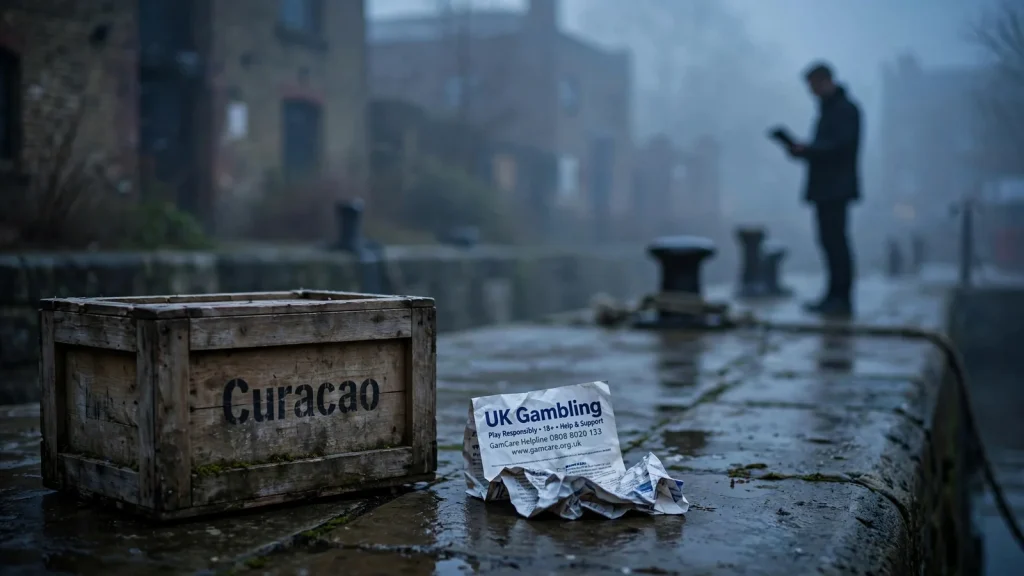
The article separates offshore licensing claims from UK authorisation and explains why exclusion status and payment methods do not prove safety.
Curacao Online Casinos and the Limits of UK Oversight
The phrase “Curacao online casino” describes a location or licensing claim, not a guarantee that a site is authorised to serve customers in Britain. That distinction matters because the British system is built around the operator’s relationship with the local regulator, rather than the place where a company is incorporated or where its servers happen to sit. A casino may present itself as international, but offering real-money gambling to customers in Great Britain brings a specific regulatory requirement: the operator must hold the relevant licence from the UK Gambling Commission.
A Curaçao licence, if a casino claims to have one, is not a substitute for that UK operating licence. The two labels answer different questions. One concerns an offshore licensing arrangement; the other concerns permission to provide gambling services to the British market under British rules. For someone assessing an online casino licensed in Curaçao, the central boundary is therefore not the island named in the site’s branding. It is whether the operator holds the authorisation required to serve customers here.
Online slots not on GamStop: what to know
The legal framework has its own geography. The Gambling Act 2005 governs gambling in England, Wales and Scotland, but not Northern Ireland. Within Great Britain, operators offering real-money gambling must be licensed by the Gambling Commission, regardless of where they are based. The UK describes online gambling as legal when it takes place through a properly licensed and regulated site; the age threshold for players is 18. These are not decorative credentials. A licence places an operator within a system of rules and oversight that an offshore casino outside the UKGC framework does not share.
That difference can disappear behind a polished interface. An online Curacao casino may use familiar design, publish promotional language in English and accept customers from multiple countries. Such presentation does not, by itself, establish that the company is licensed to provide gambling in Britain. Nor does a foreign licence turn an operator into a British-regulated casino. A website’s apparent accessibility and its regulatory status are separate matters. The internet makes the first easy to confuse with the second.
Casino Licensing & Safety for UK Players
The Commission’s reach is tied to the market being served, not merely to an operator’s physical address. A company located abroad that offers remote gambling to Great Britain consumers still needs the relevant UK licence. Conversely, an offshore casino that operates outside the UKGC system does not acquire the Commission’s protections simply because a British customer can open its pages. The boundary is an institutional one: who is answerable to the British regulator, and under which rules.
This is one reason the language of “licensed” can mislead when it is left unfinished. A licence is not an abstract badge with universal force. Its meaning depends on who issued it, what activity it covers and which market it permits the operator to serve. “Licensed in Curaçao” and “licensed by the UK Gambling Commission” are not interchangeable descriptions. A label that sounds reassuring in isolation may say nothing about the operator’s standing in the jurisdiction where the customer lives.
Anjouan Casino Licence in the UK: What It Means
There is a wider social story in this arrangement. Gambling regulation is not simply a technical exercise in checking corporate paperwork. It expresses a country’s decision about which businesses may sell a regulated activity to its residents, and which public body is responsible for supervising them. Britain has chosen a local licensing model for operators serving its market. That choice means a foreign company cannot rely on its overseas base as an exemption from the British requirement.
The same principle applies to claims about a new Curaçao online casino or a site described as among the best online casinos based there. “New” and “best” are descriptions, not regulatory categories. Neither tells a reader whether a casino holds the British permission required to serve Great Britain. A ranking, a striking bonus banner or a list of games cannot answer that question either. The decisive issue remains the operator’s authorisation for this market, rather than how confidently the website describes itself.
Attention: A Curaçao licence is not a substitute for a UK Gambling Commission operating licence required to serve customers in Great Britain.
GAMSTOP belongs to a different part of this landscape. It is Great Britain’s national online self-exclusion scheme, and online operators were required to participate from 31 March 2020. That date marks a regulatory obligation for the relevant online operators; it does not turn every foreign gambling website into a UK-licensed business. The licensing boundary comes first. Scheme coverage is a related but distinct question, not proof that an offshore operator sits within the same oversight system.
For British consumers, the useful distinction is plain even if websites blur it: an offshore licence is not the UK licence required to offer real-money gambling in Great Britain. A Curaçao label may describe an operator’s claimed offshore status; it cannot, on its own, establish British authorisation. The address may be elsewhere. The market rule is not.
What “Not on GamStop” Actually Means
“Not on GamStop” describes a site’s relationship to a particular self-exclusion scheme. It does not describe the quality of its games, the reliability of its payments or the protection offered to customers. The phrase is narrower than it often sounds: it means that the site is not among the participating online gambling operators whose websites and apps are covered by GamStop.
GamStop is a multi-operator scheme for online gambling. A person who registers is blocked from accessing existing gambling accounts, or opening new ones, with the online operators covered by it across the UK. The service is free. Its reach is collective: one registration applies across participating operators, rather than requiring a separate request to every covered casino.
Non-UK-Registered Casinos: Licensing Explained
That distinction matters because GamStop is not a device that filters every gambling website on the internet. It works across its participating licensed online sites and apps. A website outside that network is not subject to the same block through GamStop. So when a page describes a Curacao casino as “not on GamStop”, the wording refers to the scheme’s coverage, not to a special category of casino approved or assessed by GamStop.
The phrase can make absence sound like a feature. In reality, it is a boundary. A site outside the scheme does not become part of the shared system simply because it accepts customers from a particular country or uses familiar language in its marketing. Nor does the label itself establish what rules govern the operator, what protections it provides, or what happens when a customer asks for help. “Not on GamStop” answers one limited question: whether the site is covered by that scheme.
The UK’s regulated online-casino system uses a different rule. Since 2020, participation in GamStop has been compulsory for UK Gambling Commission-licensed operators. Every regulated casino in the UK must therefore block customers who are self-excluded through the scheme. In this setting, GamStop is not an optional badge chosen by individual casinos; it is part of the requirements applying to the licensed market.
That is why “Curacao casinos not using GamStop” should not be read as though it names a recognised class within the UK system. The expression joins two separate ideas: a claimed connection to Curaçao and absence from GamStop. The second tells nothing, by itself, about the first. A licence label and participation in a self-exclusion scheme are different matters, and one cannot be inferred from the other.
Since 2020, participation in GamStop has been compulsory for all UK Gambling Commission-licensed operators.
The same is true of phrases such as “non-GamStop Curacao casino sites”. They may sound precise, but they leave important distinctions hidden. A site might be outside GamStop because it does not participate in the scheme; that does not make it a UK-licensed operator. Conversely, the fact that a casino is covered by GamStop says that the scheme applies to it, not that the scheme is a complete description of every aspect of its operation.
The arrangement reflects a policy choice about responsibility. The UK has made cross-operator exclusion a condition for licensed online gambling, rather than leaving customers to contact each licensed casino separately. That creates a common barrier across participating websites and apps. It also means the boundary of that barrier follows the scheme’s participating operators, not every site that can be reached online.
A search for non-GamStop Curacao casinos may therefore begin with a simple-sounding phrase but arrive at a more exact distinction: coverage is not the same as approval, and absence from a scheme is not a quality mark. The wording tells where the shared block does not apply. Nothing more follows automatically.
An Exclusion Is Not a Change of Website
Self-exclusion is a formal agreement with a gambling business: the person asks to be prevented from betting with it for a chosen period. It is not simply a setting attached to a particular login, nor a declaration that loses force when someone changes device or address. The agreement carries a responsibility on the player’s side as well as obligations for the business.
Non-UKGC Licensed Casinos: UK Rules and Risks
That distinction matters when a person has excluded themselves from gambling and then considers a Curaçao casino not covered by GamStop. A site outside the scheme may not be blocked by it, but the absence of a technical barrier does not cancel the person’s decision. Gambling at a Non-GamStop casino could breach the terms of an existing self-exclusion. Changing websites is not the same as ending the agreement.
A new account elsewhere is not a responsible workaround. The point of self-exclusion is to create distance from gambling, not to move the same activity to a place where the block does not apply. If the urge to continue is driving the search for another casino, that is a reason to keep the exclusion in place, not to test its boundaries. The practical availability of a site cannot settle the personal question of whether gambling is consistent with an agreement already made.
What the agreement asks of both sides
Gambling businesses must offer self-exclusion by law. Once a person has excluded themselves from a venue or website, they should be refused service there. The system depends on the business taking its part seriously, but self-exclusion is still an agreement not to gamble; the person who made it remains responsible for honouring it.
That responsibility can extend beyond one account. Someone tempted to gamble in several settings may need to exclude themselves from all the places where that temptation is likely to arise, rather than treating one blocked website as a complete safeguard. Online accounts and physical venues are different routes into the same activity. A change of route does not necessarily change the underlying risk.
Breach of Exclusion
Gambling at a non-GamStop casino could breach the terms of an existing self-exclusion agreement.
For online gambling, self-exclusion can be requested through the multi-operator scheme or from an individual casino. For a single website or app, the business’s safer-gambling instructions or customer service can explain how to make the request. A person seeking exclusion from a land-based casino can ask staff at the venue. These steps make the agreement concrete: it identifies where the restriction applies and gives the business information needed to recognise the account holder.
Self-exclusion periods are set for a defined duration, commonly within a range from six months to five years. The length is part of the decision, not an invitation to treat the agreement as temporary whenever it becomes inconvenient. A person who has chosen a period has made a commitment to stay away for that period.
There is a wider consequence to remember. A regulator cannot refund money spent gambling. Self-exclusion is a preventative measure, not a way to recover losses after gambling has taken place. That is why an apparent opening at a casino outside GamStop should not be mistaken for a remedy or a harmless exception. It may remove one obstacle while leaving the original reason for self-exclusion untouched.
In practice, the useful question is not whether a particular Curaçao casino appears accessible, or whether it accepts a preferred payment method. Those details do not decide what a person’s exclusion agreement means. The relevant point is that someone who has chosen to stop gambling has a commitment to honour, and should not open another account to get around it. The agreement remains personal, even where a website sits beyond the reach of the block.
Casinos That Bypass GamStop: What UK Players Should Know
Not a loophole.
A Licence Label Is Not a Verified Casino List
A casino described as Curaçao-licensed and a casino licensed to serve the British market are not interchangeable categories. The label points towards an offshore regulatory claim; it does not establish that the operator holds the permission required to offer remote gambling to people in Great Britain. That distinction matters more than the wording on a banner or the presence of a licence emblem.
British rules place responsibility on the operator, wherever it is based. Remote gambling businesses serving consumers in Great Britain must hold the relevant licence from the UK Gambling Commission. Online gambling is legal in the UK only through licensed and regulated sites. A foreign licence, even where an operator presents it as genuine, does not replace that requirement.
The distinction is institutional, not decorative. A reference to Curaçao eGaming may describe the regime an operator says applies to it, but it does not by itself establish a UK Gambling Commission licence. Nor does the word “licensed” answer the separate question of whether a casino is within the British system of consumer protections. One adjective cannot do the work of two regulators.
That is where GamStop enters the picture, but only as a consequence of UK licensing. The Gambling Commission made participation in GamStop compulsory for online operators from 31 March 2020. Since the requirement took effect, every regulated casino in the UK has had to block people who have self-excluded through the scheme. A Curaçao label, on its own, says nothing about whether an operator is among those UK-licensed businesses.
UK Licensing Requirements
Remote gambling businesses serving consumers in Great Britain must hold the relevant licence from the UK Gambling Commission. Online gambling is legal in the UK only through licensed and regulated sites.
This makes a Curaçao casino list a poor substitute for evidence about individual operators. A list can repeat a licence claim; repetition does not verify it. A site may display a badge, quote a licence number or describe itself as regulated, but those details should not be treated as proof of permission to serve British customers. Equally, the word “Curaçao” is not a reliable shortcut for determining a site’s status under UK rules.
The same care applies to phrases such as “Curaçao licence casino” or “Curaçao eGaming licence online casinos”. They can sound precise while leaving the central distinction unresolved: which regulator is said to have authorised the operator, and whether the operator also holds the licence required for the British market. Without a substantiated operator record, a label remains a claim rather than a finding.
There is a quiet social history in this difference. Gambling regulation is not simply a collection of logos; it is a decision about which institutions are answerable when commercial activity reaches people in a particular place. Britain has chosen to make local licensing the condition for offering remote gambling to its residents. An offshore label cannot erase that boundary.
So a licence label is not a verified casino list, and a foreign licence is not a British one. GamStop’s compulsory reach among UK-licensed online operators follows from that local framework. It should not be inferred from a casino’s branding, nor disproved by it. The label is the beginning of a claim, not its conclusion.
What “Best” Can—and Cannot—Mean Here
“Best” is a demanding word. It suggests that a set of casinos has been identified, compared on consistent grounds and shown to outperform its peers. Without reliable, operator-specific evidence, a named ranking of Curaçao casinos would offer the appearance of judgement without its substance. A polished table cannot repair that gap.
British Casinos Not on GamStop: What It Means
A more useful standard begins with what happens when a player asks to stop. Gambling businesses must provide a way to self-exclude. Once an agreement is in place, the business must close the customer’s account, return any funds remaining in it and remove the customer’s details from marketing databases. It must also take reasonable steps to prevent that person from gambling there.
Those are not decorative promises. They describe actions that can be checked: whether access ends, whether account funds are returned and whether promotional messages cease. They say more about a business’s handling of a vulnerable customer than a high rating or an adjective such as “trusted”. Even so, these safeguards are not evidence that one Curaçao casino is better than another. A comparison needs verifiable information about particular operators and how they carry out their obligations.
A “best Curacao casino” selection also risks folding different questions into one label. A site may be praised for its games, payments or customer service, but those claims do not establish how it responds to self-exclusion. Nor does a list labelled for UK players establish that its entries have been assessed against the protections expected in the UK market. The label does a great deal of work. Evidence must do more.
For someone who has excluded themselves, the relevant test is not which non GamStop casino looks most appealing. Opening an account elsewhere to work around an exclusion is not a safe substitute for honouring it; gambling at a non-GamStop casino could breach the terms of that exclusion. Self-exclusion is meant to create distance from gambling, not send a person searching for a different door. Excluding oneself from every place where temptation may arise is more consistent with that purpose.
Do
- Check if the account is closed after exclusion
- Verify that remaining funds are returned
- Ensure marketing materials are removed
Don’t
- Rely on high ratings or “trusted” labels
- Use a non-GamStop casino to work around exclusion
- Assume a “best” ranking is based on verified evidence
A responsible assessment can therefore describe the safeguards that matter without pretending to have established a league table. It can ask whether the account is closed after exclusion, whether remaining funds are returned, whether marketing is removed and whether reasonable steps are taken to prevent further gambling. These are concrete standards, not a recommendation of any particular casino.
There is a difference between a useful test and a verified winner. The first can be stated plainly; the second requires evidence tied to named operators. Without that foundation, calling particular sites the best would turn uncertainty into endorsement. A ranking is not proof.
Bitcoin Payments: What the Evidence Does Not Establish
A Bitcoin option may look like a useful dividing line between one Curaçao casino and another. It is not, by itself, a reliable guide to what a site offers, how it handles deposits or withdrawals, or what protections apply. The presence of a payment symbol would answer only a narrow question about payment, not the larger ones that matter when real money is involved.
Those details belong to individual operators and should not be inferred from the word “Bitcoin” in a site description. A familiar currency does not make unfamiliar terms clearer.
The same distinction matters for UK players. A payment method does not turn an offshore casino into a UK-licensed operator, and it does not establish that a casino is covered by the protections attached to the British regulatory system. For real-money gambling offered to people in Great Britain, the operator must hold the relevant Gambling Commission licence. Bitcoin does not alter that boundary.
Non-GamStop European Casinos: UK Rules
There is also a human question beneath the technical one. Self-exclusion is meant to interrupt access to gambling, not merely to particular payment routes. A person can ask an individual gambling business to exclude them; moving to a different casino because it appears to accept another currency is not a safe substitute for keeping that commitment. Playing at a non-GamStop casino could breach the terms of an existing self-exclusion. Opening another account elsewhere to work around it is not a solution.
British gambling businesses are required to offer self-exclusion. That safeguard is meaningful only when the agreement is respected across the places where gambling might be tempting. A payment method cannot perform that work. Nor can it ensure that an operator closes an account or stops marketing after an exclusion request; those responsibilities sit with the gambling business.
Bitcoin may be the detail that draws attention to a casino, but it cannot settle the questions of regulatory status, exclusion coverage or responsible treatment. A payment label is not a licence, and it is not a protection. The distinction is plain.
Paysafecard Searches and the Meaning of Casino Safety
A Paysafecard logo can answer a narrow question about how a site presents its payment options. It cannot, by itself, answer the more consequential question of whether the casino is safe. Payment convenience and player protection are different things, even when a page places them side by side.
A payment method logo identifies a possible means of transaction but does not establish a casino’s regulatory status or its safety standards.
The same distinction applies to searches for Paysafecard at a Curaçao casino. A payment method does not establish how a business handles self-exclusion, whether it removes a person from marketing, or whether it prevents that person from gambling after an exclusion request. Nor does the presence of a payment brand settle a casino’s regulatory status in the United Kingdom. For real-money gambling offered to people in Great Britain, the operator must hold the relevant UK Gambling Commission licence; a payment option does not substitute for it.
Safety has a less decorative measure: what happens when someone asks to be excluded. Gambling businesses must offer self-exclusion, and they must take reasonable steps to stop a self-excluded customer from gambling. For an individual website or app, the route is generally through its Responsible Gambling or Safer Gambling page. If the instructions are not available there, customer services can be contacted.
The substance matters more than the button. A process that records the request but leaves the account usable, or continues to direct gambling promotions to the excluded person, would undermine the purpose of exclusion. The protection is not a promise that every risk disappears; it is a formal barrier the business is expected to respect.
That is also why a payment search should not become a route around an existing exclusion. Opening an account elsewhere to keep gambling does not honour the agreement. Gambling at a non-GamStop casino could breach the terms of self-exclusion, even if the site accepts a different payment method or sits outside the scheme. The sensible boundary is to exclude from every place where gambling might be tempting, rather than treating a new cashier as a fresh start.
Online Casinos With No Sister Sites in the UK
Small distinction. Large consequence.
A casino’s claims about safety deserve attention where they describe concrete conduct: how an exclusion request is made, what happens to the account, and whether the business takes steps to prevent further play. A payment logo may be useful information about checkout. It is not evidence of those safeguards, and it should not be mistaken for them.
Crypto Licensing Without Unsupported Promises
Crypto casinos are often described as though the currency accepted and the licence held were parts of one package. They are separate questions. A casino might advertise digital-asset payments, but that description alone says nothing about who supervises its gambling activity or which rules apply to customers in Britain.
The phrase “Curaçao-licensed crypto casino” can therefore carry more weight than it earns. A licence claim needs to identify the operator and the authority responsible for it; the word “crypto” does not verify either. Nor does a Curaçao label, by itself, establish that a site is authorised to offer real-money gambling to people in Great Britain.
Britain’s system draws its boundary by the market served, not by the location of a company or the currency used. The Gambling Commission’s participation requirement for online operators in GAMSTOP took effect on 31 March 2020. That date belongs to the UK’s self-exclusion framework; it does not certify foreign licences, digital currencies or particular casino brands.
Licensing vs Payments
A payment label describes a transaction method, while a licensing claim concerns the legal authority to operate.
There is a useful distinction here. A payment label describes how a transaction may be made. A licensing claim concerns the legal authority under which gambling is offered. Neither can stand in for the other, and neither turns an unsupported promotional phrase into proof.
The wording of a site’s claims matters, but so does what sits behind them: an identifiable operator, a regulator with relevant authority, and a clear account of the market in which the service is offered. Without that, “licensed crypto casino” is a label, not a finding. The distinction is less glamorous than a coin logo. It is more important.
Trustly, GamStop, and the Limits of a Payment Method
Trustly is a payment method, not a test of whether a casino is covered by GamStop. A site does not enter or leave the scheme because it accepts a particular way to pay. GamStop operates across participating licensed online gambling websites and apps; the payment choice is a separate matter.
That distinction matters when a casino is described as operating from Curaçao. The word “Trustly” in a payment menu, if present, would not show that the casino participates in GamStop. Nor would the absence of Trustly establish that it sits outside the scheme. Coverage depends on the operator’s relationship to the scheme, not on the route used to move money.
Non-GAMSTOP Casinos in the UK: What It Means
Claims about Trustly at Curaçao casinos need operator-specific evidence. Without confirmed terms from a named casino, availability cannot responsibly be stated as fact. A logo, search result or general payment-method description is not proof that a particular account can use the service. Payment options may also be subject to the operator’s own terms.
The practical boundary is clearer than the payment detail. People seeking to exclude themselves from online gambling can register with GamStop or contact individual casinos to self-exclude. A payment method cannot cancel either step, and opening an account elsewhere to get around an exclusion is not a safe substitute. Gambling at a non-GamStop casino could breach the terms of a self-exclusion agreement.
The British system treats exclusion as a barrier to access, not as a preference about deposits. That is why a payment brand cannot answer the question posed by a “Curaçao casino with Trustly” description. One identifies a possible means of payment; the other concerns whether a site is within a multi-operator self-exclusion scheme. They are different checks, and one cannot stand in for the other.
No shortcut there.
A “Top” Ranking Needs Names and Evidence
For UK readers considering non-GamStop Curacao casino sites in 2026, this list offers a quick reference point based on the information available. Check the relevant terms and suitability for your circumstances before choosing a site.
1. SlotoSport
Payout speed: 1-3 business days The stated payout speed for SlotoSport is 1–3 business days.
2. NightLuck
Payout speed: 1-3 business days NightLuck has a stated payout speed of 1–3 business days.
3. Britsino
Payout speed: 1-3 business days The available payout-speed information for Britsino is 1–3 business days.
4. Dieselwin
Payout speed: 1-3 business days Dieselwin lists a payout speed of 1–3 business days.
5. SpinFormula
Payout speed: 1-3 business days SpinFormula’s stated payout speed is 1–3 business days.
6. Revery Play
Payout speed: 1-3 business days Revery Play has a stated payout speed of 1–3 business days.
7. Amunbet
Payout speed: 1-3 business days Amunbet lists payouts as taking 1–3 business days.
8. Jetsetspins
Payout speed: 1-3 business days The stated payout speed for Jetsetspins is 1–3 business days.
9. x3bet
Payout speed: 1-3 business days x3bet’s available payout-speed detail is 1–3 business days.
10. NightWin
Payout speed: 1-3 business days NightWin has a stated payout speed of 1–3 business days.
A “top” label is a comparative claim, not a decoration. It implies that particular casinos have been identified and assessed against stated criteria, with evidence to support the order. Without named operators and a clear basis for comparison, a ranking offers no way to distinguish an informed recommendation from promotional language.
That matters especially when the subject is Curacao casinos. A list can look authoritative while leaving its essential questions unanswered: what was compared, how the assessment was made, and whether the claims apply to the casino currently operating under that name. A polished table does not supply those answers.
A responsible assessment would need to connect each recommendation to evidence about that operator, rather than rely on a broad label or a familiar-sounding promise. General safeguards are useful, but they do not turn into a shortlist. Nor does the word “top” establish that a casino is suitable for someone who has excluded themselves from gambling.
Self-exclusion has practical consequences for the business as well as the customer. Once an agreement is in place, the gambling business must close the account, return any funds held there and remove the customer’s details from its marketing databases. Those are concrete obligations, not ranking criteria that can be inferred from a promotional badge.
A named recommendation should therefore be treated as a claim requiring support, not as evidence in itself. Where the names and grounds for comparison are not clear, a “top” list cannot responsibly settle the choice. The label is easy. The substantiation is the work.
How does self-exclusion work?
You identify the gambling sites or venues you want to exclude yourself from, provide information to confirm your identity, choose an exclusion period and receive confirmation. Online, you can use GAMSTOP to exclude yourself from participating operators or contact an individual casino; for a land-based casino, ask staff at its customer service desk.
How do I return from self-exclusion?
To end a GAMSTOP exclusion, contact GAMSTOP directly and request removal. A 24-hour cooling-off period applies to every request; after removal, operators may take a further 24 to 48 hours to update your status.
How does Gamstop benefit me?
GAMSTOP is free and blocks access to your existing accounts, and prevents you opening new accounts, with participating online gambling operators across the UK. It lets you exclude yourself from multiple sites with one registration.
How long does it take for GamStop to become active after sign-up?
After your identity has been verified, GAMSTOP starts a 24-hour cooling-off period, and your exclusion remains active during it.
How do I verify the licensing of a casino not on GamStop?
Check whether the operator holds the relevant UK Gambling Commission licence to offer real-money gambling in Great Britain. A Curaçao licence is not a substitute for that UK authorisation.
How does a non-GamStop casino handle self-exclusion?
You can request self-exclusion from an individual online casino through its Responsible or Safer Gambling page, or by contacting customer services. A self-exclusion agreement requires the business to close your account, return any account funds and remove your details from marketing databases.
Safety

Anjouan Casino Licence in the UK: What It Means
An Anjouan authorisation applies under its own jurisdiction and does not by itself permit an...

Best foreign casinos for UK players: what to know
The label refers to accepting British customers without a UK Gambling Commission licence, not simply...
International Casinos for UK Players: Licensing
Understand how UK authorisation differs from overseas access, and why bonuses, withdrawals and player safeguards...

Offshore Casino Sites for UK Players: Rules and Risks
The guide examines licensing, business relationships, bonus terms, crypto withdrawals and safeguards beyond a site's...

Offshore casinos for UK players: risks and rules
Offshore sites may accept British visitors, but access does not mean authorisation or the safeguards...

British Casinos Not on GamStop: What It Means
GamStop applies to UK-licensed operators, so a site's regulatory status affects whether a registered self-exclusion...

Casino Sites Not Registered with GamStop in the UK
GamStop blocks registered UK residents from gambling at UKGC-licensed online casinos, but does not cover...

Casino Without a Swedish Licence: UK Player Guide
A foreign licence is not a UKGC licence, and a casino’s location does not determine...

Casinos That Bypass GamStop: What UK Players Should Know
GamStop applies to UKGC-licensed operators; access beyond that system does not carry the same regulatory...

Curacao Casino Licence in the UK: What It Means
A Curaçao licence identifies a jurisdiction, but does not establish UK regulation, customer access or...

Gibraltar Casino Licence and UK Legal Status
A Gibraltar link identifies an operator’s declared regulatory setting, but does not determine its UK...

Merkur Casino Online in the UK: Games and Rules
Merkur titles are products in an operator’s changing catalogue, while the casino platform is responsible...
UK Online Casino Trustworthiness: Start with the Licence
Trust depends on verifiable UK licensing and how operators handle safeguards, terms, payments and withdrawals....

Non-GAMSTOP Casinos in the UK: What It Means
A site's absence from Gamban does not establish whether GAMSTOP applies or whether the casino...

Non-GamStop European Casinos: UK Rules
A casino’s location, branding and audience do not determine whether its UK-facing operations fall within...

Non-UK Licence Casinos: How Overseas Regulation Works
The issuing authority shapes oversight and complaint options, so an overseas licence is not equivalent...

Non-UK-Registered Casinos: Licensing Explained
The guide separates a casino’s business location from its gambling regulator and examines the practical...

Non-UK Regulated Casinos: What UK Rules Cover
UK licensing depends on serving customers in Great Britain, while offshore permissions and safeguards vary...

Non-UKGC Licensed Casinos: UK Rules and Risks
The distinction between an operator’s UK licensing duty and an individual’s position shapes the risks...

Malta MGA Licence for UK Online Casinos: What It Means
A Malta licence regulates an operator in Malta, while real-money offers to Great Britain require...

Online Casinos With No Sister Sites in the UK
Shared ownership or technology can shape casino features, but familiar games, layouts and promotions are...

Online slots not on GamStop: what to know
GamStop blocks access at participating UKGC-licensed casinos; mobile play and unfamiliar offers do not change...

Safe Online Casinos in the UK: Player Protections
A practical guide to licensing, gambling limits, payments, bonus terms and security, without treating a...

Trusted Casinos Not on GamStop UK: What to Check
The guide weighs licensing, player protections, payments and promotional terms at casinos operating outside the...

Trusted UK Casino: Licensing, Checks and Safeguards
Licensing, identity checks, public records and payment terms help explain what can—and cannot—be verified about...

USA Casinos for UK Players: Access and Licensing
A guide to how licensing, safeguards, payments, bonuses and recourse differ for UK players at...
VPN-Friendly Casinos UK: Access, Licensing and Risk
A casino accepting VPN connections does not necessarily hold a UK licence or offer the...