
Live Roulette UK with English-Speaking Dealers
 Available in GB
A practical guide to physical wheels, table layouts, live-game costs and the limits of roulette bonuses and betting systems.
A Live Wheel Is Still a Physical Wheel
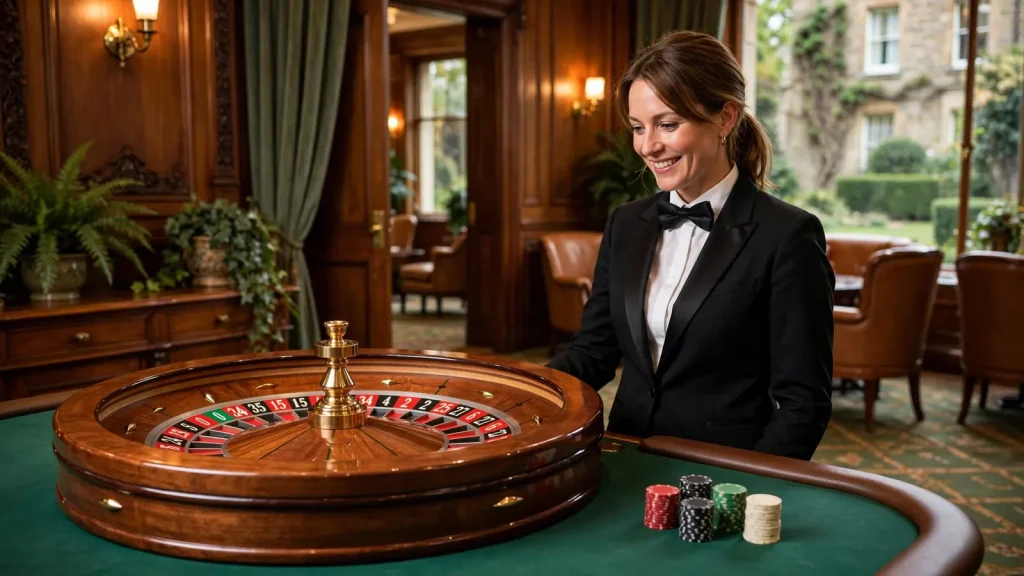
The word “live” describes more than a screen with movement on it. In live dealer roulette, a human dealer spins a physical wheel and the ball travels across its surface. The result comes from that action at a real wheel. Computerised roulette works differently: its outcome is generated by a Random Number Generator, or RNG. The screen may show a familiar wheel and ball, but the underlying process is digital.
That distinction can be easy to miss when both games appear in the same online casino. They share roulette’s central idea, yet they present it through different means. One makes a physical event visible; the other produces an outcome through software. Neither changes the basic question of the game: which number will the ball land on?
The rules of the central wager are spare. A player selects a number, the ball lands on a number, and the selection wins if the two match. The dramatic part is the interval between those facts: a wheel turning, a ball moving, and an outcome still unresolved. Roulette gives chance a visible journey. In a digital version, that journey may be represented on screen, while the RNG determines the result.
For live roulette, the details of the playing experience matter, but the available information here is limited to payout speed. Use these verdicts as a brief reference rather than as confirmation of dealer language or table availability.
1. SlotoSport
Payout speed: 1-3 business days SlotoSport is listed with a payout speed of 1–3 business days. No details are provided about its live roulette tables or dealer language.
2. NightLuck
Payout speed: 1-3 business days NightLuck is listed with a payout speed of 1–3 business days. The available information does not specify whether it offers English-speaking roulette dealers.
3. Britsino
Payout speed: 1-3 business days Britsino is listed with a payout speed of 1–3 business days. No live roulette or dealer-language details are available here.
4. Dieselwin
Payout speed: 1-3 business days Dieselwin is listed with a payout speed of 1–3 business days. The information provided does not describe its roulette offering or dealer languages.
5. SpinFormula
Payout speed: 1-3 business days SpinFormula is listed with a payout speed of 1–3 business days. No details are available about live roulette or English-speaking dealers.
6. Revery Play
Payout speed: 1-3 business days Revery Play is listed with a payout speed of 1–3 business days. The available facts do not cover live roulette tables or dealer language.
7. Amunbet
Payout speed: 1-3 business days Amunbet is listed with a payout speed of 1–3 business days. No information is provided about its live roulette experience or the languages spoken by dealers.
8. Jetsetspins
Payout speed: 1-3 business days Jetsetspins is listed with a payout speed of 1–3 business days. The provided information does not establish whether English-speaking live roulette dealers are available.
9. x3bet
Payout speed: 1-3 business days x3bet is listed with a payout speed of 1–3 business days. No details are given about its live roulette tables or dealer languages.
10. NightWin
Payout speed: 1-3 business days NightWin is listed with a payout speed of 1–3 business days. The available information does not specify live roulette availability or whether its dealers speak English.
This is why live dealer roulette feels distinct from a computerised game even when the possible outcome is still a number. The physical wheel is not just scenery. It is the object being spun, and the dealer’s action is part of what makes the game live. The ball’s movement supplies a visible sequence between the start of a spin and its result. Digital roulette, by contrast, does not require a dealer to produce the outcome; the RNG does that work.
The difference is one of process, not of the player’s basic aim. In either version, a selected number must match the one where the ball lands for that bet to win. The presence of a human being does not turn roulette into a game of judgement or conversation. The dealer spins; the result is still decided by the ball’s landing place. The wheel is physical. The uncertainty remains.
For an online casino in the UK, “live” therefore signals a particular arrangement: an actual dealer operating an actual wheel, rather than a digital system generating the result. That distinction may matter to people who want the visible ritual of a casino game on screen. It may matter less to someone interested only in selecting a number and seeing whether it wins. The game’s meaning is partly in the action, partly in the result.
There is a small social history hidden in that contrast. Roulette presents chance as something that can be watched. A wheel makes randomness theatrical: the eye follows the ball, and for a few moments the room—whether a casino floor or a screen—has a common point of attention. Computerised roulette strips away the need for that physical performance. It can keep the familiar shape of the game while letting software generate the outcome. One is an event; the other is a calculation made visible.
Monopoly Live Casino UK: Format and Gameplay
That does not make a live wheel more predictable. Watching a ball move does not reveal which number it will settle on, just as the presence of a dealer does not alter the central condition for a winning number bet. Nor does a digital display make the result a player’s choice. In both forms, the selected number and the ball’s landing place must coincide.
The online setting can blur these categories. A moving image may suggest a live event, while a digitally animated wheel may resemble one closely. The useful distinction is not whether the screen looks convincing, but how the result is produced: a dealer spins a physical wheel in live roulette; a Random Number Generator determines the outcome in computerised roulette. The appearance can overlap. The process does not.
For anyone comparing roulette online, that is the first distinction worth understanding, before attention turns to the particular form of roulette on offer. Live play retains the dealer and the physical wheel; digital play relies on an RNG. The basic wager survives the change in setting: select a number, then see whether the ball lands there. The rest is ceremony—or its absence.
One Zero, Two Zeros, and the French Exception
A roulette wheel can look almost identical from one table to another while carrying a small, consequential difference in its pockets. The European wheel has a single green zero. The American version has that zero and a second green pocket marked 00. The extra mark is not decoration: it changes the number of possible outcomes and slightly reduces the chance of a selected number coming up.
European Roulette at UK Online Casinos: Rules and Odds
For a straight-up bet on one number, the distinction can be stated plainly. On a European wheel, the winning chance is one in 37; on an American wheel, it is one in 38. The extra pocket gives the ball one more place to land without matching the chosen number. The layout has changed by a single pocket, but the mathematics keeps count.
That is why the colour of the zero pockets matters. They are green, set apart from the red and black numbered spaces, and neither counts as an ordinary numbered selection for a bet on a particular red, black, odd or even result. On the American wheel, both 0 and 00 sit outside those familiar categories. A red bet, for instance, does not win merely because the ball avoids black: it must land on red. Green is its own answer.
The difference is easy to overlook when the table is reduced to a screen of numbers and betting boxes. Yet the wheel and the table layout tell the same story: American Roulette includes 00; European Roulette does not. There is no need for a more elaborate distinction to explain the basic odds. One green pocket, or two.
Live Dream Catcher Casino UK: How It Works
The house edge figures also reflect how the wheel’s outcomes are distributed. The stated edge for a straight-up bet is 2.9%, while other bets carry a 2.7% edge. Those figures are not a promise about what happens in any individual round. A ball can land on a selected number, or fail to do so; the edge describes the mathematical tilt over time, not the fate of the next spin. Roulette is unusually candid about its arithmetic. The felt does not hide the extra pocket.
French Roulette adds a rule that changes what happens to certain bets when the ball lands on zero. For an even-money bet, such as red or black, the loss is only half rather than the whole stake. These bets are called even-money because a winning selection returns an amount equal to the stake, in addition to that stake. The French rule softens the effect of zero on that category of wager.
It does not mean that zero becomes red, black, odd or even. Nor does it apply to every kind of bet: the specified exception concerns even-money bets. The ball still lands in the green zero pocket, but the treatment of the affected stake differs. A small rule, with a substantial bearing on how the zero is counted.
That distinction is the French exception, not a different way of reading the wheel’s colours. European and American roulette are distinguished here by their pocket layouts; French Roulette is notable for how an even-money bet is handled on zero. These are related details, but they answer different questions: how many pockets compete with a selected number, and what happens to a particular bet when the ball finds the green one.
European Roulette
Features a single green zero pocket, providing a winning chance of one in 37 for a straight-up bet.
American Roulette
Includes both 0 and 00 green pockets, which reduces the winning chance for a straight-up bet to one in 38.
French Roulette
Distinguished by a rule where the loss on even-money bets is only half the stake when the ball lands on zero.
A roulette table’s apparent simplicity invites the belief that all versions are interchangeable. They are not. The American double zero changes the pool of possible outcomes; the French rule changes the loss on an even-money bet when zero appears. For anyone comparing roulette in a live casino, those details matter more than the shared rhythm of betting, spinning and waiting. The wheel is familiar. Its terms are not always the same.
What a Live Roulette Table Actually Requires
A live roulette table joins two things that a digital game can keep separate: a studio broadcast and an online betting interface. The broadcast shows a human dealer conducting the game in real time; the interface is where players enter their bets. A live dealer roulette table is therefore not simply a video placed beside a familiar game. Its working parts have to remain connected.
The dealer gives the table a human centre. There is a person in the studio carrying out the game, rather than a sequence of actions generated entirely on a screen. That changes the feel of the session, but it also gives the stream a practical job: it has to show enough of the live proceedings for players to follow what is happening. The game is experienced through that view, not by standing at the table.
The other part is the betting panel. Players use the on-screen interface to place bets while the studio game unfolds. The broadcast and the controls serve different purposes: one presents the table; the other records the player’s choices. A player can watch the dealer without having placed a bet, or use the interface to take part. In either case, the screen is the point where the studio and the remote player meet.
Deal or No Deal Casino UK: Game Format Explained
This arrangement makes live play a small exercise in attention. The table is not only a set of symbols on a screen; it is a live event accompanied by controls. Players need to follow the stream and understand the interface well enough to make their selections. The interface does not replace the dealer, and the dealer does not place bets on a player’s behalf. The division is straightforward, even if the two parts appear together.
A stable internet connection is a practical requirement because the game depends on a real-time stream. If the connection falters, the view of the table can become difficult to follow. That is not a matter of taste or table rules: it is part of the basic arrangement of live play. The session takes place through a connection to a studio, rather than entirely within a locally running digital game.
This is one reason live dealer roulette differs in feel from a computerised version, though the contrast is not a question of which format is superior. A digital game can proceed without a studio broadcast or a human dealer on screen. A live table depends on both. The distinction is in how the game is presented and operated, not in a promise that one format produces better outcomes.
There is also a useful boundary between the table’s practical requirements and the status of the casino offering it. In the UK, live dealer casinos are legal when they hold a UK Gambling Commission licence. That is a question of regulation, not a technical feature of the stream. A working camera feed and a usable betting panel do not, by themselves, establish whether an operator is licensed. Conversely, licensing does not make a weak connection reliable.
In the UK, live dealer casinos are legal only when they hold a current operating licence from the UK Gambling Commission.
For anyone comparing live roulette casino sites, those are separate matters: the stream, the interface and the connection determine how the table functions, while licensing belongs to the operator’s legal standing. The studio may make remote play feel more social and immediate, but the player remains outside it, watching through a screen and acting through controls. A real table, at a distance.
Choosing a Table Without Pretending There Is a ‘Best’ One
A label such as “best live roulette casino” sounds like a verdict, but it conceals several different decisions. A table may suit one player’s preferred stake and rules while being a poor match for another’s. A useful comparison therefore begins with conditions that can be checked, not a league table that treats preference as measurement.
In the United Kingdom, the first distinction is legal rather than decorative. A casino offering live dealer games to British customers must hold a current operating licence from the UK Gambling Commission. The licence places the operator within the local regulatory system; a polished page or familiar-sounding brand name cannot do that work on its own. This is a more meaningful starting point than an unsupported claim that one venue is the best roulette casino in the country.
The second question is whether the individual table fits the intended style of play. “Roulette” is not a complete description of a table’s terms. The rules, available limits and paytable should be reviewed before play, because these are the conditions under which a bet is settled. A table’s title, studio presentation or prominent position on a casino page cannot substitute for them.
Limits matter in a practical, not glamorous, way. A minimum that sits outside a player’s planned budget makes the table unsuitable, regardless of how attractive its presentation may be. A maximum can matter too, particularly where a player wants room to vary stakes. Neither figure should be inferred from a casino’s general description: the terms shown for the particular table are the relevant ones. Set a budget before playing, and keep the comparison anchored to it.
Crazy Time Live Casino Game Show in the UK
The paytable deserves the same quiet scrutiny. It spells out what the table pays for the bets it offers. Two tables that appear similar in a lobby should not be assumed to have identical terms; the displayed rules and paytable are the evidence. Familiarity can make a game feel self-explanatory, but confidence in the name of a bet is not a substitute for checking how the table handles it.
That leaves room for preference without turning preference into a universal ranking. Some players may value a particular range of limits; others may care more about a table’s rules or whether its pace suits them. Those are legitimate reasons to choose one table over another. They are not proof that it is the best choice for everyone, or that a casino deserves an unqualified crown.
Casino comparisons can also become blurred by averages and general claims. A statement about an operator as a whole does not establish the terms of every roulette table it offers. The table itself is the unit that matters: its rules, its limits, and its paytable. Checking those details is less dramatic than reading a top-ten list. It is also more useful.
The word “best” often turns a comparison into a promise that no set of preferences can support. A sound choice is narrower: a UK-licensed operator, and a table whose stated conditions suit the intended play and budget. No grand winner required.
The Numbers on the Layout and What They Mean
Roulette reduces a complicated-looking table to a simple test: a ball comes to rest on a number, and a bet wins when that number matches the one selected. The layout is the public map of that test. Its numbered spaces and green zero pockets show which outcomes the wheel can produce; the choice of wheel therefore changes the chances attached to a selection.
Hi-Lo Casino UK: Rules, Formats and Licensing
The table can look busier than the game itself. Numbers are arranged in rows and columns, while the wheel carries them around its rim. But a selection is not made more likely by the amount of space it occupies on the felt, nor by how familiar its position seems. The ball decides the result. Roulette’s visual order gives players a way to state a choice, not a way to influence where the ball lands.
That distinction matters in a casino roulette game because the layout is not merely decoration. A European wheel has a single green pocket, marked 0. An American wheel has two: 0 and 00. The extra pocket is also part of the American table layout, so the difference appears both on the wheel and in the map used to place bets. One additional outcome may look like a small design change. Mathematically, it is not.
The stated chance of winning in American Roulette is 1 in 38; for European Roulette it is 1 in 37. The comparison makes the effect of the extra green pocket plain. With more possible outcomes, a chosen number is less likely to be the one where the ball stops. The green spaces have no special power beyond being outcomes the layout includes, but they alter the arithmetic for every selection.
This is why the name of a roulette game is worth reading carefully rather than treating as a label. A table showing both 0 and 00 is not the same arrangement as one showing only 0. The difference does not depend on a dealer’s style, the colour of the felt or the speed of the game. It is built into the set of possible results.
There is a small social history in the table’s geometry. Casino games turn chance into something that can be watched and discussed: a number is chosen, the ball travels, and the result becomes visible to everyone at the table. The layout gives that uncertainty a tidy public address. The zero pockets sit apart in green, marked as exceptions to the numbered field. On the American layout, there are two such exceptions, and the odds reflect them.
For a UK player comparing roulette tables, the practical point is not that one layout can make a chosen number safe. Neither can. It is that a European and an American wheel present different sets of outcomes, so the same selected number faces different odds. Reading the layout before a spin is therefore part of understanding the game, not a ceremonial pause before it begins.
The rule itself remains spare: select a number; win if the ball lands there. The layout supplies the context that makes that sentence less simple than it first appears. One zero or two. That is the difference.
Stakes, Pace, and the Cost of Playing Live
The price of a live roulette session is not only the stake shown on the table. It is also a question of pace: each round belongs to a dealer, a wheel and the people waiting for bets to close. Digital roulette can move faster because it does not depend on a human dealer performing the next spin. Live play takes longer, and that slower rhythm can make a session feel less like a sequence of clicks and more like a public event.
That difference matters when money is involved. A higher minimum bet can make a live table unsuitable for a small budget, even when the game itself is familiar. A player learning the interface and a player wagering real money are doing different things; the first is getting used to the controls, while the second is exposed to the table’s minimum and to the possibility of losing each stake. A screen full of chips does not make those costs less real.
One specialist review reports that many live roulette and baccarat tables start at around 20p. That is a figure reported by that kind of source, not a guarantee about every casino or table. Limits vary, and blackjack tables are often described as having higher starting limits. The useful point is not to treat a headline minimum as a promise: the specific table’s terms determine what can be placed.
Live Blackjack at UK Online Casinos: How It Works
Live play also depends on a stable internet connection. A stream that stalls can interrupt the rhythm of a round, while the game itself cannot be hurried to match the pace of a digital version. Connection quality is therefore part of the practical cost: not a charge on a statement, but a condition for following the table reliably.
For a measured session, the budget belongs in place before play begins, with a clear stopping point that is not moved to recover losses or extend a winning run. The slower pace may make decisions feel more deliberate; it does not make the outcome safer. A pause between rounds is still a pause, not protection.
Learning and wagering should not be blurred together. Familiarity with the controls may make the interface easier to follow, but it does not alter the stake or the game’s outcomes when real money is placed. The social theatre of a live table can soften the appearance of spending. The account balance remains less theatrical.
This section is for entertainment purposes only and is not gambling advice.
Free Play Is Practice, Not a Payout
A free roulette game can make the table less unfamiliar. It gives room to look over the numbered layout, find the betting controls and see how a selection is placed before a spin. That is a modest purpose, but a useful one: the interface can be learned without turning every hesitation into a money decision.
The basic outcome remains simple. The ball lands on a number, and a bet wins when it matches the number selected. Free play can help make that sequence legible on screen; it cannot make a chosen number more likely to appear. Practice changes familiarity, not chance.
Free-play games do not award real winnings, and any balance shown within them cannot be withdrawn.
That distinction matters because a simulation can feel consequential even when no money is at stake. Chips appear, bets are accepted, and a result is displayed. The theatre is intact. The payout is not: free-play games do not award real winnings, and any balance shown within them is not money that can be withdrawn.
For someone comparing a free roulette game in the UK with a real-money table, the useful comparison is therefore about handling, not value. The practice version may show where selections are made and how the table responds. It does not establish what a particular real-money table offers, nor does success in a free session provide evidence of future success. A run of wins in a simulation is still only a run in a simulation.
Nor is free play a substitute for reading the table’s rules. A familiar-looking interface does not settle how a particular game treats its bets or pays them. Where a game presents its rules and paytable, those remain the relevant terms; comfort with the buttons is not a rulebook.
There is a social oddity here. Gambling’s rituals are often rehearsed as if competence might tame randomness: learn the layout, place the chip neatly, watch the wheel. Free play can teach the choreography. It cannot negotiate with the ball.
The value of a no-cost session is narrow and clear: orientation, not prediction; rehearsal, not income. It may help someone decide whether the screen is understandable, while leaving the mathematical outcome untouched. Anyone moving from practice to real-money play should set a budget beforehand and keep to it. This is entertainment information, not gambling advice.
Roulette Bonuses Meet the Small Print
A welcome offer can look generous while being of little use at a live roulette table. The distinction is often between receiving a promotion and being able to use it on the game in mind. A specialist review of UK welcome offers describes most as free spins for slot games, which cannot be used at live tables. That makes the label “casino bonus” broader than the practical offer: a roulette player may qualify for a promotion without being able to play roulette with it.
A roulette welcome bonus, where one is available, still comes with its own terms. Some offers exclude live games altogether. Others allow live play but count it only partly towards wagering requirements. A stated weighting of 10%, for instance, means that only a small part of eligible roulette stakes is credited towards the requirement. The balance is not made up by the table; it remains in the promotion’s arithmetic.
That arithmetic deserves more attention than the headline amount. Wagering requirements set the conditions attached to bonus funds or winnings, while game weighting determines how much activity on a particular game contributes. A maximum-bet rule can impose another restriction during the qualifying period. Breaching a term may affect eligibility for the offer or its associated winnings, so the full conditions matter before opting in.
The same caution applies to a no-deposit bonus. The phrase does not establish that the offer covers roulette, that live play counts towards its requirements, or that any resulting winnings are unrestricted. Those details belong to the individual promotion’s terms, not to the name attached to it.
Do
- Check if the promotion permits live roulette
- Review the game weighting for wagering requirements
- Read the maximum-bet rules for the qualifying period
Don’t
- Assume a general “casino bonus” applies to live tables
- Overlook the small print regarding no-deposit offers
- Ignore how live play contributes to wagering requirements
For a live roulette player, the useful comparison is therefore not simply between larger and smaller offers. It is whether the promotion permits live roulette, what weighting the game receives, and what wagering and maximum-bet rules apply. A bonus that excludes the chosen table is decoration. A bonus that permits it may still contribute too little to suit the intended play.
Small print, large consequences.
House Edge Is Not a Winning System
Roulette offers a tidy promise: a ball, a wheel and a result that appears to invite calculation. The house edge is the less theatrical part. It describes the casino’s mathematical advantage built into the game, not a prediction of what any individual spin will do.
The stated edge is 2.9% on a straight-up bet and 2.7% on other bets. A straight-up wager selects one number; other bets cover different selections on the layout. The smaller figure does not turn those bets into a reliable route to profit. It indicates a narrower house advantage, not an advantage for the player.
The wheel matters too. An American wheel has a winning chance of one in 38 for a selected number, while on a European wheel the chance is one in 37. That difference belongs to the game’s structure, not to a pattern that can be read from previous results. A run of reds, blacks or repeated numbers does not make a later outcome due to correct the record.
This is why staking systems cannot remove the house edge. Changing the size of a bet after a win or loss changes the amount at risk; it does not change the wheel’s probabilities. A system may produce a sequence of apparent successes, then leave a larger exposure when the result goes the other way. No arrangement of stakes can promise a win every time, online or at a physical table.
The attraction of a system is understandable. It makes chance look like a problem with a method, and method is a comforting idea. But the mathematics remains in place regardless of the ritual around it. Roulette is entertainment, not a dependable income plan, and this is not gambling advice. An intended budget should be set before play and kept; losses or winnings are not a reason to extend it.
Lightning Roulette and the Limits of What Can Be Verified
The name Lightning Roulette suggests a recognisable branch of roulette, and it appears in searches for both casino tables and slot-style games. The name alone, however, does not establish how a particular game works. It cannot confirm what determines a result, whether special features are present, or how any such feature changes a bet.
The distinction between live dealer roulette and computerized roulette offers only a starting point. In live roulette, a dealer spins a physical wheel; computerized roulette uses a Random Number Generator. That broad difference does not identify the mechanics of a particular Lightning game. A title containing “Lightning” might be attached to a live presentation or a computerized one, but the label itself proves neither.
That boundary matters when comparing descriptions of Lightning Roulette at UK casinos. A casino page may use the name prominently, while the details that determine play sit in the game’s own rules. Without those rules, claims about special numbers, multipliers, bonus rounds or how winnings are calculated would be guesswork. The familiar roulette name is not a substitute for a stated paytable.
Nor does the word “slots” settle the question. Search language can group games by appearance or by the casino page on which they are listed; it does not demonstrate that a named game is a slot or explain its format. The same restraint applies to any claim about what makes a Lightning version different from ordinary roulette.
For a British player, the useful distinction is between what the general description establishes and what the specific game rules establish. A physical wheel and a Random Number Generator describe two broad ways roulette results can be produced. They do not reveal the operating details of a particular Lightning Roulette title. A name can attract attention. It cannot do the work of rules.
What are the different types of roulette you can play with a live dealer?
Live roulette can include European, American and French Roulette. European wheels have one zero, American wheels have 0 and 00, and French Roulette has a rule that returns half of an even-money bet when the ball lands on zero.
How do you choose a live dealer casino?
Choose a casino that holds a UK Gambling Commission licence. Check the table minimums, make sure your internet connection is stable, and review how live games contribute to bonus wagering requirements.
What is the difference between European and American Roulette?
European Roulette has one green zero, while American Roulette has both 0 and 00. A straight-up bet has odds of 1 in 37 on the European wheel and 1 in 38 on the American wheel.
Live Tables
Live casino UK: how streams, licences and bets work
A guide to remote casino play, UK licensing, table decisions, bonuses and the limits that...

Crazy Time Live Casino Game Show in the UK
A guide to the live format, casino access, practice play, wagering terms and UK licensing...

Deal or No Deal Casino UK: Game Format Explained
A look at the Banker-offer decision, online play mechanics and which bonus or return details...
French Roulette Online Casinos in the UK
A practical guide to zero rules, table formats, bet payouts and bonus terms, with the...

Hi-Lo Casino UK: Rules, Formats and Licensing
Hi-Lo turns each exposed card into a higher-or-lower decision, with formats differing in ties, card...

Live Baccarat Online Casinos in the UK: How It Works
Live baccarat combines a human dealer and a video stream with online betting, while table...

Live Blackjack at UK Online Casinos: How It Works
Live blackjack streams a human dealer in real time, bringing physical cards, table chat and...

Live Casino Lightning Roulette UK: How Play Works
A physical wheel and dealer give live roulette a visible rhythm, while the interface presents...

Live Dream Catcher Casino UK: How It Works
A camera shows a human dealer in a studio while an interface records bets, but...

Monopoly Live Casino UK: Format and Gameplay
Live casino play combines a studio stream, a human dealer and an on-screen interface for...

Online American Roulette in UK Casinos: Rules
American roulette adds a 00 pocket to the familiar wheel, affecting the outcomes behind every...

European Roulette at UK Online Casinos: Rules and Odds
Explore how the single-zero wheel affects risk, how online and live play differ, and what...