
UK Online Casino Trustworthiness: Start with the Licence
 Available in GB
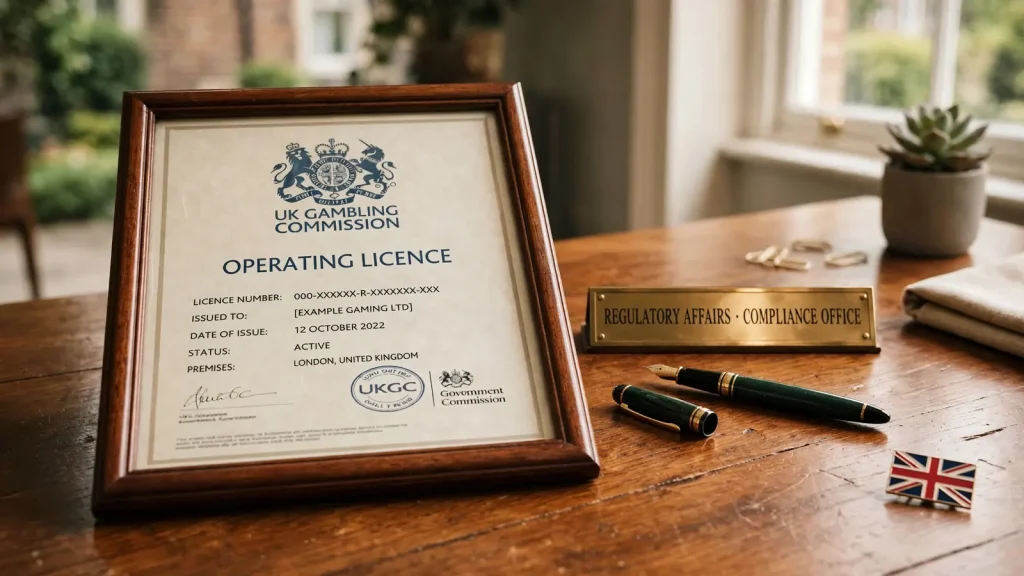
Trust depends on verifiable UK licensing and how operators handle safeguards, terms, payments and withdrawals.
Trust Starts with a Licence, Not a Promise
A casino can describe itself as safe, fair or dependable. Those words are easy to place on a website and harder to assess in isolation. For a business offering remote gambling to people in Great Britain, the first meaningful test is more definite: it needs the relevant UK Gambling Commission licence, wherever the business itself is based.
That requirement makes location a poor shortcut. A company does not avoid the rule by operating from elsewhere; what matters is that it offers gambling facilities to consumers in Great Britain. The distinction is simple, though online presentation can blur it. A site may look local, use familiar language and accept familiar forms of payment, yet none of those features establishes that the business holds the licence required to serve this market.
The licence is a threshold, not a decorative badge. Without it, assurances about careful management or generous treatment remain assertions made by the business itself. With it, the most basic question has a verifiable answer: the operator has the relevant permission to offer remote gambling in Great Britain. That is where a judgement about a trustworthy online casino should begin.
Choosing a trustworthy online casino means looking for clear, relevant information rather than relying on a label alone. This list offers a concise reference point for reviewing the details available for each operator.
1. SlotoSport
Payout speed: 1-3 business days SlotoSport lists a payout speed of 1–3 business days. This gives readers a stated timeframe to consider when reviewing the operator.
2. NightLuck
Payout speed: 1-3 business days NightLuck lists a payout speed of 1–3 business days. That stated timeframe is the available detail to use when assessing it.
3. Britsino
Payout speed: 1-3 business days Britsino lists a payout speed of 1–3 business days. Readers can use this stated timeframe as one point of reference.
4. Dieselwin
Payout speed: 1-3 business days Dieselwin lists a payout speed of 1–3 business days. This is the available practical detail for readers considering the operator.
5. SpinFormula
Payout speed: 1-3 business days SpinFormula lists a payout speed of 1–3 business days. The stated timeframe provides a concrete detail for readers to consider.
6. Revery Play
Payout speed: 1-3 business days Revery Play lists a payout speed of 1–3 business days. This gives readers a stated timeframe to keep in mind.
7. Amunbet
Payout speed: 1-3 business days Amunbet lists a payout speed of 1–3 business days. This payout information is the available specific detail for the operator.
8. Jetsetspins
Payout speed: 1-3 business days Jetsetspins lists a payout speed of 1–3 business days. Readers can consider this stated timeframe when reviewing the operator.
9. x3bet
Payout speed: 1-3 business days x3bet lists a payout speed of 1–3 business days. This is the specific information available to guide readers’ assessment.
10. NightWin
Payout speed: 1-3 business days NightWin lists a payout speed of 1–3 business days. The stated timeframe offers a practical point of reference for readers.
Not end. Trust is not a single quality that can be stamped onto a company and carried unchanged through every interaction. It is built from rules, conduct and the way a business handles the ordinary points at which its interests meet those of its customers. But starting elsewhere—at a polished design, a familiar name or a confident promise—puts the least solid evidence first.
There is a reason promises work so well in commercial life. They are immediate. A reassuring sentence asks little of the person reading it, and the human mind is inclined to treat fluency as a sign of competence. Regulation is less theatrical. It is a condition attached to the business, not a compliment it has written about itself. The difference matters most in a market where the customer encounters the operator through a screen and may have little sense of the company behind it.
A claim to be among the most trustworthy online casinos is therefore not proof. Nor is a smooth welcome, a large selection of games or a prominent customer-service link. Such details may help describe the experience, but they cannot replace the licensing question. A trustworthy casino online is not made trustworthy simply by adopting the vocabulary of trust.
The same caution applies to the word “UK” in a site’s branding. A national flag, British spelling or a domain that appears familiar can create an impression of local standing. Impressions are not permissions. The relevant issue is whether the business serving Great Britain holds the UKGC Licence required for that activity. The company’s base abroad does not remove that requirement, and a local-looking presentation does not establish that it has been met.
Offshore Casino Sites for UK Players: Rules and Risks
This is a modest test, but modest tests are often the useful ones. It does not require a theory about what makes every company admirable. It asks whether the business has crossed the basic legal threshold for offering remote gambling here. That separates a checkable condition from a marketing description, and gives any further assessment a sounder place to stand.
There is also a social point in that threshold. Gambling has long been sold as entertainment, but it involves money, chance and the possibility of loss. A market that leaves the rules entirely to each seller would ask customers to judge businesses using the very claims those businesses make about themselves. Requiring a licence places a public condition between the offer and the customer. It is not a guarantee that every experience will be trouble-free; it is a recognition that commercial confidence alone is not enough.
For someone comparing trustworthy online casinos, the sensible order is consequently plain: establish that the operator is licensed to serve Great Britain before weighing its presentation or promises. That does not settle every question about how the business behaves. It does prevent the first question from being replaced by a more flattering one.
A promise can be rewritten. A licence is a condition.
What UK Casino Trustworthiness Actually Means
Trustworthiness is not a badge handed out by the state. In Great Britain, the Gambling Commission regulates remote gambling offered to consumers, including casino gambling conducted online. Its role is to oversee the market under a licensing system; it does not recommend individual casinos or certify one as the most trustworthy choice.
Regulation Framework
Regulation sets the framework within which a licensed business must operate, but it is not a personal seal of approval or an endorsement of a casino’s overall quality.
That distinction matters because official-sounding language can blur two different ideas. A casino may be subject to regulation, but that does not mean the Commission has endorsed its games, customer service, payment arrangements or overall quality. Regulation sets the framework within which a licensed business must operate. It is not a personal seal of approval, and it should not be read as a promise that every customer will have a good experience.
The line between oversight and endorsement is easy to miss in a market built around persuasive claims. “Trusted”, “safe” and “reliable” are words that can appear in advertising, reviews and operator descriptions. Their presence does not establish who is making the claim or what evidence supports it. The Commission’s regulatory role has a more specific meaning: remote gambling businesses serving consumers in Great Britain are within the system it oversees, and real-money casino operators serving England, Scotland and Wales need a UKGC Licence.
The licence is therefore an institutional threshold, not a ranking. It helps distinguish a business operating within the British regulatory framework from one that is not. It does not settle every question someone might reasonably have about an online casino. A licence cannot tell whether a site’s presentation is clear, whether its customer support is satisfactory, or whether its particular terms suit a person’s circumstances. Those are separate matters, and a regulator’s existence should not be used to make them disappear.
This is why asking which online casino is trustworthy has no answer in the form of a government-approved winner. The Commission regulates the activity; it does not publish a universal judgement that one casino is better or more dependable than another. A “most trustworthy” label in a review may express that review’s assessment, but it is not interchangeable with regulatory approval. The difference is not a technicality. It tells the reader whose judgement is being relied upon.
Merkur Casino Online in the UK: Games and Rules · Curacao Casino Licence in the UK: What It Means
Trust also has a social dimension. Gambling regulation is one way a country decides that a commercial activity may be offered, but not without public rules. In the British system, remote gambling is not treated as an entirely private arrangement between a business and its customers. The state has a regulatory role because the service reaches people in their homes, through devices that can make gambling feel as ordinary as any other online purchase. The licence marks the operator’s place within that regulated market. It does not turn the operator into a public institution.
A trustworthy casino, then, is not simply one with polished design or confident claims. Nor does the presence of a regulator remove the need for judgement. The more accurate question is whether the business belongs to the regulated system and whether its own conduct and terms withstand closer attention. The first point is institutional; the second concerns the operator. Confusing them allows marketing language to borrow authority it has not earned.
There is also a difference between regulating remote gambling and guaranteeing an outcome. The Commission’s role is to regulate the provision of those services to consumers in Great Britain. That should not be stretched into a claim that the regulator stands behind every transaction, resolves every disappointment automatically, or makes a casino risk-free. No regulator can make the word “trust” do all that work. The sensible interpretation is narrower, and therefore more useful: the UKGC Licence identifies a business operating under the relevant British licensing framework, while the quality of the individual service remains a matter for scrutiny.
Do
- Verify if the operator holds a UKGC Licence
- Treat a licence as evidence of regulatory status
Don’t
- Treat a licence as a consumer review
- Confuse regulatory oversight with a personal endorsement
So the phrase “trustworthy online casino” describes a judgement, not an official category. A licence is important evidence about regulatory status, but it is not a consumer review written by the Commission. Likewise, a favourable review is not a substitute for that status. Each answers a different question: one concerns whether the operator is within the regulated system; the other concerns how someone assesses its offer or service.
That separation is the foundation for making sense of claims about safety and trust. Regulation gives the market a public structure. Endorsement would imply a recommendation, and the Commission’s role is not to provide one. A licence can establish the former. It cannot honestly be made to mean the latter.
The distinction is modest. It is also the point.
GAMSTOP Is Part of the UK Licensing Framework
A casino that does not appear on GAMSTOP may look, at first glance, as though it offers a separate kind of freedom. But absence from the scheme is not a badge of independence or evidence of unusual trustworthiness. For online operators serving customers under the Gambling Commission’s Great Britain regime, taking part in GAMSTOP is a requirement, not an optional mark of good character.
The timing matters. Participation became compulsory on 31 March 2020. Since then, a site offering gambling under that regime cannot treat the scheme as an extra feature to include or omit according to its own preferences. The requirement sits within the conditions of operating in the regulated market. A claim to be a trustworthy British-facing casino therefore cannot sensibly rest on being outside a system that licensed operators are expected to join.
Casino Without a Swedish Licence: UK Player Guide · USA Casinos for UK Players: Access and Licensing
GAMSTOP is a self-exclusion service. Its purpose is to give people a way to exclude themselves from online gambling with participating operators. The scheme is not a prize awarded to casinos, nor a consumer rating that distinguishes the careful from the careless. It is part of the framework through which exclusion is made available across the regulated sector. That makes participation a baseline condition, rather than a special endorsement.
This distinction is easy to lose in the language of casino advertising. A site may present itself as more flexible because it is not connected to GAMSTOP; the implication may be that fewer restrictions mean better service. Yet the same absence may point to a different, more consequential fact: the operator may not be serving customers within the Great Britain licensing framework. Without that context, “not on GAMSTOP” describes a missing connection while concealing why it is missing.
For someone searching for a trustworthy casino outside the scheme, the useful question is not whether the site advertises fewer barriers. It is whether the operator has the standing required to offer gambling to people in Great Britain. A casino cannot turn non-participation into a reliability credential merely by describing it as choice. The scheme’s compulsory status means that its absence calls for scrutiny, not applause.
Licensing Risk
Absence from the GAMSTOP scheme may indicate that an operator is not serving customers within the Great Britain licensing framework.
There is also a human reason not to treat exclusion controls as mere administrative scenery. They exist because gambling can become difficult to contain, and because a decision to step away needs more than a promise made in a moment of resolve. A shared exclusion mechanism is one way regulation gives that decision practical force across participating operators. It does not guarantee that every person will find support sufficient, or that every problem has a technical answer. But removing the mechanism is not evidence that the underlying risks have vanished.
The phrase “non-GAMSTOP casino” can therefore describe very different things in casual conversation, but it does not identify a recognised class of more trustworthy operator within the regulated Great Britain system. The scheme is not a quality seal, and joining it does not by itself prove that a casino handles every other responsibility well. Equally, a site’s absence cannot be read as a mark of superior care. Trust is not measured by the number of safeguards a business can avoid.
The sensible reading is narrower and more useful: GAMSTOP participation is expected of operators in the Commission’s Great Britain regime, and that expectation has applied since the requirement took effect in 2020. A site presenting itself as an alternative should not be assumed to offer the same protections simply because it uses British-facing language or invites British customers. A missing safeguard is not a shortcut to confidence.
Real-Money Play, Bonuses and the Small Print
A welcome offer can look generous in a banner and demanding in its terms. The difference is not a matter of presentation alone: wagering requirements determine how much qualifying play must take place before bonus funds, or any resulting winnings, can be withdrawn. For a trustworthy real-money casino, the useful question is not simply how large the advertised bonus appears, but what conditions attach to it.
International Casinos for UK Players: Licensing
A straightforward calculation shows the scale. A £20 bonus with 10x wagering requires £200 in total stakes to meet that requirement. The £200 is not a sum owed to the player, nor a promise of winnings; it is the cumulative amount that must be wagered. The original bonus may be lost during play, and meeting the wagering condition does not itself guarantee a profit. The wording matters: terms should make clear which funds count towards wagering and which games qualify.
A specialist review describes a different illustrative offer: a 100% match bonus capped at £200, with a 30x rollover. That multiplier cannot be interpreted safely without checking its base. A casino may calculate wagering against the bonus alone or against the combined deposit and bonus, and those produce very different requirements. The offer’s headline percentage says little about its practical value until the calculation is explicit.
The same care applies to contribution rules. Terms may distinguish between games, giving some full credit towards wagering while assigning others a lower contribution or none. A player who chooses a game that does not count may make little progress against the requirement, even while placing real-money stakes. Clear terms should explain eligible games and the contribution assigned to each category; vague wording leaves the cost of interpretation with the customer.
Eligibility can narrow an offer before play begins. A specialist review reports that welcome deals may be restricted to new customers, limited to one per household, and unavailable with certain payment methods, including some e-wallets. These are conditions to verify in the promotion’s own terms, not universal features of every casino offer. Payment restrictions deserve particular attention: deposit and withdrawal availability are separate, and a method that qualifies for a promotion may not be available for withdrawals on the same basis.
Bonus Wagering
Calculate Total Stakes
Multiply the bonus amount by the wagering requirement (e.g., £20 bonus × 10x wagering = £200 total stakes).
Check Contribution Rules
Verify which games count towards the wagering requirement and at what percentage.
Review Restrictions
Check for household limits, eligible payment methods, and the promotion’s expiry date.
A bonus is also a contract with an expiry and withdrawal rules, not simply extra money added to a balance. The terms should state when the offer ends, what happens to unused bonus funds or spins, whether winnings are capped, and whether a withdrawal cancels the promotion. If these points are scattered across several pages, the difficulty of finding them is itself relevant to assessing the offer. Generosity that requires detective work is a peculiar kind of generosity.
Casinos must give customers more control over the types of promotions they receive and the channels through which they arrive. That matters because marketing is part of the product’s design: an account should not be treated as open permission for every offer in every format. The distinction between accepting a particular promotion and receiving promotional messages should be intelligible in the account settings and the terms.
The criteria for trustworthy online casinos therefore extend beyond the banner. The stated wagering base, eligible games, payment exclusions, household limits, expiry rules and withdrawal consequences all shape the real value of a deal. If any of these conditions cannot be understood before acceptance, declining the promotion may be more prudent than discovering its cost after the money is committed.
Online Slots Have Their Own Safeguards
Online slots are treated differently from casino games played at a table. The distinction is not merely about the shape of the screen. A slot can turn a decision into a repeated, rapid action, so British rules place limits on the pace and size of play. These safeguards are part of what makes trustworthy online slots different from products that simply carry reassuring labels.
Non-UK Licence Casinos: How Overseas Regulation Works · Gibraltar Casino Licence and UK Legal Status
The maximum stake depends on age. Players aged 18 to 24 may stake no more than £2 per spin; for players aged 25 and over, the ceiling is £5. The lower limit for younger adults recognises that exposure to gambling risk does not begin and end at the legal age of entry. Permission to play is not treated as proof that every level of intensity is appropriate.
The figures matter, but so does the way a game presents them. A stake limit applies to the amount risked in a spin, not to a promise that losses will remain small or that a session will be harmless. A series of permitted spins can still accumulate into substantial spending. Regulation can set boundaries around the product; it cannot turn chance into a reliable source of income.
Speed is regulated too. Each online slot spin must take at least 2.5 seconds. That may seem a modest pause, but it interrupts the machinery of instant repetition: one result, another stake, another result, before attention has time to settle. The rule does not make a slot slow in any ordinary sense. It makes it less able to compress decisions into an uninterrupted blur.
Autoplay is banned in Britain. A player cannot set a slot to keep spinning automatically while they watch, look away or stop attending to each individual stake. The ban puts a decision back between one spin and the next. A small intervention, perhaps, but one aimed directly at the design feature that removes repeated choices from the person playing.
Stake Limits
Maximum stakes are £2 for players aged 18–24 and £5 for those 25 and over.
Spin Duration
Each online slot spin must take a minimum of 2.5 seconds to prevent uninterrupted repetition.
Autoplay Ban
Autoplay is prohibited in Britain to ensure a decision is made between every individual stake.
These rules are product safeguards, not signs that every game is equally transparent or that a casino deserves trust on the strength of its slot lobby. The relevant test is whether the game behaves within the rules: the age-based stake ceiling is respected, spins meet the minimum duration, and autoplay is absent. A glossy interface cannot compensate for a missing safeguard.
There is a social idea embedded in these limits. The state has not prohibited online slots; it has tried to govern the conditions under which their rapid, repetitive form is offered. That compromise is imperfect by design. It leaves room for play while attempting to prevent the interface from setting the pace entirely on its own. A boundary, not a blessing.
Bitcoin Payments Need Evidence, Not Assumptions
Bitcoin can make a casino’s payment page look like a statement of independence. It is not one. A payment method tells little about who operates the gambling business, which rules govern it, or where a complaint would go. A familiar logo, a polished cashier and a promise of quick transfers are no substitute for those answers.
That distinction matters because money and authority are separate questions. A site may describe Bitcoin as an available way to pay; that description does not establish that the business has permission to offer gambling to people in Great Britain. Nor does the presence of a regulated payment option, where one is offered, turn an operator into a regulated one. The cashier is not the licence.
For remote gambling businesses serving consumers in Great Britain, the relevant UK Gambling Commission licence is required regardless of where the business is based. The location of the company, the currency shown on a page and the method used to move funds do not displace that requirement. A business cannot make the British regulatory question disappear by putting a different instrument between itself and the player.
Offshore casinos for UK players: risks and rules
This is why the phrase “trustworthy Bitcoin casino” needs more than a payment claim behind it. Trustworthiness concerns the operator and the framework in which it works, not merely the route taken by a deposit. Bitcoin acceptance, even if clearly stated by a site, is evidence about the site’s payment offering alone. It does not demonstrate licensing, oversight or a route for resolving disputes.
The same caution applies to lists of trustworthy online casinos that treat Bitcoin as a badge of quality. A list may put payment features in bold type because they are easy to compare. The harder and more consequential detail is whether the business serving Great Britain holds the required UKGC Licence. Without that, the payment method answers the wrong question.
There is a cultural appeal in the idea that a new form of money must bring a new kind of freedom. Yet a casino remains a gambling business, not merely a wallet with games attached. The public interest in regulation concerns the activity and the operator, not the novelty of the payment rail. Technology changes quickly; responsibility does not dissolve with it.
Bitcoin should therefore be treated as a payment detail, not a trust signal. A claim about deposits cannot certify the company making it, and a payment page cannot stand in for regulatory status. The essential evidence lies with the operator’s permission to serve the market. The rest is decoration.
Attention: Bitcoin acceptance is a payment detail only; it does not demonstrate licensing, oversight, or the legal permission to serve the Great Britain market.
A Licence Check Is More Useful Than a ‘Best’ Label
A superlative says what a reviewer thinks; a register entry shows what the regulator records. For a casino presented as British-facing, the useful comparison is between the operator named on the UK Gambling Commission’s public register and the domain through which the service is offered. A familiar brand, polished design or confident claim cannot make that connection on its own.
The register gives a concrete example. It lists LeoVegas Gaming PLC under operator account number 39198, and its domain record identifies leovegas.co.uk as the active UK-facing domain linked to that account. This is more informative than finding a brand name in isolation: it connects a corporate operator to a specific web address in the regulator’s records.
That connection is a check, not a medal. It does not rank casinos, certify every feature of a site or promise that every customer experience will be satisfactory. Nor should a saved screenshot or an old review be treated as a permanent record. Domain entries and business arrangements can change; the live register is the relevant reference when the check is made.
The distinction matters because brand names can travel further than their regulatory details. A site may use familiar imagery or language while the legal entity behind it is less visible. The register makes that entity legible, and the domain listing helps establish whether the address in use is the one associated with the operator’s British account. A mismatch deserves attention before any money is deposited; a match establishes only that particular link.
“Best” is a floating label. An operator name, account number and UK-facing domain are particulars that can be checked against the regulator’s own record. That is a quieter basis for confidence, and a more useful one.
Non-GamStop European Casinos: UK Rules
What Casino Reviews Should Notice: Enforcement
Promotional claims are designed to be remembered: a welcome deal, a polished page, the promise of attentive service. Regulatory history is less decorative, but it says something more consequential about how an operator has handled its obligations when customers needed protections to work.
A useful review therefore looks beyond the offer and asks what enforcement records reveal. The UK Gambling Commission fined Grace Media £60,000 on 26 June 2025 after finding breaches connected with self-exclusion and consent for direct electronic marketing. Those are not obscure administrative details. Self-exclusion is intended to give people a way to stop gambling with an operator; marketing consent concerns whether promotional messages are sent with permission. A failure in either area reaches into the relationship between a business and its customers.
That record does not, by itself, describe every part of the operator’s service or establish what a customer will experience in future. It does give a review a concrete event to examine rather than relying on the operator’s own description of its standards. Careful coverage should identify what the regulator acted on, when it acted, and whether the issue concerned customer protection, marketing conduct or another duty. A vague reference to “past problems” is less useful than a clear account of the matter.
This is also why a review should not treat a penalty as a dramatic flourish, or bury it beneath more appealing copy. Enforcement is evidence of a particular failure and a reason to scrutinise the safeguards involved. It is not a substitute for assessing the present service, and it should not be inflated into claims the record does not support.
Regulatory Scrutiny
- A UKGC Licence is the primary threshold for trustworthiness
- GAMSTOP participation is a requirement for licensed operators
- Bonus terms and slot safeguards must be verified explicitly
- Enforcement records provide a factual history of an operator’s conduct
Trustworthy casino reviews make room for both kinds of information: what an operator advertises and how it has behaved under scrutiny. The second is less glossy. It is often more revealing.
The ‘UK’ in UK Casino Rules Has a Boundary
“UK casino” is a convenient phrase, but it can blur a legal distinction. The Gambling Commission’s authority under the Gambling Act 2005 covers England, Scotland and Wales. Northern Ireland does not fall within the Commission’s remit for remote-gambling provision in the same way.
That matters when deciding whether online casinos are trustworthy. A UKGC Licence is evidence of regulation within the Commission’s jurisdiction; it should not be treated as a universal certificate for every part of the United Kingdom. A site’s use of “UK” in its name, or wording that suggests it serves the whole country, does not erase the boundary.
Northern Ireland has a separate legal framework for gambling, including the Betting, Gaming, Lotteries and Amusements (Northern Ireland) Order 1985. The distinction is not a decorative detail in legislation. It reflects different jurisdictions, so a statement about what the Gambling Commission regulates in Great Britain cannot automatically be extended to Northern Ireland.
This also makes broad claims about a casino being “regulated in the UK” less informative than they sound. The relevant question is which authority and legal framework apply to the service being offered in the location concerned. For Great Britain, the Commission’s role is clear: it regulates remote gambling offered to consumers there. For Northern Ireland, the same Commission remit does not apply.
The boundary does not mean that a UKGC Licence is meaningless; it means its scope must be described accurately. A trustworthy assessment begins by identifying the jurisdiction, then interpreting any regulatory claim within that jurisdiction. The country name is not the regulator. A small distinction with large consequences.
Casino Licensing & Safety for UK Players
Verification, Withdrawals and the Moment Trust Is Tested
A casino’s identity checks become most visible when a withdrawal is requested, but they are not meant to begin there. In Britain, operators must verify age before allowing a customer to deposit, and verification must be completed before play. The process commonly involves a passport or driving licence image and a recent utility bill. These are identity or payment-ownership questions, not an optional hurdle invented when winnings appear.
The details can vary between operators. LeoVegas, for instance, asks for identity verification, generally at the first withdrawal, using photo identification and proof of address dated within the previous three months. That gives a useful indication of the kinds of documents that may be requested, not a timetable or promise that applies elsewhere.
A withdrawal request may therefore pause while documents are supplied and checked. One specialist review reports an additional 12–24 hours for document checks on a first withdrawal. That is a reported estimate, not a standard deadline for every casino or every account. Incomplete images, mismatched details or a request for further evidence can make the practical process less straightforward; the key is whether the operator explains what remains outstanding and how to provide it.
Anjouan Casino Licence in the UK: What It Means
There are distinct stages: the account holder submits a withdrawal request, the operator reviews the account and any required evidence, and the payment then proceeds through the chosen method. A fast-looking payment option cannot remove an unfinished identity check. Nor does a delay, by itself, show that a casino is dishonest: the reason and the handling matter.
Trust is easier to assess when document requirements are stated before a withdrawal, requests are explained clearly, and the account shows whether evidence has been received or is still needed. Vague demands made only after money is requested deserve scrutiny. So do promises of instant payment that leave no room for the operator’s review.
The first withdrawal is a practical test of the relationship: not merely whether the balance can be requested, but whether the rules are intelligible when they matter. Clear process, not theatrical speed.
How can I check whether a casino is legal?
Check the UK Gambling Commission’s public register to see whether the operator holds a licence to offer gambling in Great Britain.
Is LeoVegas UK licensed?
Yes. The UKGC register lists LeoVegas Gaming PLC under account number 39198 and identifies leovegas.co.uk as its active UK-facing domain.
What payment types are listed?
The listed methods are PayPal, debit cards and bank transfers.
What is the fastest withdrawal method?
PayPal is the fastest method listed, with withdrawals taking roughly 4–6 hours on weekdays and 8–10 hours from Friday to Sunday.
Is LeoVegas legitimate and safe to bet with?
LeoVegas Gaming PLC is listed by the UK Gambling Commission, and leovegas.co.uk is listed as its active UK-facing domain. A licence means the operator is regulated; it is not a guarantee of a trouble-free experience or an endorsement by the Commission.
Where can I find responsible gambling tools?
Use GAMSTOP to self-exclude from online gambling operators in the UKGC regime. The National Gambling Helpline is also available 24 hours a day on 0808 8020 133.
Safety

Anjouan Casino Licence in the UK: What It Means
An Anjouan authorisation applies under its own jurisdiction and does not by itself permit an...

Best foreign casinos for UK players: what to know
The label refers to accepting British customers without a UK Gambling Commission licence, not simply...

International Casinos for UK Players: Licensing
Understand how UK authorisation differs from overseas access, and why bonuses, withdrawals and player safeguards...

Offshore Casino Sites for UK Players: Rules and Risks
The guide examines licensing, business relationships, bonus terms, crypto withdrawals and safeguards beyond a site's...

Offshore casinos for UK players: risks and rules
Offshore sites may accept British visitors, but access does not mean authorisation or the safeguards...

British Casinos Not on GamStop: What It Means
GamStop applies to UK-licensed operators, so a site's regulatory status affects whether a registered self-exclusion...

Casino Sites Not Registered with GamStop in the UK
GamStop blocks registered UK residents from gambling at UKGC-licensed online casinos, but does not cover...

Casino Without a Swedish Licence: UK Player Guide
A foreign licence is not a UKGC licence, and a casino’s location does not determine...

Casinos That Bypass GamStop: What UK Players Should Know
GamStop applies to UKGC-licensed operators; access beyond that system does not carry the same regulatory...

Curacao Casino Licence in the UK: What It Means
A Curaçao licence identifies a jurisdiction, but does not establish UK regulation, customer access or...

Gibraltar Casino Licence and UK Legal Status
A Gibraltar link identifies an operator’s declared regulatory setting, but does not determine its UK...

Merkur Casino Online in the UK: Games and Rules
Merkur titles are products in an operator’s changing catalogue, while the casino platform is responsible...

Non-GAMSTOP Casinos in the UK: What It Means
A site's absence from Gamban does not establish whether GAMSTOP applies or whether the casino...

Non-GamStop Curaçao Casinos and UK Oversight
The article separates offshore licensing claims from UK authorisation and explains why exclusion status and...

Non-GamStop European Casinos: UK Rules
A casino’s location, branding and audience do not determine whether its UK-facing operations fall within...

Non-UK Licence Casinos: How Overseas Regulation Works
The issuing authority shapes oversight and complaint options, so an overseas licence is not equivalent...

Non-UK-Registered Casinos: Licensing Explained
The guide separates a casino’s business location from its gambling regulator and examines the practical...

Non-UK Regulated Casinos: What UK Rules Cover
UK licensing depends on serving customers in Great Britain, while offshore permissions and safeguards vary...

Non-UKGC Licensed Casinos: UK Rules and Risks
The distinction between an operator’s UK licensing duty and an individual’s position shapes the risks...

Malta MGA Licence for UK Online Casinos: What It Means
A Malta licence regulates an operator in Malta, while real-money offers to Great Britain require...

Online Casinos With No Sister Sites in the UK
Shared ownership or technology can shape casino features, but familiar games, layouts and promotions are...

Online slots not on GamStop: what to know
GamStop blocks access at participating UKGC-licensed casinos; mobile play and unfamiliar offers do not change...

Safe Online Casinos in the UK: Player Protections
A practical guide to licensing, gambling limits, payments, bonus terms and security, without treating a...

Trusted Casinos Not on GamStop UK: What to Check
The guide weighs licensing, player protections, payments and promotional terms at casinos operating outside the...

Trusted UK Casino: Licensing, Checks and Safeguards
Licensing, identity checks, public records and payment terms help explain what can—and cannot—be verified about...

USA Casinos for UK Players: Access and Licensing
A guide to how licensing, safeguards, payments, bonuses and recourse differ for UK players at...

VPN-Friendly Casinos UK: Access, Licensing and Risk
A casino accepting VPN connections does not necessarily hold a UK licence or offer the...