
Live Dream Catcher Casino UK: How It Works
 Available in GB
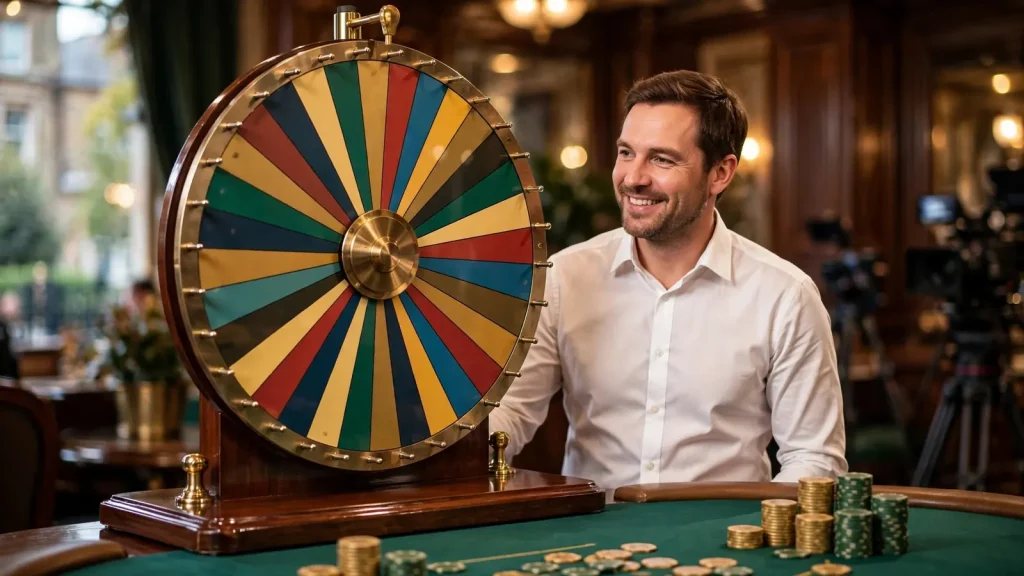
A camera shows a human dealer in a studio while an interface records bets, but the live label alone does not establish a game’s rules.
The Live Table, Seen in Real Time
The phrase “Dream Catcher online casino” can suggest a game that exists entirely inside a screen: software, animation, a result generated in the background. Live dealer play belongs to a different arrangement. A camera carries a real-time picture from a studio, where a human dealer conducts the game. Bets are entered through an on-screen interface, joining a physical performance to a digital account.
That combination is the defining feature. The image is not merely a decorative layer over a digital game. A dealer is present in the studio, and the stream shows play as it happens. The interface, meanwhile, turns a player’s selection into a bet. Two systems share the work: a broadcast that makes the table visible and software that records the action taken on screen.
This is why a search for a live version of Dream Catcher calls for care in interpreting the word “live”. It describes the format, not necessarily every detail of a particular game or its rules. The general live-casino model can be described without assuming how a named title works. A game’s name may travel widely across casino menus and search results; that does not make its rules self-evident.
When looking for a UK casino to play live Dream Catcher in 2026, payout timing is one practical detail to check. The entries below include the stated withdrawal timeframe for each operator.
1. SlotoSport
Payout speed: 1-3 business days SlotoSport has a stated payout speed of 1–3 business days.
2. NightLuck
Payout speed: 1-3 business days NightLuck has a stated payout speed of 1–3 business days.
3. Britsino
Payout speed: 1-3 business days Britsino has a stated payout speed of 1–3 business days.
4. Dieselwin
Payout speed: 1-3 business days Dieselwin has a stated payout speed of 1–3 business days.
5. SpinFormula
Payout speed: 1-3 business days SpinFormula has a stated payout speed of 1–3 business days.
6. Revery Play
Payout speed: 1-3 business days Revery Play has a stated payout speed of 1–3 business days.
7. Amunbet
Payout speed: 1-3 business days Amunbet has a stated payout speed of 1–3 business days.
8. Jetsetspins
Payout speed: 1-3 business days Jetsetspins has a stated payout speed of 1–3 business days.
9. x3bet
Payout speed: 1-3 business days x3bet has a stated payout speed of 1–3 business days.
10. NightWin
Payout speed: 1-3 business days NightWin has a stated payout speed of 1–3 business days.
The studio is an old idea dressed in new machinery. Casino games have long depended on a person whose gestures make procedure legible: dealing, turning, announcing, moving the game onwards. The camera preserves that visible ritual for people who are nowhere near the table. In the online version, the dealer remains in a room built for the broadcast, while the players appear as names, balances and bet selections in an interface. It is a social scene with most of the society edited out.
That is not quite the same as playing against a computerised version of a game. A digital game can present animated objects and accept selections, but its play is generated by software rather than shown as a dealer-led studio event. Live play gives the player a view of a human dealer and the action taking place in real time. It does not turn the screen into a physical casino, nor does it make the interface disappear. The camera supplies presence; the buttons supply participation.
The distinction matters because “online” can conceal several different experiences. A game may be digital from beginning to end, or it may use a live studio stream as its central feature. The two can look similarly polished on a phone or laptop, but they do not move in the same way. In a live table, the broadcast and the dealer’s actions set the visible rhythm. The interface does not make each round appear instantly just because it is electronic.
Live Baccarat Online Casinos in the UK: How It Works
There is a cost to that rhythm. Live games move more slowly than digital versions, where software can carry a game from one result to the next without a studio performance in between. A dealer-led round takes place in public view, and that visible sequence gives the game a measured pace. For some players, the human presence may be the point: it makes the action easier to follow as an event. For others, waiting is simply waiting. The format offers ceremony, not speed.
Minimum bets are also higher in live games than in digital versions. That difference changes the feel of a session before the stream has become familiar. The visual presence of a dealer can make the table seem more approachable, but it does not mean the financial threshold is the same as in a digital game. Live presentation is not a discount on participation. The table brings its own conditions.
The third condition is less theatrical and more decisive: a stable internet connection is needed to follow the stream. A live game depends on a continuous picture of events. If the connection falters, the experience can become difficult to follow, even when the betting interface remains visible. A digital game may also rely on an internet connection, but the live format adds a real-time broadcast whose continuity is part of the experience. The dealer cannot be reduced to a still image without changing what the game is.
Live games exchange speed for a visible human presence and often require a higher minimum bet than digital versions, all while depending on a reliable internet connection for the studio stream.
These trade-offs explain why the live format is not automatically preferable to its digital counterpart. It exchanges speed for a visible human presence, and often a lower minimum for a higher one. The studio stream can make an online game feel less abstract, but it also places the player inside a slower sequence that depends on a reliable connection. None of those qualities tells a person whether a particular game is suitable; they describe the arrangement around play.
For a UK searcher looking for Dream Catcher online, the useful first distinction is therefore modest. “Live” means a real-time studio stream with a human dealer and bets placed through the screen. It does not, by itself, establish the game’s rules or promise that every casino listing presents the same experience. The format is clear enough. The particulars belong to the table itself.
A screen, a dealer, and a pause.
Dream Catcher in the UK: The Licensed Setting
A live Dream Catcher listing sits inside a larger question than whether a particular casino has placed the game in its lobby. In the United Kingdom, the relevant distinction is between a site operating within the local gambling system and one that is not. Live-dealer casinos are legal here when they hold a licence from the UK Gambling Commission. The licence is not decorative wording in a footer; it is the condition that makes offering remote gambling to the British market lawful.
Live Casino Lightning Roulette UK: How Play Works
The legal framework reflects a particular view of responsibility. The Gambling Act 2005 governs gambling in England, Wales and Scotland, while Northern Ireland is outside that Act. For remote operators serving consumers in Great Britain, the rule is direct: the operator must hold the relevant Gambling Commission licence, wherever the company itself is based. A business cannot avoid the requirement simply by placing its office or servers elsewhere. The market is defined by whom it serves, not only by where it sits.
That matters when a live casino game appears under a familiar name. A site may present a studio game, an account page and a payment screen as parts of one seamless service, but the legal question concerns the operator providing that service. A game’s title does not establish that the site is licensed, and a polished interface does not alter the requirement. The licence belongs to the operator’s right to offer gambling to customers in the regulated market; it is not a blanket promise about every game’s character or a certificate that any particular listing is available.
The phrase “Dream Catcher casino UK” can therefore point to two different things: a game someone hopes to find, and the jurisdiction in which the casino offering it must operate. Those are related, but not interchangeable. A search result or promotional page may describe a live casino Dream Catcher, yet the relevant legal setting is determined by the service behind the page. If a remote operator accepts British customers for real-money gambling, it must be licensed by the UK Gambling Commission. A foreign address does not provide an exemption.
Licensing Requirement
Remote operators serving consumers in Great Britain must hold a relevant UK Gambling Commission licence to operate lawfully, regardless of where the company is based.
This is one reason the UK system treats licensing as a threshold rather than a recommendation. Online gambling is legal in the UK for adults aged 18 and over when the operator holds the required licence. A site outside the UK regulatory system is not made part of it by using British currency, displaying English-language terms or being reachable from a British connection. The distinction is institutional, not cosmetic. A licensed operator is answerable within the local framework; an offshore casino without a UKGC licence is not operating under that framework.
The licence requirement also explains why a game’s presence should not be confused with the lawfulness of the whole service. A live Dream Catcher casino listing may be visible on a site, but the name alone says nothing about whether that site has permission to serve the market. Nor does the word “live” carry legal force. It describes a format, while the licence concerns the operator. Two separate questions, easily blurred by a page designed to make every part of its offer feel equally immediate.
There is a quieter social idea behind this arrangement. Gambling is permitted, but not treated as an ordinary retail transaction in which access is the only test. The state allows operators to sell into the market on the condition that they enter a system of local oversight. This places responsibility on the business before a customer reaches the table. It is a less theatrical kind of boundary than a warning banner, but a more consequential one.
Live casino UK: how streams, licences and bets work
For anyone trying to understand whether a dream catcher live casino is being offered within the UK setting, the useful starting point is the operator’s regulatory status, not the game’s branding. The UK Gambling Commission is the regulator named in that framework. A current operating licence is required for a legal online casino serving UK players; an offshore licence from another jurisdiction is not a substitute for it. The detail is important because gambling websites can be accessible without being authorised to serve the British market.
That is the legal backdrop to live casino Dream Catcher searches in 2026: the game name may vary in how it is presented, but the UK condition does not. The operator must hold the appropriate UK Gambling Commission licence to offer remote gambling to the British market. The title is the invitation. The licence is the boundary.
Choosing a Casino Without a False Promise of ‘Best’
“Best” sounds like a verdict, but a casino choice is a bundle of conditions: whether the operator is authorised to serve the UK, what the table rules say, and whether the bonus terms fit the way the game is played. Those conditions can be checked. A universal winner cannot be established from the name of a game alone.
For anyone comparing places to play Dream Catcher, the first distinction is between a listing and an offer to play. A casino may describe a live game in its catalogue, but that description does not settle the table’s limits, the terms attached to it, or whether a promotion can be used there. Each point belongs to a different part of the operator’s information, and each deserves its own inspection.
Do
- Check for a UK Gambling Commission licence
- Read the specific table rules and limits
- Review the game weighting in bonus terms
Don’t
- Assume a brand name guarantees a licence
- Infer table conditions from other casinos
- Mistake a headline bonus for live-game funds
Start with the licence
A live-dealer casino serving the UK must hold a UK Gambling Commission licence. The licence is not a decorative badge or a general promise of quality; it is the legal condition for offering gambling to customers in this market. The operator’s legal name and licence information should be identifiable, rather than buried beneath a brand label that leaves the business behind it unclear.
That check sets a boundary, not a ranking. A licence does not establish that a particular table is generous, that a promotion is suitable, or that one casino is better than another for a particular player. It tells the reader which regulatory framework applies. The rest still needs reading.
There is a small but useful discipline in keeping those questions separate. Legitimacy is not a perk, and a bonus is not evidence of legitimacy. Treating one as a substitute for the other is how a glossy offer comes to stand in for the less decorative paperwork.
Read the table conditions as conditions
The table information matters before any wager is placed. Its displayed rules and limits determine what is being offered at that table, and those details should be read rather than inferred from the game’s name or from another casino’s version. A familiar title does not make every operator’s conditions identical.
A comparison can therefore begin with the information shown beside the live game: whether the table is available, the minimum and maximum stakes stated by the operator, and the rules that govern participation. If those details are not clear, the absence is relevant. It is not a reason to assume that the conditions match a different table elsewhere.
Crazy Time Live Casino Game Show in the UK
This is not a request for a league table of casinos. A site with a lower stated minimum may suit one budget and not another; a promotion may be irrelevant if live play is excluded. The useful question is narrower: are the conditions visible, intelligible and compatible with the intended use? That is less theatrical than “best”. It is also answerable.
A bonus may belong to another game
Welcome offers often arrive dressed as a single sum or headline, while their terms divide the casino into separate territories. A specialist review describes most UK welcome offers as free spins on slots, rather than funds for live tables. That distinction matters: a slot promotion cannot be assumed to pay for a live-dealer session, and the presence of an offer on a casino site does not mean every game is included.
Where a bonus does apply, the wagering terms determine how it can be used and what must happen before any eligible balance can be withdrawn. Live games may count for only a small share of that requirement; one stated example is a 10% weighting. The figure is a reminder to look at the actual game contribution in the particular terms, not a rate to expect everywhere. A casino’s rules may set a different contribution, or exclude the game from the promotion altogether.
Bonus Terms Check
- Verify if live games are included in the offer
- Check the game weighting percentage
- Identify any maximum bet limits during wagering
- Confirm if the offer needs manual activation
The wording should be checked in full, including which games qualify, how each is weighted, any maximum bet while wagering, and whether the offer needs to be activated. A headline can be perfectly accurate and still say very little about whether the underlying terms suit live play. The small print is doing the larger job.
For a live-game comparison, a bonus that looks valuable at first glance may have little practical relevance if the table contributes minimally or not at all. Conversely, declining a promotion can be simpler than trying to make an unsuitable offer fit. That is a matter of conditions, not a judgement about the quality of the game.
Compare what can be verified
A careful comparison keeps observable facts apart from impressions. The UK Gambling Commission licence can be checked; the stated table limits and rules can be read; the promotion’s game exclusions and weighting can be examined. Claims that a casino is “best” rarely explain which of these matters, or why one should outweigh another.
It is also worth distinguishing a game’s availability from a promise about its performance. A listing can establish that an operator presents a game in its catalogue, but it cannot establish that the experience will be preferable for every player. Nor does an attractive promotion prove that the live table itself offers more favourable conditions. These are separate claims and should not be bundled together.
Live Blackjack at UK Online Casinos: How It Works
The word “best” is useful only after the criteria have been made explicit. Best for clear table information? Best for a particular set of bonus terms? Best for a player who does not want a promotion at all? Without a stated measure, the label is mostly packaging.
Before opting into any offer, the wagering requirements, game weighting and maximum bet terms need to be reviewed. A budget should be set before play and kept to; losses or winnings are not a reason to push beyond it. Credit cards are not a permitted way to fund gambling in the UK. These points do not make a casino comparison exciting. They make it less likely that a headline will decide a money question on its own.
No ranked list can settle the choice without criteria that matter to the person making it. For a UK player, the sounder comparison is a current licence, legible table conditions and bonus terms that do not disguise where the offer can be used. The rest is preference, not proof. Content is for entertainment purposes only and is not gambling advice.
Playing a Live Game: Pace, Bets and the Stream
A live table has a rhythm that belongs partly to the studio and partly to the people watching from home. The dealer appears on a real-time video stream; the betting controls sit alongside it on screen. Rather than setting every event in motion at once, the interface opens a period for bets, displays the dealer’s activity and moves on when that part of the round is complete. The game is both a broadcast and an interface.
A live table functions as both a broadcast and an interface, where the dealer provides the visible scene and the on-screen controls handle stake entry and selection.
That arrangement changes the small habits of play. Attention moves between the stream and the controls: the dealer’s actions provide the visible scene, while the interface is where a stake is entered and a selection is made. The camera does not place a physical table in the room, of course. It gives the game a human presence while leaving the player’s practical decisions to the screen.
For anyone looking to play Dream Catcher at a live table, the same distinction matters. A name or image may suggest a familiar sort of wheel game, but the screen itself is what governs the moment-to-moment experience: when betting is available, which controls are active and when the round has moved on. Those details should be read from the game interface rather than guessed from its title. The dealer’s presence does not make the pace faster; it makes the sequence visible.
Live games move more slowly than digital versions. A digital game can complete its cycle without waiting for a dealer to perform the next action on camera. A live table has to leave room for the human sequence: the betting period, the dealer’s work, and the display of what follows. A pause that might feel like dead air in a fast digital game is part of the format here. The studio has to show events in order.
This pace can feel more legible, because there is a person at the centre of the action and the round unfolds in front of the camera. It can also mean fewer decisions fit into a given stretch of time. The trade-off is plain: less speed, more visible process. For some, that is the attraction; for others, it is simply a slower way to reach the next result.
Deal or No Deal Casino UK: Game Format Explained
The betting controls are not incidental decoration. They are the part of the screen that turns watching into participation. A selection is made through the on-screen interface, and a stake is entered there while betting is open. The layout can vary between games, so the labels and available controls matter more than assumptions carried over from another table. A familiar-looking display is not proof that its controls work in the same way.
Minimum bets are another practical difference from digital play: live games have higher minimums. That affects how much room there is to make small, cautious stakes. The amount available at a particular table is a condition of that table, not a detail that can be inferred from the word “live” or from a game’s name. The screen should make the relevant betting conditions visible before a stake is placed. A camera can add theatre; it cannot make a minimum disappear.
The stream also depends on the connection. Live gameplay arrives continuously from a studio, so a stable internet connection is necessary for the video and the betting interface to remain in step. If the picture stalls or the connection becomes unreliable, it becomes harder to follow what is happening and when the interface is ready for the next action. This is not a question of atmosphere. The stream is part of the game’s working surface.
Attention: A stable internet connection is essential, as the real-time broadcast and betting interface must remain in step for the game to function correctly.
A sensible session begins before the first bet, with a budget set and kept separate from the changing pace of the table. The game’s rules and paytable should be reviewed before play, rather than after an unfamiliar outcome has appeared on screen. This is especially relevant when a game’s title tempts a player to import expectations from another format. A live dealer can explain or present a round, but the interface and stated rules define the conditions.
The social texture is unusual: a person performs in a studio for viewers who remain largely elsewhere, each using a private screen to make a decision. It is a small piece of theatre, but not quite a shared room. The screen gives the impression of presence while preserving distance. That distance can make the pace feel calm; it can also make it easy to mistake watching for control.
Live play is entertainment, not gambling advice. Its defining practical features are modest ones: a human dealer, a real-time stream, on-screen betting, a slower cycle, higher minimums and a need for reliable connectivity. The atmosphere may be the reason people stay. The mechanics still deserve their own attention.
A Wheel Game Is Not Automatically Roulette
A wheel is an old promise of suspense: one object turns, its divisions pass, and attention gathers around the point where motion stops. That image can make a game look like roulette before its rules have been established. A wheel in a live casino does not, by itself, tell anyone what bets are offered, how outcomes are decided or what a winning selection pays.
Monopoly Live Casino UK: Format and Gameplay
That distinction matters when considering Dream Catcher. The name and wheel imagery are not enough to classify it as roulette, or to import roulette’s rules into it. The mechanics of a particular game have to come from its own displayed rules. Familiar scenery is not a rulebook.
Roulette is a useful comparison, provided it remains a comparison. In live roulette, a dealer sets a physical wheel spinning and a ball settles into one of its numbered pockets. A bet wins when it corresponds to the number on which the ball comes to rest. Computerised roulette produces its result through a Random Number Generator instead. The screen may present the same broad idea of a number being selected, but the process behind the result is different: one uses a wheel and ball in a studio, the other a computer-generated outcome.
Even roulette is not a single unchanging arrangement. European Roulette has one green pocket, marked zero. American Roulette has two: zero and double zero. That extra pocket changes the odds attached to a number selection. The chance of winning such a bet in American Roulette is one in thirty-eight; in European Roulette it is one in thirty-seven.
Those figures describe roulette, not every game that happens to feature a wheel. They also show how a small change in a table’s design can alter the mathematics beneath an apparently simple spectacle. The green pocket is not decorative. It gives the house an advantage, and the second green pocket in American Roulette increases it further.
Roulette Comparison
In live roulette, a physical wheel and ball determine the result. European Roulette features one green zero (1 in 37 chance for a number), while American Roulette has two green pockets (1 in 38 chance), increasing the house advantage.
For a game presented as a live casino wheel, the useful questions are therefore about its own rules: what determines the result, what choices are available, and how each choice is settled. Roulette can supply a familiar reference point, but it cannot supply missing mechanics by analogy. A spinning circle is an image, not a guarantee of shared rules.
The distinction is modest, but important. A wheel may invite comparison; it does not make the games interchangeable.
What a Live Casino Site Can—and Cannot—Tell You
A live casino page describes a particular kind of transmission, not simply a digital game dressed in studio lighting. The game is streamed in real time from a studio, where a human dealer conducts the action. Bets are entered through an on-screen interface. The screen therefore joins two different environments: a physical table in one place and a player’s digital controls elsewhere.
That distinction matters when a title such as Dream Catcher appears in a casino’s live section. The category signals a dealer-led stream, but it does not by itself establish the exact rules, available bets or table conditions for that particular game. Those details belong to the game information presented by the operator, not to the general label “live casino”. A polished studio image is not a rulebook.
French Roulette Online Casinos in the UK
Nor does the word “live” mean that every part of the experience is personal. The dealer is human and the gameplay is transmitted as it happens, while the betting takes place through software. The interface is the point at which the player’s decision enters the game. The studio supplies the visible event; the screen supplies the means of taking part.
There is also a legal boundary behind the format. In the UK, a live dealer casino must hold a licence from the UK Gambling Commission to operate legally. A live stream, a familiar game name or a professional-looking studio does not replace that requirement. The licence concerns the operator, rather than serving as a claim that every game has identical rules or qualities.
What a site can establish, then, is limited but useful: whether it presents live dealer play, with a real-time studio stream and betting through an on-screen interface, and whether its operation sits within the UK licensing framework. What the general description cannot establish is the precise character of an individual table. That requires the game’s own information.
The distinction is modest, almost bureaucratic. It is also the difference between a format and a promise. This content is for entertainment purposes only and is not gambling advice.
The Demo Question, Without Invented Answers
A request for a Dream Catcher demo sounds simple: a version to try without staking money. But the name alone does not establish that such a mode is available. A casino may present a live game through its own platform, and the options shown there are not evidence that every game has a free-play version.
A demo mode may be a simulation rather than actual access to the studio game, and it does not produce real payouts.
That distinction matters particularly for a live title. A demo, where one is offered, may be a simulation rather than access to the studio game with real-money betting. Its display can give an impression of the interface, but it cannot establish what a real session will feel like or what conditions apply when money is involved. Nor should free play be mistaken for a route to cash prizes: it does not produce real payouts.
The sensible answer is therefore conditional, not promotional. A casino’s own game page or help information is the place to establish whether it provides a free mode and what that mode includes. If no such option is clearly described, its existence should not be assumed. The same applies to any claim that a demo is unlimited, identical to paid play or available without an account; those are specific terms, not properties that follow from the word “demo”.
There is a small cultural tell in the appeal of trial play. It promises the rehearsal of a leisure activity whose real version has uncertainty at its centre. The rehearsal can still be useful, but only within its limits. It may show how a screen is arranged; it does not turn chance into something rehearsed.
Where free access is available, it remains entertainment rather than a source of income. Where real-money play begins, a budget set in advance is more meaningful than any imagined continuation of a practice session. A demo can remove the stake. It cannot remove uncertainty.
For Dream Catcher, no reliable conclusion about a demo’s availability or its terms should be drawn from the game name alone. That is less satisfying than a confident promise, but more useful. The word “demo” is not a guarantee.
European Roulette at UK Online Casinos: Rules and Odds
A Review Based on What Can Actually Be Checked
A review of Dream Catcher as a live-casino experience has to separate the format from claims about a particular game or operator. The verifiable starting point is the structure of live dealer play: a studio sends out a real-time stream, a human dealer conducts the game, and players submit bets through an on-screen interface. That is a different kind of encounter from a digital game, where the action is generated on screen rather than shown as it happens at a studio table.
This distinction matters to a review because it sets the terms of the experience without pretending to measure its quality. A live stream makes the dealer and the unfolding game visible; the interface carries the player’s betting choices. Those are features of the format, not proof that a particular stream is sharp, a dealer is engaging, or an unnamed operator runs a reliable service. Such judgements need evidence about the specific game and service.
Hi-Lo Casino UK: Rules, Formats and Licensing
The pace is another concrete point. Live games proceed more slowly than digital versions, as action is tied to a dealer-led stream rather than an uninterrupted sequence of on-screen results. That can make the experience feel more social and legible, but it also means fewer decisions fit into the same stretch of time. The slower rhythm is not a quality mark in itself. It is a condition of play.
Minimum bets are higher than in digital games, while a stable internet connection is needed to follow the stream and use the interface. Together, those requirements shape who can comfortably take part: the table may not suit someone looking for low-cost, rapid play, and a faltering connection can interrupt the view of an event taking place in real time. The camera cannot wait.
A careful Dream Catcher live-casino review can therefore describe the live-dealer format, its pace and its technical demands without assigning unverified rules, payouts or performance to the game. It should not turn the presence of a dealer into a promise of fairness beyond what the format establishes, or treat a polished-looking stream as evidence of a better result. Reviews are most useful when their boundaries are visible.
This is entertainment, not gambling advice. Any play should remain within a budget set in advance.
How do you play live roulette?
Place your bets through the on-screen interface, then watch the dealer spin a physical wheel. You win if the ball lands on a number you selected.
How can you win live dealer roulette?
You win when the ball lands on the number you selected. The odds of winning are 1 in 37 on European Roulette and 1 in 38 on American Roulette.
What is the difference between European and American Roulette?
European Roulette has one green pocket, 0; American Roulette has two, 0 and 00. The odds of winning are 1 in 37 on European Roulette and 1 in 38 on American Roulette.
How does the house edge change between games?
In roulette, the stated house edge is 2.9% for straight-up bets and 2.7% for other bets. In French Roulette, an even-money bet loses only half when the ball lands on zero.
Live Tables
Live casino UK: how streams, licences and bets work
A guide to remote casino play, UK licensing, table decisions, bonuses and the limits that...

Crazy Time Live Casino Game Show in the UK
A guide to the live format, casino access, practice play, wagering terms and UK licensing...

Deal or No Deal Casino UK: Game Format Explained
A look at the Banker-offer decision, online play mechanics and which bonus or return details...
French Roulette Online Casinos in the UK
A practical guide to zero rules, table formats, bet payouts and bonus terms, with the...

Hi-Lo Casino UK: Rules, Formats and Licensing
Hi-Lo turns each exposed card into a higher-or-lower decision, with formats differing in ties, card...

Live Baccarat Online Casinos in the UK: How It Works
Live baccarat combines a human dealer and a video stream with online betting, while table...

Live Blackjack at UK Online Casinos: How It Works
Live blackjack streams a human dealer in real time, bringing physical cards, table chat and...

Live Casino Lightning Roulette UK: How Play Works
A physical wheel and dealer give live roulette a visible rhythm, while the interface presents...
Live Roulette UK with English-Speaking Dealers
A practical guide to physical wheels, table layouts, live-game costs and the limits of roulette...

Monopoly Live Casino UK: Format and Gameplay
Live casino play combines a studio stream, a human dealer and an on-screen interface for...

Online American Roulette in UK Casinos: Rules
American roulette adds a 00 pocket to the familiar wheel, affecting the outcomes behind every...

European Roulette at UK Online Casinos: Rules and Odds
Explore how the single-zero wheel affects risk, how online and live play differ, and what...