
USA Casinos for UK Players: Access and Licensing
 Available in GB

A guide to how licensing, safeguards, payments, bonuses and recourse differ for UK players at foreign casinos.
What “USA casino” means from the UK
The phrase “USA casino” can sound like a statement about where a casino is based, which country licenses it, or the games it offers. From the British side of the screen, it answers none of those questions by itself. It is a label, not a legal category. A site may present itself as American, use a US-themed name or offer games familiar from American casinos; none of that establishes whether it is authorised to serve customers in Britain.
For the UK market, the key distinction is simpler and less theatrical. A foreign casino is an online gambling operator that accepts British customers without a licence from the UK Gambling Commission. “Foreign” describes its position in relation to the British licensing system; it does not necessarily identify its headquarters or the country suggested by its branding. A site described as a USA casino may therefore be foreign in this sense, but the label alone cannot settle the matter.
The relevant question is not whether an operator looks American. It is whether it holds the licence required to offer gambling to customers in the relevant part of Britain. In England, Scotland and Wales, an online gambling site must hold a Gambling Commission licence to offer its services legally. The rule concerns the operator and what it offers, rather than the nationality implied by its name. A distant address does not remove that responsibility.
For UK players exploring US casinos in 2026, this list offers a concise reference point for considering the options. Use the available payout information as one practical detail when deciding what to investigate further.
1. SlotoSport
Payout speed: 1-3 business days SlotoSport lists a payout speed of 1–3 business days.
2. NightLuck
Payout speed: 1-3 business days NightLuck lists a payout speed of 1–3 business days.
3. Britsino
Payout speed: 1-3 business days Britsino lists a payout speed of 1–3 business days.
4. Dieselwin
Payout speed: 1-3 business days Dieselwin lists a payout speed of 1–3 business days.
5. SpinFormula
Payout speed: 1-3 business days SpinFormula lists a payout speed of 1–3 business days.
6. Revery Play
Payout speed: 1-3 business days Revery Play lists a payout speed of 1–3 business days.
7. Amunbet
Payout speed: 1-3 business days Amunbet lists a payout speed of 1–3 business days.
8. Jetsetspins
Payout speed: 1-3 business days Jetsetspins lists a payout speed of 1–3 business days.
9. x3bet
Payout speed: 1-3 business days x3bet lists a payout speed of 1–3 business days.
10. NightWin
Payout speed: 1-3 business days NightWin lists a payout speed of 1–3 business days.
This is where the language of online casino advertising can blur categories. “American” may suggest a style, an imagined casino culture, or simply an identity chosen for a website. “USA-friendly” can suggest that customers from Britain are welcome, but welcome is not the same as authorised. And “US online casino” may be used loosely enough to describe a site with no meaningful connection to the United States at all. The words travel more easily than the legal status.
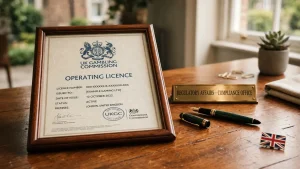
The distinction matters because a casino’s licence is not a decorative badge. It identifies the regulatory system under which the operator is permitted to provide gambling services. A UK Gambling Commission licence is the relevant authorisation for operators serving customers in England, Scotland and Wales. A licence issued elsewhere does not become a British licence because the site accepts a British customer, nor because its marketing calls it American.
That does not mean the player’s position mirrors the operator’s. British law places the licensing obligation on the company offering the gambling. Playing at a casino licensed outside the UK is not, in itself, illegal for a British player. The Gambling Act does not create a criminal offence for an individual merely for placing a bet with an overseas operator. The legal line falls on the supply of the service, not on the act of a person choosing to use it.
Gibraltar Casino Licence and UK Legal Status
This separation can seem counterintuitive. The same transaction may involve an operator that is not permitted to offer gambling in Britain and a player who is not committing a crime by placing a bet there. There is no contradiction once the roles are kept distinct: one party is conducting a regulated business; the other is taking part in gambling. The licensing rule governs the former.
The wording “USA casinos for UK players” therefore brings together two different ideas. “USA” is a description used by a site or by the market around it. “For UK players” describes the intended or accepted audience. Neither phrase, on its own, says that the operator has permission to serve that audience under British rules. A reader can recognise the category being advertised without treating the advertisement as evidence of authorisation.
The phrase also carries a cultural suggestion. American casino imagery has become a shorthand for scale, spectacle and a particular kind of entertainment, even when a website’s legal identity lies elsewhere. Online, that atmosphere can be assembled from a name, graphics and a few familiar references. Geography becomes part of the performance. The regulator’s records, by contrast, are not a matter of atmosphere.
A careful description keeps these layers apart: branding, where a company is licensed, and whether it is authorised to offer gambling in Britain. In this market, a foreign or offshore casino means an operator accepting British customers without a UK Gambling Commission licence. That definition does not depend on whether the site calls itself American, nor does it imply that the player has committed an offence by using it. It describes the operator’s place outside the British licensing framework.
The Label vs Licence
A name or theme evoking the USA does not establish legal permission to operate in the British market; only a UK Gambling Commission licence does.
The distinction is modest in wording and substantial in consequence. A name can evoke a country; only the relevant licence establishes permission to operate in the British market. The label is not the licence.
Access is not the same as authorisation
A casino website appearing on a screen in Britain proves only that the page can be reached. It does not establish that its operator has the right to accept British customers. The distinction is easy to miss because the internet presents access as a simple fact: a page loads, an account form appears, perhaps a game opens. Regulation is less visible. It concerns the operator’s permission to provide gambling facilities, not the player’s ability to find a website.
For an operator selling remote gambling to customers in Great Britain, a licence from the UK Gambling Commission is required regardless of where the business is based. A site may be described as American, or may use imagery that suggests a United States connection, but neither its branding nor its location changes that rule. A US casino site open to a British visitor is not thereby authorised to serve that visitor. The relevant question is whether the operator holds the British licence required for this market.
That makes “open” an ambiguous word. A site can be technically open while being outside the legal framework for offering gambling in Britain. It can also display pages to people in the country without having obtained the right to provide gambling facilities to them. The browser measures connection, not permission. A welcoming homepage is not a regulatory document.
Merkur Casino Online in the UK: Games and Rules
Why a site may still load
Some overseas casinos are supposed to prevent access from Britain, even though the practical effect of those restrictions can be uneven. Gambling.com has reported that some non-UK-licensed sites do not enforce such blocks, and that users can get around them with a basic VPN. This is a report about access controls, not evidence that the sites are entitled to accept British customers. Nor should it be read as a dependable description of every operator: blocking practices can change.
A VPN can alter how a connection appears to a website. It cannot confer a Gambling Commission licence, change the law governing the operator, or turn a prohibited service into an authorised one. The technical route and the legal status remain separate matters. A door that has not been locked is not the same as an invitation issued by the regulator.
The language around USA casinos for UK players can blur these distinctions. A site may be reachable from Britain, may accept registration details, or may present itself as international. Those features describe what its systems allow at a particular moment. They do not answer whether the operator may lawfully provide gambling services to customers in the country. “Can register” and “is authorised” belong to different categories.
That difference matters because a platform’s own design is not a reliable guide to its legal standing. Interfaces are built to make participation feel ordinary: buttons are labelled, forms are ready, games are visible. The legal boundary is not necessarily reflected in the layout. A site can look entirely available while its operator remains outside the British licensing system.
Access and Authorization
Technical reachability of a website (even via VPN) is not evidence that an operator is authorized to provide gambling services to British customers.
The restriction is on the operator
Under the British framework, the legal restriction falls on the business offering the service. An operator without the required UKGC licence cannot lawfully provide gambling facilities to customers in England, Scotland and Wales. It is also not permitted to advertise its services in the UK. These are related restrictions, but they are not interchangeable: advertising is one way of promoting an operation; accepting customers is the provision of the gambling service itself.
The distinction explains why a site’s presence online does not settle the question. A foreign operator may have a website accessible to British users, but that does not give it a right to target or serve the British market. In the same way, an advert or promotional message does not become lawful merely because the operator is based elsewhere. The market being served is what matters.
This is not a technicality about the shape of a web address. Britain regulates the activity of remote gambling offered to people within its market, rather than treating an overseas address as a passport around local rules. “USA casino” may describe a brand, a theme or a claimed origin. It is not a category of British authorisation.
There is a dry little irony here: the internet can make a foreign service feel closer than a local shop, while leaving the operator beyond the local regulator’s reach. Visibility encourages the impression of availability; availability encourages the impression of legitimacy. Neither impression supplies the missing permission.
So, when an American-branded casino can be opened from Britain, the important fact is not merely that the page loads. Reachability tells little about the operator’s legal right to serve British customers, and a VPN changes neither that right nor the restriction on advertising. The screen shows access. Authorisation is another matter entirely.
Non-UK Regulated Casinos: What UK Rules Cover
The safeguards missing beyond the UKGC perimeter
A casino can have a licence somewhere and still sit outside the system that protects customers in Britain. American casinos accepting UK players, where they do so, are not regulated by the UK Gambling Commission unless they also hold the relevant British licence. An offshore licence is not a substitute for one. That distinction matters most when something goes wrong: the protections attached to a UKGC-regulated operator cannot simply be assumed to travel with the website.
One important difference concerns affordability. UKGC-licensed operators must follow rules intended to identify and respond to signs that gambling may be causing financial harm. Offshore operators are not subject to UKGC-mandated affordability checks. The absence of those checks may make opening or continuing an account feel less obstructed, but it also removes a point at which an operator in the British system is expected to consider whether a customer’s spending is sustainable. Friction can be protective. It rarely advertises itself that way.
That is not a claim that every offshore site ignores player welfare, or that every licensed British operator applies the rules perfectly. It is a difference in regulatory obligation. A company operating beyond the UKGC’s authority is not answerable to the Commission for compliance with its requirements. The British regulator cannot use its licensing powers to supervise that company as it would an operator licensed to serve the local market.
The practical consequences become clearer when a dispute concerns money. A report by gambling.com describes cases in which unlicensed sites refused to pay customers’ winnings, leaving those customers without legal recourse. That is a reported risk, not a statement that every foreign casino behaves this way. But the difficulty is structural: when an operator is outside the UK regulatory system, the familiar route of raising a complaint within that system is not available in the same way. A customer may face the added difficulty of dealing with a company based abroad and subject to another jurisdiction’s rules.
Regulatory Risk
Using offshore casinos means operating outside the UKGC protection framework, leaving players without UK-mandated affordability checks or local legal recourse for payment disputes.
The difference is not merely where a complaint is filed. UKGC oversight gives the British regulator authority over licensed operators serving the market; offshore operators are outside that enforcement relationship. A foreign regulator may exist, and an operator may be licensed offshore, but neither fact turns the UK Gambling Commission into its supervisor. Nor does an offshore licence provide the same route to resolution as a British operating licence. The word “licensed” describes a relationship with a regulator; it does not tell the whole story about which regulator, what rules apply, or what practical remedy is available to a customer in Britain.
This makes the phrase “USA casino site” a poor guide to security. It may describe branding, a theme or a claimed origin. It does not establish that the operator is authorised to serve British customers, and it says nothing by itself about how a payment dispute will be handled. The same caution applies to a polished website, a visible licence badge or confident language about customer care. Presentation is not jurisdiction.
Safe Online Casinos in the UK: Player Protections
There is a human consequence in the way these systems differ. A safeguard is often most noticeable when it interrupts a transaction, asks for an explanation or prevents further activity. In a lightly supervised setting, the experience may feel more permissive. Yet when the relationship turns adversarial—when a withdrawal is challenged, an account is restricted or terms are interpreted against the customer—the balance of power is not necessarily improved by the absence of checks. The operator’s procedures and the law governing it become central, while British regulatory oversight is not there to supply the same backstop.
For anyone comparing US casino sites that appear to accept British customers, the useful question is therefore not simply whether the site opens or whether it displays a licence. The relevant distinction is whether it holds a UK Gambling Commission licence to serve the British market. Without that licence, it operates outside the UKGC protection and enforcement framework, and it does not have to apply UKGC-mandated affordability checks. A claim of robust security or responsible gambling measures may describe the operator’s own policies, but it is not the same as a duty imposed and enforced by the British regulator.
The gap is easy to miss while everything is working. It is the dispute, the unaffordable pattern or the denied payout that reveals what oversight was absent. A licence elsewhere may establish that some authority has issued permission under its own rules. It does not recreate the safeguards of the UKGC perimeter.
Deposits, withdrawals and the time money takes
A payment method can make a foreign casino appear quicker or slower before the games have even entered the picture. For a British customer, the useful distinction is between the casino’s own handling of a withdrawal and the time the payment network takes to deliver it. Those are separate parts of the journey, and a short advertised processing time does not describe the whole route.
E-wallets (Skrill, Neteller)
Reported as the quickest options, with most transactions cleared within 24 hours and many in under 12 hours.
Bank Transfers
Generally slower, often taking five to seven business days, potentially extended by casino-side processing delays.
E-wallets such as Skrill and Neteller are reported as the quickest withdrawal option at many foreign casinos. A specialist review of these services describes most transactions as being cleared within 24 hours, with many processed in under 12 hours. That is a comparison of processing times, not a promise that every casino will release every withdrawal on the same schedule. It also does not establish that a site is trustworthy: speed tells little about the standards behind an operator or the remedies available if a payment is disputed.
Bank transfer is the slower route in the account given by a specialist review. Transfers often take five to seven business days, and some casinos add their own processing delay before the bank’s timeline begins. The distinction matters. A casino may have completed its part while the money is still moving through banking systems; equally, a casino-side pause can extend the wait before that journey starts. The calendar does not belong to one institution.
That difference can shape the appeal of a site described as offering fast payouts. An e-wallet may shorten the stated wait compared with a bank transfer, but the word “fast” is incomplete unless it is clear which stage is being measured. A payment that clears quickly at the operator’s end is not necessarily money already available in a bank account. Payment claims are most useful when they identify the method and the point at which the clock starts.
The wider setting should not disappear behind a neat list of payment speeds. A foreign casino accepting British customers without a UK Gambling Commission licence is outside the UKGC regulatory system. E-wallet processing times and bank-transfer estimates do not change that status or provide the protections attached to a UK-licensed operator. A swift transaction is a feature of payment handling, not a badge of regulatory approval.
Trusted UK Casino: Licensing, Checks and Safeguards
There is also a difference between choosing how to receive money and judging whether the underlying arrangement is sound. A method may be quick on paper yet sit within terms that are difficult to assess; another may be slower but familiar to the account holder. These are not equivalent measures. Nor does a faster route establish that a casino will handle a disagreement fairly.
For anyone comparing overseas sites, payment information is therefore most useful as a description of the route, not as a verdict on the destination. Skrill and Neteller are reported to clear faster than bank transfers, while bank payments can take longer and may face an additional casino-side delay. The practical trade-off is plain enough. Time is only one part of the price.
What an American label does—and does not—prove
“American casino” sounds like a statement about place. In practice, the phrase alone establishes very little. It does not identify the company operating a site, the jurisdiction that issued its licence or the countries in which that licence allows it to serve customers. A name or theme can suggest a destination; it cannot supply the legal permission.
That distinction matters to British players because gambling regulation follows the operator and the market it serves, not the mood created by a website. Remote operators offering gambling to customers in Great Britain must hold the relevant UK Gambling Commission licence. A licence from elsewhere is not a substitute for that authorisation. Nor does a reference to the United States show that a site is licensed there.
Santeda offers a precise example of how far the label can mislead. The company held a Curaçao licence, but that licence did not permit it to operate in either the UK or the US. The jurisdiction printed beside a licence, then, is not a passport to every market. Permission has borders.
The Santeda Example
Santeda held a Curaçao licence, but this did not permit the company to operate in either the UK or the US, demonstrating that a licence from one jurisdiction is not a passport to all markets.
This is a small but consequential distinction. A player comparing American casino sites for UK customers may encounter language that sounds geographically definite, while the legal position depends on the operator’s actual authorisation. “American” might be used as a theme or a description, but neither interpretation tells whether the operator may lawfully offer gambling in Britain. The same caution applies to reviews: a favourable account of a site’s games or interface cannot, by itself, establish where the operator is authorised.
The label also cannot settle questions implied by phrases such as “no verification” or “no wagering”. Those are claims about an operator’s procedures or particular promotion, not consequences of being American. Without reliable, operator-specific terms, the label proves neither that identity checks are absent nor that a bonus can be withdrawn without conditions. Geography is a poor substitute for the small print.
There is a cultural habit behind the appeal of national labels: people use a familiar place-name as shorthand for an imagined style, scale or identity. Casinos are no exception. But the shorthand becomes dangerous when it is allowed to do the work of a licence. A site can look American, call itself American, or be discussed as an American option for British players without that description establishing its legal status in either country.
For the UK market, the useful question is not whether a casino sounds American. It is whether the operator holds the permission required to serve British customers. Offshore casinos sit outside UKGC regulation; a foreign licence does not bring them within the Commission’s system. Santeda’s Curaçao licence makes the point unusually plainly: one licence, two markets in which it did not authorise operation. The label is not the licence.
Casino Without a Swedish Licence: UK Player Guide
Small deposits still call for basic checks
A low starting deposit can make an unfamiliar casino feel like a modest experiment. The size of the first payment, however, says little about what happens when personal details are checked or a withdrawal is requested. Choosing a payment route is only one part of the decision.
Before accepting a deposit, a gambling operator must verify a customer’s age. Identity details matter too: names and other information supplied during registration may later need to be supported with identification. A mismatch can turn a small initial payment into an avoidable obstacle when account checks take place. The practical order is simple: establish what information is required, make sure it can be provided, then consider whether the available deposit method is suitable.
Payment choice should not be mistaken for proof of authorisation. Some overseas sites accept British customers without a UK Gambling Commission licence; in that case they are outside the UKGC’s regulatory system. A US-themed name or a small deposit threshold does not change that position. Nor does the presence of a familiar payment route.
Some non-UK licensed casinos accept cryptocurrency as a deposit option, alongside other methods. The useful question is not whether a method sounds modern, but whether its terms, handling and risks are understood before money is sent. A deposit method cannot settle a dispute about an account, and it cannot supply the protections that come with a UKGC-licensed operator.
The distinction is especially important for affordability. Offshore casinos are not subject to UKGC-mandated affordability checks. A low initial payment is therefore no substitute for the checks and limits that form part of the British regulatory framework. That absence is not a feature of a smaller deposit; it is part of the wider difference between a locally licensed service and an offshore one.
Attention: A low initial deposit threshold is not a substitute for the affordability checks and limits enforced within the British regulatory framework.
Caution begins before the payment screen. The operator’s licence status, the details required for verification and the deposit method are separate questions, even when a site presents them as one smooth registration. A careful choice keeps them separate. Small sums can still lead into a large uncertainty.
Bonus size is only half the story
A welcome offer can look generous when described as a match on a deposit, but the headline does not say how much betting stands between bonus funds and a withdrawal. A specialist review describes foreign casinos as offering larger welcome packages, linking that to their freedom from UK Gambling Commission restrictions on bonus terms and promotional language. That is a reported comparison, not a promise attached to every offer.
The formats commonly described in specialist reviews include deposit matches, free-spins packages, no-deposit bonuses and cashback. A deposit match adds bonus funds in relation to a qualifying deposit; free spins provide turns on selected games, while cashback returns a stated portion of eligible losses. A no-deposit offer does not require an initial deposit, but its conditions still matter. The label alone reveals little about what can eventually be withdrawn.
Wagering requirements are the less decorative part. They specify how much must be staked on qualifying bets before bonus funds can be cashed out. A specialist review gives a £20 bonus with a 35x requirement as an illustration: the required qualifying bets total £700. The multiplier applies to the bonus, not the sum of bonus and deposit.
The same review illustrates a 100% match bonus of £100 with a 35x requirement. In that calculation, the bonus must be wagered through £3,500 in bets before it converts to withdrawable cash. The larger number in the promotional banner may therefore be the smaller number in the actual decision.
Malta MGA Licence for UK Online Casinos: What It Means
Other terms can narrow an offer further: which games count, whether winnings are capped, how long the offer remains available, and whether a cash deposit must be used first. These conditions belong to the individual promotion, not to a general rule shared by every operator. A free-spin award, in particular, is not automatically cash; any winnings may carry their own restrictions.
The arithmetic is plain. The qualification is not. A promotional page should be read as a set of conditions, not as a balance already earned. Offshore casinos are not regulated by the UKGC, and they do not provide UKGC-mandated affordability checks. The brighter banner has no power to change either fact.
Fast withdrawals come with conditions
“Instant” and “same-day” describe an advertised target, not necessarily the moment money reaches a bank account. A payout can pass through several stages: the casino approves the request, any pending period expires, identity checks are completed, and the payment provider processes the transfer. A delay at any stage can make the headline speed less meaningful.
The details are operator-specific. Withdrawal limits, pending periods and verification procedures can differ considerably between sites, according to specialist reviews. The terms should therefore be read as part of the withdrawal estimate, not as small print unrelated to it. A site may set a cap on what can be withdrawn at once, hold a request before processing it, or ask for documents before releasing funds. None of those steps is captured by a simple claim of rapid payment.
Bonus Wagering Calculation
Step 1: Identify the bonus
Take a £100 match bonus with a 35x wagering requirement.
Step 2: Apply the multiplier
Multiply the bonus amount by the requirement (£100 × 35).
Step 3: Determine the target
Calculate the total amount of qualifying bets required (£3,500) before the bonus converts to withdrawable cash.
Verification is particularly relevant when an account is new or its details need confirming. An offshore casino may require checks of its own, but it is not regulated by the UK Gambling Commission and does not provide the UKGC’s protection framework. Nor does it have to apply UKGC-mandated affordability checks. Speed is not a substitute for those safeguards.
Crypto can shorten the transfer stage, but it changes the nature of the risk. A specialist review reports that withdrawals at foreign casinos using cryptocurrency can clear in under an hour, faster than fiat methods. That is a reported outcome, not a promise for every operator or transaction. Cryptocurrency values can move while funds are being held or converted, so a quick arrival does not guarantee that the amount will retain its value.
The practical comparison is therefore not simply between fast and slow. It is between the full route to receipt, the conditions attached to release, and the form in which the money arrives. A payout estimate that omits pending time, verification and value fluctuation is only half a timetable.
The interests behind the review
A review is not made independent simply by adopting the language of consumer advice. Its commercial connections matter, particularly when the money behind a recommendation depends on what happens after someone signs up and plays.
The Santeda–SIS arrangement makes that point unusually concrete. Under their contract, SIS received a percentage of revenue from losing bets placed through Santeda’s brands. That is more than a general business association: the payment was linked to losses. It does not, by itself, establish what any particular review said or whether it was fair. It does establish a financial interest that belongs in the picture when the relationship is discussed.
That distinction is useful when reading coverage of casinos presented as American options for people in Britain. A polished description of games, offers or service can look like neutral evaluation, while the commercial arrangement sits elsewhere—in a disclosure, a corporate record or nowhere prominent at all. The connection does not automatically make every statement false. It changes the conditions under which those statements were produced.
UK Online Casino Trustworthiness: Start with the Licence
A careful review therefore needs more than a verdict. It should make clear who benefits if a reader follows its recommendation, and whether that benefit is tied to deposits, play or losses. In the Santeda case, the documented link was to revenue from losing bets. That is a material fact, not a footnote.
Commercial ties are not proof of dishonesty. They are a reason to read praise with the same attention given to the small print. Reviews have interests, too.
Real-money play and the limits of recourse
Money won from gambling is not treated as taxable income in the UK. That remains true whether the operator holds a UK Gambling Commission licence or is based overseas. Tax treatment, however, says nothing about the protections attached to a particular site. A payout may be real money; the route to resolving a dispute is another matter.
Self-exclusion makes that distinction especially important. GamStop covers every UKGC-licensed gambling operator. Once someone has registered with the scheme, they are excluded from all UK-licensed sites. A casino operating outside the Commission’s remit is not part of GamStop, so the exclusion does not automatically follow a person there.
That gap is not a technicality. Someone seeking USA casinos that pay real money to UK players may encounter a site where registration and deposits remain possible despite a GamStop exclusion. Specialist reviews have described this as a practical risk, but the central point is structural: foreign casinos are outside the scheme, not exceptions within it. They also do not provide the UKGC-mandated affordability checks.
Casino Sites Not Registered with GamStop in the UK
GamStop is designed to create a barrier across the UK-licensed market. It cannot create the same barrier at operators beyond that market’s reach. For someone who self-excluded because gambling had become difficult to control, the ease of opening an account elsewhere can undo a deliberate safeguard at precisely the moment it is needed.
The tax position may be simple. The protections are not universal.
Can I play at a casino licensed outside the UK?
Yes. UK law does not make it a criminal offence for an individual to bet with an overseas casino, although the operator may be acting illegally if it offers gambling to customers in Great Britain without a UK Gambling Commission licence.
Are foreign casinos safe for UK players to use?
There is no blanket assurance of safety: foreign casinos are outside the UK Gambling Commission’s oversight, and some unlicensed sites have refused to pay winnings, leaving customers with no legal recourse. Security measures and licences from other authorities do not provide the same UK protections.
Can I use cryptocurrency at foreign casinos from the UK?
Yes, some foreign casinos offer crypto payment options. Crypto withdrawals can clear in under an hour, but the value can fluctuate.
What is the fastest way to withdraw from an online casino in the UK?
E-wallets are generally the fastest option at UK-market operators, with most processing withdrawals within 24 hours. UKGC-licensed operators must verify your identity before processing a withdrawal.
Is playing at an international casino legal for UK residents?
Yes. A UK resident does not commit a criminal offence simply by playing at an overseas casino, but an operator without a UK Gambling Commission licence may not legally offer gambling to customers in Great Britain.
Are bonuses at foreign casinos actually better than at UKGC-licensed sites?
Foreign casinos often advertise larger welcome bonuses because they are not subject to UKGC restrictions on bonus terms and promotions. Check the wagering requirements carefully: a larger bonus can still require substantial betting before funds are withdrawable.
Is it legal for UK residents to use casino sites that operate outside the UK’s licensing framework?
Yes, using such a site is not itself a criminal offence for a UK resident. The licensing obligation is on the operator, which must hold a UK Gambling Commission licence to offer gambling to customers in England, Scotland and Wales.
Safety

Anjouan Casino Licence in the UK: What It Means
An Anjouan authorisation applies under its own jurisdiction and does not by itself permit an...

Best foreign casinos for UK players: what to know
The label refers to accepting British customers without a UK Gambling Commission licence, not simply...

International Casinos for UK Players: Licensing
Understand how UK authorisation differs from overseas access, and why bonuses, withdrawals and player safeguards...

Offshore Casino Sites for UK Players: Rules and Risks
The guide examines licensing, business relationships, bonus terms, crypto withdrawals and safeguards beyond a site's...

Offshore casinos for UK players: risks and rules
Offshore sites may accept British visitors, but access does not mean authorisation or the safeguards...

British Casinos Not on GamStop: What It Means
GamStop applies to UK-licensed operators, so a site's regulatory status affects whether a registered self-exclusion...

Casino Sites Not Registered with GamStop in the UK
GamStop blocks registered UK residents from gambling at UKGC-licensed online casinos, but does not cover...

Casino Without a Swedish Licence: UK Player Guide
A foreign licence is not a UKGC licence, and a casino’s location does not determine...

Casinos That Bypass GamStop: What UK Players Should Know
GamStop applies to UKGC-licensed operators; access beyond that system does not carry the same regulatory...

Curacao Casino Licence in the UK: What It Means
A Curaçao licence identifies a jurisdiction, but does not establish UK regulation, customer access or...

Gibraltar Casino Licence and UK Legal Status
A Gibraltar link identifies an operator’s declared regulatory setting, but does not determine its UK...

Merkur Casino Online in the UK: Games and Rules
Merkur titles are products in an operator’s changing catalogue, while the casino platform is responsible...
UK Online Casino Trustworthiness: Start with the Licence
Trust depends on verifiable UK licensing and how operators handle safeguards, terms, payments and withdrawals....

Non-GAMSTOP Casinos in the UK: What It Means
A site's absence from Gamban does not establish whether GAMSTOP applies or whether the casino...

Non-GamStop Curaçao Casinos and UK Oversight
The article separates offshore licensing claims from UK authorisation and explains why exclusion status and...

Non-GamStop European Casinos: UK Rules
A casino’s location, branding and audience do not determine whether its UK-facing operations fall within...

Non-UK Licence Casinos: How Overseas Regulation Works
The issuing authority shapes oversight and complaint options, so an overseas licence is not equivalent...

Non-UK-Registered Casinos: Licensing Explained
The guide separates a casino’s business location from its gambling regulator and examines the practical...

Non-UK Regulated Casinos: What UK Rules Cover
UK licensing depends on serving customers in Great Britain, while offshore permissions and safeguards vary...

Non-UKGC Licensed Casinos: UK Rules and Risks
The distinction between an operator’s UK licensing duty and an individual’s position shapes the risks...

Malta MGA Licence for UK Online Casinos: What It Means
A Malta licence regulates an operator in Malta, while real-money offers to Great Britain require...

Online Casinos With No Sister Sites in the UK
Shared ownership or technology can shape casino features, but familiar games, layouts and promotions are...

Online slots not on GamStop: what to know
GamStop blocks access at participating UKGC-licensed casinos; mobile play and unfamiliar offers do not change...

Safe Online Casinos in the UK: Player Protections
A practical guide to licensing, gambling limits, payments, bonus terms and security, without treating a...

Trusted Casinos Not on GamStop UK: What to Check
The guide weighs licensing, player protections, payments and promotional terms at casinos operating outside the...

Trusted UK Casino: Licensing, Checks and Safeguards
Licensing, identity checks, public records and payment terms help explain what can—and cannot—be verified about...

VPN-Friendly Casinos UK: Access, Licensing and Risk
A casino accepting VPN connections does not necessarily hold a UK licence or offer the...