
Gibraltar Casino Licence and UK Legal Status
 Available in GB

A Gibraltar link identifies an operator’s declared regulatory setting, but does not determine its UK status, safeguards or available recourse.
What “Best” Means When the Licence Is Outside the UK
The word “best” tends to make a crowded market sound orderly. It suggests that a row of casino sites can be measured against one clean scale, then placed from first to last. For a Gibraltar-linked casino considered by someone in Britain, that confidence is misplaced. A jurisdiction named beside a site is not, by itself, a measure of how closely its conduct is supervised or what recourse a player has when something goes wrong.
A more useful assessment begins with the nature of the oversight. The important question is not simply whether a site displays a licence, but which authority issued it and what that authority’s role means in practice. A Gibraltar connection may be relevant to understanding an operator’s declared regulatory setting; it does not settle the quality of its safeguards. A label can identify a place. It cannot do the work of scrutiny.
That distinction matters because non-UK-regulated casinos may apply less demanding standards for responsible gambling and data protection than operators licensed by the UK Gambling Commission. Those are not decorative differences. Responsible-gambling provisions shape what protections are built into the service; data rules affect how personal information is handled. The details deserve attention before any claim of quality, particularly when a site’s presentation makes its location seem like a substitute for evidence.
For a UK-focused look at Gibraltar casino licensing in 2026, the listed payout timeframe is one practical detail to consider. Check each operator’s licensing information separately before choosing where to play.
1. SlotoSport
Payout speed: 1-3 business days SlotoSport lists a payout speed of 1–3 business days.
2. NightLuck
Payout speed: 1-3 business days NightLuck lists a payout speed of 1–3 business days.
3. Britsino
Payout speed: 1-3 business days Britsino lists a payout speed of 1–3 business days.
4. Dieselwin
Payout speed: 1-3 business days Dieselwin lists a payout speed of 1–3 business days.
5. SpinFormula
Payout speed: 1-3 business days SpinFormula lists a payout speed of 1–3 business days.
6. Revery Play
Payout speed: 1-3 business days Revery Play lists a payout speed of 1–3 business days.
7. Amunbet
Payout speed: 1-3 business days Amunbet lists a payout speed of 1–3 business days.
8. Jetsetspins
Payout speed: 1-3 business days Jetsetspins lists a payout speed of 1–3 business days.
9. x3bet
Payout speed: 1-3 business days x3bet lists a payout speed of 1–3 business days.
10. NightWin
Payout speed: 1-3 business days NightWin lists a payout speed of 1–3 business days.
There is also a difference between a tool being mentioned and a safeguard being available in a meaningful form. A responsible-gambling page may describe limits or ways to seek help, but the existence of a page alone does not establish how controls work, whether they are mandatory, or what happens when a customer asks for assistance. The standard should be practical: what protections are actually offered, how clearly are they explained, and who can intervene if the operator does not follow its own terms?
Complaints provide another revealing measure. A polished site can make support appear close at hand, yet customer service and independent redress are not the same thing. An internal response comes from the business whose decision is being challenged. An external route offers a separate point of review. In the UK-regulated system, players have access to established protections; when gambling at an offshore casino, they forfeit access to the UK’s Financial Ombudsman Service and to mandatory responsible-gambling tools. That absence changes the weight of every promise made on a site.
The strongest assessment therefore looks past the reassuring language and asks what happens at the point of disagreement. Is the complaints process explained in plain terms? Is there an independent body with a defined role, or only the operator’s own support channel? Are the relevant policies easy to find before an account is opened? These are not minor details to be postponed until a dispute. They describe the relationship a casino offers from the start.
Merkur Casino Online in the UK: Games and Rules
Data protection belongs in the same frame. A privacy notice is useful only insofar as it explains what information is collected and how it is handled. The existence of a notice does not prove that protections match those expected under UKGC oversight. Nor does a Gibraltar reference, on its own, tell a customer how information will be treated. Clarity is a sign of seriousness; it is not proof of equivalence.
This is why a list of the best online casinos in Gibraltar cannot be made credible by arranging names beside attractive claims. A ranking would need a consistent basis: the scope of oversight, the substance of safeguards, and the availability of complaint routes. Without those distinctions, “best” risks meaning merely most visible, most confidently advertised, or easiest to describe.
There is no glamour in checking the machinery behind a casino’s claims. Yet that is where the meaningful comparison lies. A jurisdictional label is the beginning of an inquiry, not its answer. Oversight, protection and recourse do the harder work.
Casino Sites and the Limits of the Label
“Gibraltar casino site” sounds like a precise category. In practice, the phrase can carry several meanings, and those meanings should not be mistaken for one another. It may refer to a gambling site described as Gibraltar-linked, to a business associated with the territory, or to a site whose licensing information names Gibraltar. The words alone do not tell which connection is intended.
A "Gibraltar casino site" may refer to a site described as Gibraltar-linked, a business associated with the territory, or a site whose licensing information names Gibraltar.
That distinction matters because a place name in marketing is not the same thing as regulatory oversight. A non-UK-regulated casino is an online gambling site operating without oversight from the UK Gambling Commission. Such sites may be licensed in jurisdictions including Gibraltar, Malta, Curaçao or Anjouan. The jurisdiction named in a description therefore identifies a possible licensing context; it does not, by itself, establish that the UK Gambling Commission supervises the site.
The label can also blur the difference between a company and the service it offers. A phrase such as “Gibraltar casino companies” might be read as referring to businesses connected with the territory, while “Gibraltar online casino sites” sounds more like a description of websites or gambling services. Neither phrase, without more, establishes the exact relationship between a company, a site and a licence. One is a broad description; the other is not necessarily a verified credential.
A casino website can present itself in ways that make geography feel like a guarantee. A flag, a place name or a reference to a regulator can lend an air of official certainty. Yet the label is only useful when its meaning is clear. Does it describe where a business is associated, which jurisdiction issued a licence, or simply the audience imagined by the marketing? Those are different claims, even when they appear in the same paragraph.
The same caution applies to searches for online slots connected with Gibraltar. Slots are games offered through a site; their presence does not establish where the site is licensed, who oversees it, or whether a geographic label describes the operator or the service. “Gibraltar slot sites” may sound like a neat shelf in a shop, but the phrase can gather together businesses with different regulatory arrangements. The games themselves do not settle the question.
UK Online Casino Trustworthiness: Start with the Licence
This is not merely a matter of wording. Gambling regulation is organised by jurisdiction, while the internet encourages people to think in terms of a single, borderless storefront. A site can be visible from one country and describe itself by reference to another. The screen compresses those distinctions into a logo, a footer or a few lines of promotional copy. The underlying arrangements remain separate.
For that reason, a territorial label is a starting point for identifying what a site claims, not a substitute for identifying what the claim means. The word “licensed” should be read as a specific assertion about oversight in a named jurisdiction, rather than as a general badge of approval everywhere. Equally, a reference to Gibraltar should not be expanded into a claim about UK oversight unless the site’s regulatory position actually says so. A place is not a passport.
The distinction is especially easy to lose when phrases such as “online casino companies in Gibraltar” and “casino sites in Gibraltar” are treated as interchangeable. A company may be discussed as a business entity; a casino site is the service through which gambling is offered. A marketing description may link either to a territory without making the nature of that link plain. Clear language matters because a reader cannot infer regulatory supervision from a geographic association alone.
The label, then, has a modest but real use: it signals that Gibraltar may be relevant to the site’s claimed identity or licensing context. It cannot establish, unaided, who is responsible for the service or which regulator oversees it. The distinction is less dramatic than a banner suggests. It is also the distinction that keeps a location from being mistaken for a guarantee.
Do
- Treat a territorial label as a starting point for inquiry
- Read “licensed” as a specific assertion about oversight in a named jurisdiction
Don’t
- Use a geographic label as a substitute for identifying what a claim means
- Expand a reference to Gibraltar into a claim about UK oversight without verification
Gibraltar Casinos and the UK Legal Boundary
A Gibraltar licence and permission to serve customers in Great Britain are different things. The first concerns the operator’s authorisation in Gibraltar; the second depends on the rules governing the market in which gambling services are supplied. A Gibraltar online casino does not acquire the right to serve British customers simply by holding a licence issued there.
Under the Gambling Act 2005, the regulatory focus falls on operators supplying gambling services into the British market. Operators serving customers in Great Britain must hold a UK Gambling Commission licence, regardless of where their business is based. Moving an office, registering a company or obtaining a Gibraltar online gambling licence does not remove that requirement.
The distinction is easy to blur because a website may be available from Britain while being licensed elsewhere. Availability is not authorisation. Nor does the word “Gibraltar” in a casino’s description settle whether the operator has the UK permission required to serve customers in Great Britain. The relevant question is not merely where a licence was issued, but whether the operator holds the licence required for the market it is addressing.
The boundary is directed at businesses, not framed as a criminal prohibition on individual players. UK law does not explicitly forbid British citizens from using gambling services licensed in other countries, and a person who gambles on an unlicensed site does not commit a criminal offence under UK law. That does not make the service lawful for the operator to provide into Great Britain. The two positions can coexist: the provider may be acting outside the licensing rules, while the player is not thereby committing the same offence.
Casino Without a Swedish Licence: UK Player Guide
That separation matters in practical terms. A customer’s presence in Britain does not turn an overseas licence into a UK licence, and the player’s lack of criminal liability does not confer regulatory approval on the site. The legal burden described by the Act rests on the operator supplying the service. A label such as “Gibraltar casino” identifies, at most, a claimed connection to another licensing jurisdiction; it cannot answer the separate question of UK authorisation.
The scope also requires care. The Gambling Act 2005 governs England, Wales and Scotland, but not Northern Ireland. “Great Britain” therefore has a specific meaning in this context and should not be casually exchanged for “the UK” when describing the licensing rule. The country’s regulatory boundary is drawn around the supply of gambling services, not simply the nationality of a customer or the location displayed on a casino’s website.
For anyone assessing a Gibraltar casino licence in 2026, the legal distinction is therefore plain, if not especially convenient: an overseas licence may exist, yet it does not substitute for the UK Gambling Commission licence required of an operator serving Great Britain. The player’s position under criminal law is separate from the operator’s obligation. Different sides of the same transaction.
A Licence Is a Framework, Not a Guarantee
A licence is often treated as if it were a certificate of character. It is not. It identifies a regulatory framework under which an operator is authorised; it does not, by itself, promise that every transaction will be smooth or every decision will favour a player. The distinction matters when the licence named is Gibraltar’s rather than the one required for the British market.
Regulatory Difference
A Gibraltar casino licence is not a UK Gambling Commission licence and does not grant an operator the right to serve customers in Great Britain.
Gibraltar is among the jurisdictions that license non-UK-regulated casinos, alongside Malta, Curaçao and Anjouan. That tells something about the operator’s regulatory setting, but not everything a British customer might assume from the word “licensed”. A Gibraltar casino licence is not a UK Gambling Commission licence by another name. The two belong to different systems, and the existence of one does not establish the presence of the other.
This is where the language of assurance tends to outrun the facts. “Licensed” can sound like a universal endorsement, as though a single seal followed a business wherever it travelled. In practice, a licence is tied to the jurisdiction and market for which it applies. A Gibraltar online casino licence may indicate that an operator is licensed in Gibraltar; it cannot stand in for the separate authorisation required to serve customers in Great Britain.
That distinction is not a technical footnote. Operators serving customers in Great Britain must hold a UK Gambling Commission licence, wherever their business is based. The British requirement follows the market served, not the address on a company’s paperwork. A foreign licence therefore cannot be read as evidence that the operator has met the UKGC’s requirements for serving that market.
Online Casinos With No Sister Sites in the UK
Nor should a jurisdiction’s name be mistaken for a complete description of a site. “Online casinos licensed in Gibraltar” describes a licensing connection, not a guarantee about every part of the customer experience. The licence alone does not establish how a particular operator will handle a specific situation, and it does not convert a claim in marketing into UKGC oversight.
The more useful question is not whether a casino has a licence in the abstract, but what that licence applies to. The answer depends on the regulator and the market in question. For a service directed at Great Britain, the relevant distinction is plain: a Gibraltar licence and a UKGC licence are not interchangeable credentials.
A framework, not a halo.
Gibraltar in the Wider Offshore Casino Landscape
Gibraltar appears in the same familiar roll-call as Malta, Curaçao and Anjouan: jurisdictions associated with casinos operating outside UK Gambling Commission oversight. That association is useful as a map, but not as a verdict. A place name identifies a licensing connection; it does not, by itself, explain what standards apply, how complaints are handled or what happens to player funds if an operator fails.
Curacao Casino Licence in the UK: What It Means
The phrase “online casinos in Gibraltar” can therefore cover businesses with different regulatory arrangements and different relationships to the territory. A Gibraltar connection should not be treated as a complete description of a casino’s oversight. Nor does the shared category of non-UK-regulated casino make Gibraltar and Anjouan equivalent. The jurisdiction behind a licence matters because its rules determine what an operator is required to do, and what the regulator is equipped to do when something goes wrong.
Anjouan offers a particularly clear contrast because its framework has stated limits. It does not require casinos to arrange independent testing of random number generators, conduct audits, or keep player funds segregated from company money. If an operator fails, customers are unsecured creditors rather than holders of protected, ring-fenced funds. That is a material distinction, not a technical footnote: the legal status of money in a company’s accounts can become painfully practical when the company cannot pay.
Gibraltar
Associated with casinos operating outside UKGC oversight; specific rules determine oversight and complaint handling.
Anjouan
Does not require independent RNG testing, audits, or segregation of player funds; no authority-led complaint resolution.
Malta & Curaçao
Other jurisdictions commonly associated with non-UK-regulated casinos operating in the offshore landscape.
The Anjouan authority also does not take up individual player disputes to investigate, mediate or decide them. Its framework does require operators to answer complaints within thirty calendar days, but an answer from the business is not the same thing as independent adjudication. The distinction is easy to blur in promotional language, where “licensed” can sound like a promise of help. It is not the same promise everywhere.
This does not establish that every Gibraltar-linked casino offers a particular level of protection, or that every Anjouan-licensed operator behaves alike. It does establish why licences should be compared by their actual requirements and remedies, rather than grouped under the broad word “offshore”. The same caution applies to labels such as “top online casinos in Gibraltar” or “new online casinos in Gibraltar”: prominence, novelty and geography do not tell the whole regulatory story.
A Gibraltar address may carry a different meaning from an Anjouan licence, but the comparison cannot be completed from the place name alone. The relevant questions concern the rules attached to the licence and the routes available when those rules are disputed. Against Anjouan’s explicit omissions—no mandated audits, testing or fund segregation, and no authority-led complaint resolution—any claim about another jurisdiction needs to be tied to its own published framework, not borrowed from reputation.
Jurisdictions are not interchangeable. That is the point.
Online Casino Access Does Not Travel with a Licence
A casino’s licence belongs to a regulatory arrangement, not to the person who opens its website. A Gibraltar connection, or a description suggesting an online casino based there, does not by itself place the site inside Britain’s self-exclusion system. The same distinction applies to casinos operating under other overseas licences: location and licensing do not automatically bring a business into GamStop.
Safe Online Casinos in the UK: Player Protections
GamStop is the UK Gambling Commission’s self-exclusion scheme. Casinos not on GamStop are outside that scheme, so registering with it does not mean every gambling website will recognise the exclusion. A site’s appearance in a search, or its readiness to accept an account, is not evidence that it has joined the scheme. Access and exclusion are separate matters.
That separation can be hard to see because websites are designed to make borders feel incidental. A familiar language, sterling prices or a Gibraltar reference may suggest a connection with the British market. None of those details establishes participation in GamStop. The scheme’s reach depends on whether the operator is part of it, not on how close the site looks to home.
An Anjouan casino licence makes the boundary clearer still. It does not authorise an operator to serve customers in the United Kingdom. An Anjouan licence is therefore not a substitute for the permission required to operate in the British market, nor does it make a casino part of a UK exclusion scheme. The names of jurisdictions may travel easily across a website; their authority does not.
This matters because self-exclusion is a practical barrier, not merely a declaration of intent. Where a site is outside GamStop, the exclusion cannot be assumed to apply there. A casino promoted as a Gibraltar online option may be subject to a different arrangement, or may have no connection to the scheme at all. The label alone settles nothing.
The quieter lesson is that access is not proof of status. A site loading successfully says only that the page can be reached; it does not establish that its licence permits UK operations or that an existing self-exclusion will be honoured. Those are distinct questions, and conflating them turns a useful safeguard into a word on a screen. Dry distinction, serious consequence.
Attention: Registering with GamStop does not guarantee that every gambling website will recognise the exclusion, especially sites operating outside the UKGC scheme.
New Casino Sites and the Cost of Uncertainty
A newly encountered casino operating under a Gibraltar-linked label can look settled before its track record has had time to form. A polished site and a licence claim may say little about how a particular operator handles an account when a withdrawal is requested. With a recent arrival, there is less history against which to judge the routine promises: whether verification is proportionate, whether explanations stay consistent, and whether a payment actually arrives when expected.
Identity checks are a normal part of online gambling, but their timing and demands matter. A specialist review has reported cases in which offshore operators sought notarised documents or video calls before releasing withdrawals. That is a report about particular cases, not a standard feature of every site. Still, such demands illustrate how verification can become burdensome after money is already in an account. For a new operator, limited public experience makes it harder to tell in advance whether a request is routine or a warning sign.
Withdrawal estimates deserve similar care. Accounts of non-UK-regulated casinos disagree: some describe payments arriving within 24 hours to 5 business days, while others say a withdrawal can take three or four weeks. These are not interchangeable expectations. The method, checks and operator may affect the result, and an advertised processing time is not the same as a payment received. Where a delay persists, there is no regulatory clock compelling enforcement in the way a UK-regulated service is subject to its regulator’s framework.
International Casinos for UK Players: Licensing
That gap is especially consequential for a site with little operating history. A delay may be temporary; it may also be difficult to resolve when the operator’s procedures are opaque and there is no established record of how complaints are handled. Online accounts tend to make money look immediate: a balance is displayed, a button is pressed, and the transaction appears nearly complete. The difficult part begins when the operator controls the next step.
Caution around new online casinos in Gibraltar is therefore less about novelty as such than about evidence. A recent launch may have few independent accounts to compare, while its withdrawal terms and verification process are still the practical test of its promises. Uncertainty is not proof of misconduct. It is simply a poor substitute for a record.
Real-Money Play: Deposits, Withdrawals and Bonus Terms
The cashier is where an overseas licence becomes a household matter. A site associated with Gibraltar may present familiar options: credit cards, e-wallets, bank transfers and cryptocurrencies, sometimes handled through alternative payment processors. The list of ways to put money in, however, says little by itself about how money can come back out. A deposit route does not guarantee that the same method will be available for withdrawals; the operator may set different conditions for each direction.
That distinction is easy to miss when payment logos sit beside a deposit button. Before funds are sent, the relevant terms are those governing withdrawals: which methods are supported, whether an account must be verified, and whether the operator can impose a cap or process a payment in stages. These conditions can change the practical value of a balance. A large win subject to instalments is not the same as a large win available at once.
Withdrawal and Bonus Caveats
Some non-UK-regulated casinos may impose daily, weekly, or monthly withdrawal limits, requiring large sums to be collected in portions. Additionally, welcome bonuses often carry wagering requirements, such as 35x or more, which restrict access to funds.
A specialist review has reported that some non-UK-regulated casinos set daily, weekly or monthly withdrawal limits, so larger sums may have to be collected in portions. That is a report about some operators, not a rule that applies to every site. The written cashier terms matter more than a general description of the market, particularly where the same account offers several deposit methods but fewer withdrawal choices.
Timing is similarly unsettled. Some accounts describe withdrawals as taking from 24 hours to five business days, depending on the method. Other reports say a payment can take three or four weeks. Those descriptions disagree, and the faster range should not be mistaken for a promise. Verification requests or processing stages can add friction; where the operator is outside UK regulation, there is no UK regulatory clock compelling a payout within a stated period. The uncertainty is part of the cost.
Bonuses belong in the same calculation. An offshore welcome offer may advertise extra funds, but the wagering attached to it determines how much play must occur before withdrawal becomes possible. A specialist review has reported welcome-bonus requirements of 35 times or more. The multiplier alone is not enough: terms may define which funds it applies to, which games count and when the offer expires. These details can turn an apparent addition to a balance into a restriction on accessing it.
A bonus is therefore not cash in the ordinary sense. Its value depends on conditions attached to it, and accepting it can bind a player to rules that would not apply to an unbonused deposit. For real-money slots, the relevant question is not simply whether a promotion exists, but whether its conditions fit the way the account is intended to be used. If the terms are unclear, the uncertainty does not vanish when the offer is accepted.
USA Casinos for UK Players: Access and Licensing
Gibraltar’s name in a site’s presentation cannot settle these payment questions. The cashier, withdrawal rules and bonus terms are operator-level arrangements, not a guarantee supplied by the jurisdiction’s label. Comparing them requires reading the conditions that govern money leaving the account, not merely the routes that make it easy to arrive. The entrance is rarely the difficult part.
What “Top” Can Mean Without a Ranking
“Top” is a small word with a large appetite. It can mean a casino that is widely mentioned, one that appears prominently in a list, or one that has been judged against protections players can rely on. Those meanings are not interchangeable. A name’s visibility is evidence of attention; it is not, by itself, evidence of independent scrutiny.
That distinction matters when people look for the top online casinos in Gibraltar. A site may be associated with Gibraltar in its branding or business arrangements, but that association does not establish that the UK Gambling Commission oversees it. Non-UK-regulated casinos operate outside the Commission’s oversight. A confident label cannot change that institutional fact.
Popularity is especially easy to mistake for quality in online gambling. Repetition gives a name the familiarity of a recommendation: the same operator may appear in reviews, promotional pages and discussions. Yet those appearances may reflect commercial prominence, audience interest or simple availability. They do not necessarily show that protections have been independently assessed, or that a complaint would be handled under UK rules.
Main Conclusions
- Visibility and popularity do not equal independent scrutiny or safety
- “Top” rankings often reflect commercial prominence rather than regulatory strength
- Non-UK-regulated sites lack access to the UK Financial Ombudsman Service and mandatory responsible-gambling tools
The word “top” also conceals the measure being used. A list might reward visibility, game choice or promotional appeal; another might give greater weight to oversight and the support available when something goes wrong. Without a clear and defensible measure, positions on a page are editorial arrangement, not a settled comparison. Numbering them makes the arrangement look more scientific than it is.
The difference is not merely academic. At a casino outside UKGC oversight, players do not have access to the UK Financial Ombudsman Service, and the responsible-gambling tools required under the UK system are not assured. Those are material absences, not footnotes to a popularity contest. A site can be talked about often and still leave a player without the protections attached to a UK-regulated service.
Nor does “Gibraltar” settle the question of what a ranking actually represents. The place named in a site’s description may tell something about its association or claimed licensing context; it cannot, on its own, establish UK regulatory supervision. So “top Gibraltar casino sites” might describe the most visible names in a particular conversation, but it cannot honestly stand as shorthand for the strongest protections unless those protections have been established separately.
This is why a responsible use of “top” needs qualification. It can describe prominence, provided prominence is not dressed up as safety. It can also introduce a comparison, but only where the criteria and evidence support the order. Where those distinctions collapse, a ranked list offers reassurance by typography: first place looks like a finding.
A more useful description is often less grand. “Frequently discussed” says something about attention. “UKGC-regulated” says something specific about oversight. Neither phrase should be made to impersonate the other. A popular non-UK-regulated casino remains outside the Commission’s system, and its prominence does not restore access to UK complaint routes or mandatory tools.
There is no neutral meaning hidden inside “top”. The word borrows authority from whatever follows it. In gambling, that borrowed authority can make a promotional impression sound like a protection. The distinction deserves to remain visible.
Anjouan Casino Licence in the UK: What It Means
Why a Casino’s Base Does Not Settle Its UK Status
A business address can acquire a public life of its own. Gibraltar, small in territory but familiar in international commerce, may appear in a casino’s name, corporate details or account of its operations. That can make the location seem like an explanation: perhaps it says something about how the operator is organised, or why the business chose to be there. But an address is not a business history. Without evidence about a particular company, its reasons for locating there should not be guessed at.
The phrase “Gibraltar-regulated online casino” also carries more weight than geography alone can bear. It points to a regulatory connection, but does not answer every question about the company’s activities in another market. A place of operation and the rules that apply to services offered across a border are separate matters. They can overlap, but one does not automatically replace the other.
For customers in Great Britain, the decisive point is operational rather than scenic or corporate. An operator serving that market must hold a licence from the UK Gambling Commission, wherever its base is. Gibraltar does not create an exception. Nor does a Gibraltar address, by itself, establish that the operator holds the permission required to serve customers in Great Britain.
This distinction is easy to lose when a place name becomes shorthand for a whole regulatory story. A company may be based in Gibraltar; that fact describes location. Whether it can lawfully provide gambling services in Great Britain depends on the relevant UK requirement. The two statements are not alternatives, and the first cannot be used as proof of the second.
So why are online casinos based in Gibraltar? The question invites a neat account of business motives, but location alone cannot supply one. It may be possible to describe a company’s stated reasons where those are documented; it is not sound to infer them from the address. For the UK-facing question, the more modest test is also the more useful one: does the operator serving Great Britain hold the required UKGC licence? A base is a fact about place. It is not a substitute for permission.
Are sites that are not on GamStop legal for players in the UK to access?
Yes, UK law does not explicitly prohibit British players from using gambling services licensed abroad, and players do not commit a criminal offence by gambling on an unlicensed site. However, operators serving customers in Great Britain need a UK Gambling Commission licence.
Are Anjouan casinos connected to the GamStop self-exclusion scheme?
No. Anjouan-licensed casinos are not required to integrate with GAMSTOP.
What payment methods work best at non UK regulated casino sites?
Offshore casinos may accept credit cards, e-wallets, bank transfers and cryptocurrencies, sometimes through alternative processors. Some also allow deposits through a mobile phone bill or prepaid balance.
Are non UK regulated casinos legal for UK players to use?
UK law does not explicitly prohibit British players from using gambling services licensed in other countries, and players do not commit a criminal offence by using an unlicensed site. Operators serving customers in Great Britain, however, require a UK Gambling Commission licence.
Safety

Anjouan Casino Licence in the UK: What It Means
An Anjouan authorisation applies under its own jurisdiction and does not by itself permit an...

Best foreign casinos for UK players: what to know
The label refers to accepting British customers without a UK Gambling Commission licence, not simply...

International Casinos for UK Players: Licensing
Understand how UK authorisation differs from overseas access, and why bonuses, withdrawals and player safeguards...

Offshore Casino Sites for UK Players: Rules and Risks
The guide examines licensing, business relationships, bonus terms, crypto withdrawals and safeguards beyond a site's...

Offshore casinos for UK players: risks and rules
Offshore sites may accept British visitors, but access does not mean authorisation or the safeguards...

British Casinos Not on GamStop: What It Means
GamStop applies to UK-licensed operators, so a site's regulatory status affects whether a registered self-exclusion...

Casino Sites Not Registered with GamStop in the UK
GamStop blocks registered UK residents from gambling at UKGC-licensed online casinos, but does not cover...

Casino Without a Swedish Licence: UK Player Guide
A foreign licence is not a UKGC licence, and a casino’s location does not determine...

Casinos That Bypass GamStop: What UK Players Should Know
GamStop applies to UKGC-licensed operators; access beyond that system does not carry the same regulatory...

Curacao Casino Licence in the UK: What It Means
A Curaçao licence identifies a jurisdiction, but does not establish UK regulation, customer access or...

Merkur Casino Online in the UK: Games and Rules
Merkur titles are products in an operator’s changing catalogue, while the casino platform is responsible...
UK Online Casino Trustworthiness: Start with the Licence
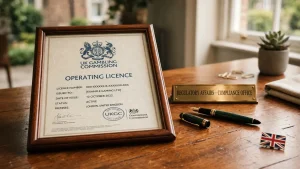
Trust depends on verifiable UK licensing and how operators handle safeguards, terms, payments and withdrawals....

Non-GAMSTOP Casinos in the UK: What It Means
A site's absence from Gamban does not establish whether GAMSTOP applies or whether the casino...

Non-GamStop Curaçao Casinos and UK Oversight
The article separates offshore licensing claims from UK authorisation and explains why exclusion status and...

Non-GamStop European Casinos: UK Rules
A casino’s location, branding and audience do not determine whether its UK-facing operations fall within...

Non-UK Licence Casinos: How Overseas Regulation Works
The issuing authority shapes oversight and complaint options, so an overseas licence is not equivalent...

Non-UK-Registered Casinos: Licensing Explained
The guide separates a casino’s business location from its gambling regulator and examines the practical...

Non-UK Regulated Casinos: What UK Rules Cover
UK licensing depends on serving customers in Great Britain, while offshore permissions and safeguards vary...

Non-UKGC Licensed Casinos: UK Rules and Risks
The distinction between an operator’s UK licensing duty and an individual’s position shapes the risks...

Malta MGA Licence for UK Online Casinos: What It Means
A Malta licence regulates an operator in Malta, while real-money offers to Great Britain require...

Online Casinos With No Sister Sites in the UK
Shared ownership or technology can shape casino features, but familiar games, layouts and promotions are...

Online slots not on GamStop: what to know
GamStop blocks access at participating UKGC-licensed casinos; mobile play and unfamiliar offers do not change...

Safe Online Casinos in the UK: Player Protections
A practical guide to licensing, gambling limits, payments, bonus terms and security, without treating a...

Trusted Casinos Not on GamStop UK: What to Check
The guide weighs licensing, player protections, payments and promotional terms at casinos operating outside the...

Trusted UK Casino: Licensing, Checks and Safeguards
Licensing, identity checks, public records and payment terms help explain what can—and cannot—be verified about...

USA Casinos for UK Players: Access and Licensing
A guide to how licensing, safeguards, payments, bonuses and recourse differ for UK players at...

VPN-Friendly Casinos UK: Access, Licensing and Risk
A casino accepting VPN connections does not necessarily hold a UK licence or offer the...