
Online Bingo in the UK: Cards, Costs and Slots
 Available in GB
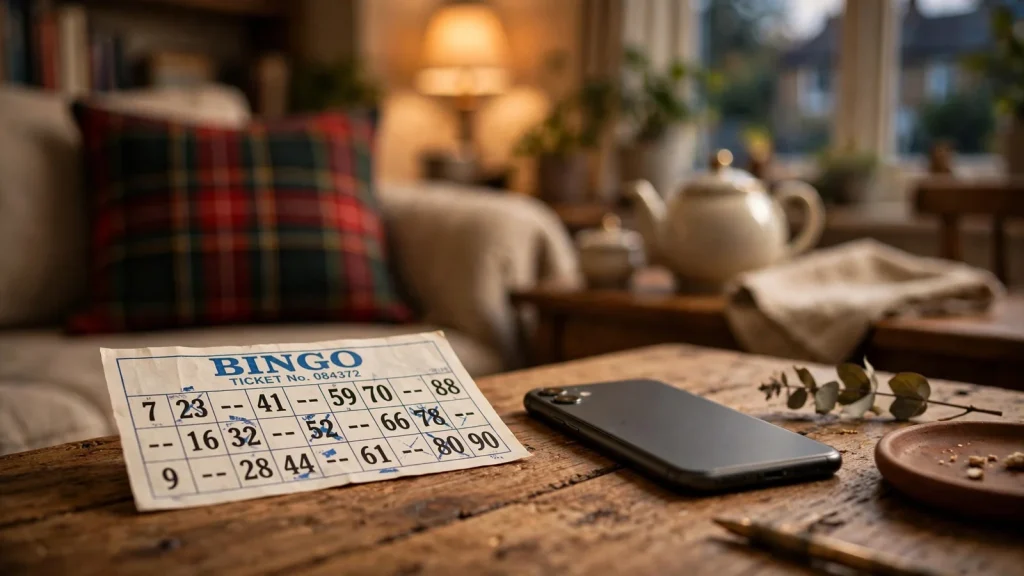
A guide to bingo formats, ticket terms, free-play conditions, mobile limits and the distinction between bingo and slot games.
The bingo card still sets the terms
A bingo game can look familiar before its rules have become clear. Numbers appear, players mark them off, and a pattern decides the winner. But the card is not merely a surface on which numbers happen to land. Its layout determines what can be completed, and the winning conditions give each format its own pace and character. In online bingo, the room may be digital; the card still writes the terms.
The best-known format in Britain is 90-ball bingo. Each ticket is arranged as a grid of nine columns and three rows. A round can pay out at three stages: when a player completes one line, then two lines, and finally a full house. That sequence matters. The game does not reserve all its attention for the last number; it creates smaller moments of arrival on the way there. A line can bring one player into the reckoning, while the full house remains the final prize.
There is something particularly legible about this structure. Rows make progress easy to see, and the successive wins give the room a shared order: first a line, then another, then the complete ticket. The format asks players to follow both their own cards and the changing state of the game. Even on a screen, bingo retains the old public quality of a room in which everyone waits for the same call, though not everyone is waiting for the same milestone.
Choosing an online bingo site in the UK involves more than finding a game: it helps to know what to expect when withdrawing winnings. This list gives a concise reference point for considering payout speed.
1. SlotoSport
Payout speed: 1-3 business days SlotoSport lists a payout speed of 1–3 business days, giving readers a concrete timing detail to consider.
2. NightLuck
Payout speed: 1-3 business days NightLuck lists a payout speed of 1–3 business days. That stated timeframe is the available detail for assessing payouts.
3. Britsino
Payout speed: 1-3 business days Britsino lists a payout speed of 1–3 business days, a useful point to keep in mind when considering withdrawals.
4. Dieselwin
Payout speed: 1-3 business days Dieselwin lists a payout speed of 1–3 business days. This provides a clear reference for its stated payout timing.
5. SpinFormula
Payout speed: 1-3 business days SpinFormula lists a payout speed of 1–3 business days, which offers a specific timing detail for prospective players.
6. Revery Play
Payout speed: 1-3 business days Revery Play lists a payout speed of 1–3 business days. Its stated timing is the available point of note.
7. Amunbet
Payout speed: 1-3 business days Amunbet lists a payout speed of 1–3 business days, giving readers a stated timeframe for payouts.
8. Jetsetspins
Payout speed: 1-3 business days Jetsetspins lists a payout speed of 1–3 business days. This is the available factual detail about its payout timing.
9. x3bet
Payout speed: 1-3 business days x3bet lists a payout speed of 1–3 business days, a concrete detail to consider when looking at withdrawals.
10. NightWin
Payout speed: 1-3 business days NightWin lists a payout speed of 1–3 business days. That timeframe is the available detail for readers weighing payout timing.
Other formats make the pattern itself more prominent. In 80-ball bingo, the ticket has an eight-column by four-row grid, and prizes can be tied to coloured designs: four corners, a letter shape or the full card. The player is not simply chasing a completed row. The relevant shape might occupy a small part of the grid or cover it entirely, so attention shifts from the progress of a line to the geometry of the ticket.
The coloured patterns also change how a card reads at a glance. Four corners form a clear boundary; a letter shape asks the eye to trace a route; a full card makes every marked position count. A round may move more quickly than 90-ball bingo, but its defining difference is not speed alone. The target is drawn on the card in a different way. Numbers are still called, yet the winning task is to build a design rather than finish a row.
That distinction is useful when comparing online bingo and casino-style game menus, where similar-looking tiles can conceal different rules. A label such as “80-ball” tells only part of the story. The pattern determines what counts as progress, and the room’s stated rules determine which completed shape wins. Two games can share a grid and still feel unlike one another if their targets differ. The card is a diagram of the bargain.
Online Casino Games for Real Cash in the UK · Best bonus buy slots UK: demo play and real stakes
75-ball bingo places even more weight on patterns. Its ticket is a five-by-five grid, and a win comes from completing a specified design. That might be a cross, an X, a diamond, a letter T or a picture frame. The named target gives the round its shape before the first number is drawn. A player’s attention moves across the ticket in more than one direction: diagonals matter for an X, while a frame depends on the outer edge.
This makes 75-ball play less about reaching a standard sequence of line-based milestones and more about matching a design. A cross and a diamond may use overlapping parts of a card, but they ask the eye to search differently. The game’s identity lies in that shifting figure: the same grid can feel like a new task when the required pattern changes.
For anyone comparing online casino bingo games, the practical question is therefore not whether one format is universally easier. The format describes a set of rules, not a promise about how a particular round will go. A three-row ticket with staged line prizes offers a different structure from a grid built around coloured shapes or a named pattern. Familiarity may make one layout easier to follow, but it cannot make the numbers arrive in a preferred order.
This is also why the phrases “bingo” and “casino” do not tell the whole story when they appear side by side. The game’s central wager remains a ticket and a pattern: numbers are drawn, and the player’s task is to complete the relevant target before others do. A page may place several kinds of bingo together, but the card is the useful starting point. Its columns, rows and winning shapes explain what the room is asking players to watch.
90-Ball Bingo
Features a grid of nine columns and three rows. Prizes are typically awarded for one line, two lines, and a full house.
80-Ball Bingo
Uses an eight-column by four-row grid. Winning targets are often coloured designs, such as four corners or letter shapes.
75-Ball Bingo
Based on a five-by-five grid. Wins are determined by completing specific named patterns like a cross, diamond, or picture frame.
The mechanics are simple enough to recognise and varied enough not to be interchangeable. 90-ball bingo advances through lines towards a full house; 80-ball bingo sets coloured patterns against a wider grid; 75-ball bingo makes a named shape the goal. The screen can rearrange the surroundings. It cannot change the card’s authority.
When bingo shares the screen with slots
A bingo room and a bank of slot games may sit under the same roof, but they ask for different kinds of attention. Bingo is a contest whose shape is set by a ticket, a sequence of drawn numbers and a pattern to complete before other players do. Slots place the outcome inside each game’s own cycle. The first has a roomful of participants moving through a shared event; the second is more self-contained. Putting them together makes switching easy, not identical.
That contrast helps explain the appeal. A bingo session has a collective tempo: numbers arrive, players follow their tickets, and the result develops in public. Slot play can be entered on its own, without waiting for that room-wide sequence to unfold. For someone moving between the two, the change is not merely from one graphic style to another. It is a change in what holds attention: a shared pattern in bingo, a separate game in the slots lobby.
The distinction is worth keeping visible because a combined menu can make unlike products look like neighbouring variations. They are not. In bingo, the ticket gives the game its terms and the draw supplies the material. Players may be pursuing the same outcome at the same time. A slot game has its own rules and outcome structure; the presence of bingo elsewhere on the site does not make it part of the bingo contest. Shared branding is not shared play.
Online Casinos Without ID in the UK: What It Means · JetX Casino Game in the UK: Slots, Demos and Rules
There is also a social difference, even when bingo is played through a screen. The room gives a player a common point of reference: the draw, the pattern, the moment when a ticket gets closer to a win. Slot play need not supply that same gathering around one event. A site offering both can therefore serve two moods, but it cannot make one mood stand in for the other. One is company organised around a draw; the other can be approached as a succession of individual games.
That variety can be useful in a practical sense. Someone who has finished with a bingo room, or does not want to join one at that moment, may find another form of play on the same platform. Yet convenience can blur the boundary between a pause and a new decision to spend time or money. Moving from one game category to another is still moving into a different wager. The room’s atmosphere does not carry over as a safeguard, and a familiar site does not make every game behave alike.
The financial comparison needs the same care. Return-to-player figures describe a game’s long-run theoretical return, not what an individual session will produce. In comparisons reported about side games, those figures can be lower than the return associated with the bingo room. That is a reason to treat the categories separately, rather than assuming that a slot offered beside bingo inherits the room’s terms. The figures do not promise a result to any one player; they are a way of describing a game over repeated play.
Return-to-player (RTP) figures for side games, such as slots, can be lower than the returns associated with the bingo room.
This is where the joined-up experience has a quiet tension. A single destination can make choice feel seamless, while the underlying products remain distinct in pace, structure and expected return. Seamless is not the same as equivalent. The difference matters most when a player moves on without noticing that the basis of play has changed: the social draw has ended, and a separate game has begun.
The culture of online bingo has long depended on turning individual tickets into a shared occasion. Slots belong to a different tradition of play, one that centres the game itself rather than a room waiting on the same numbers. Their presence alongside bingo says something about how modern gambling sites organise attention: several forms of play are gathered into one interface, even when their rules and rhythms have little in common.
A sensible way to understand bingo and slots online, then, is not as a single blended game but as neighbouring activities. Bingo remains a contest shaped by the draw and by other players pursuing a pattern. Slots remain their own games, with their own outcomes and return characteristics. The convenience of moving between them is real, but it should not disguise the change in what is being played. Familiar surroundings, different wager.
Bingo sites with slots, without the ranking table
A site that brings bingo rooms and slot games under one account is selling a shared setting, not a single game. The distinction matters. Bingo is organised around a room, a draw and tickets bought for a particular game; slots are played separately, with their own rules and outcomes. A common lobby may make both easy to find, but it does not make their terms interchangeable.
Online casino tournaments in the UK: how they work · Low-Volatility Slots in the UK: How They Work
That is the useful starting point when comparing UK bingo sites with slots. The presence of both products says little on its own about how a bingo room works. Each room sets its own schedule, ticket options and purchase rules. A site can look generous at the level of its catalogue while keeping the practical limits inside individual games. The small print is often less glamorous than the lobby. It is also more consequential.
Ticket caps are one such limit. Most bingo rooms restrict how many tickets one player may buy for a game; the cap is commonly somewhere between 10 and 50, with the price of a ticket affecting where it falls. That restriction shapes participation as much as the room’s advertised prize structure. It prevents a player from simply buying an unlimited share of the available cards, and it means that two rooms on the same site may not offer identical terms.
The cap should therefore be read as a room rule, not as a general property of the operator. A low-priced game may set one ceiling, while a more expensive room sets another. The relevant detail is the limit for the particular game being entered. A site-wide description of its bingo offer cannot substitute for that information.
This is also why a broad catalogue is not a reliable measure of fit. A larger selection can mean more choice of rooms and slot titles, but the useful comparison is more specific: whether the bingo format and ticket limit suit the way the game is intended to be played. A player looking for a quiet, low-stakes room has a different practical concern from someone drawn to a busier game. Neither is answered by the number of tiles on a home page.
Ticket caps are room-specific rules. A site-wide description of its bingo offer cannot substitute for the specific limit of the individual game being entered.
The phrase “best bingo sites with slots” tends to make unlike things sound neatly comparable. In practice, the combination is only one part of the picture. The bingo side has its own room-by-room terms; the slot side remains a separate product. An operator’s broad selection does not erase those differences, and the presence of familiar games does not tell much about ticket availability. One has to look past the shared doorway.
For anyone considering new bingo sites with slots, the same distinction applies. A new-looking lobby or recently added product is not itself evidence that every room works in the same way. The essential question is still what the chosen game permits: how many tickets may be bought, and which conditions attach to that room. A fresh coat of interface is not a rulebook.
Mobile access changes the place from which the account is used, not the logic of a bingo room. The relevant comparison is not whether a site advertises mobile play, but whether the room’s terms remain clear when viewed there. Ticket limits still belong to the game, and a compact screen does not make them less important. Claims about the best bingo sites with slots on mobile are therefore less useful than the visible rules for a particular room.
A comparison table can help organise operators, but it cannot decide which room suits a player. That judgement depends on the game selected and its specific terms, especially the ticket cap. The shared catalogue is the invitation; the room rules are the arrangement. A modest distinction. A real one.
Mines Casino Game in the UK: Demos and Licensing · High-Volatility Slots in the UK: How They Work
What a bingo ticket costs—and what it might win
A bingo ticket can cost a penny or several pounds, and the difference is more than a change in the price label. It marks the kind of room being entered, the amount committed to a game and, often, the scale of the prize on offer. In low-stakes rooms, prices can run from 1p to 5p; premium games may charge £1 or more per ticket. Other rooms described as penny games begin at 2p, while high-stakes games can reach £5 or more.
Those ranges overlap because “low stakes” and “premium” are not a single national tariff. Each game sets its own ticket price. A player buying more than one ticket commits the price of each, so the total at risk rises with the number selected. The smallness of an individual ticket can make that accumulation easy to overlook. A penny sounds almost symbolic. A handful of tickets is still a purchase.
The prize pool gives the price its context, but it does not turn a ticket into a promise. A specialist review has described a 1p game offering a £10 full-house prize, and a £1 game with a jackpot in the hundreds or thousands. Those are illustrations from that review, not fixed market terms: prizes change from game to game and over time. The important point is the relationship being presented. A higher-priced ticket may sit in a game with a larger advertised prize, while a low-cost game can still offer a meaningful win.
Ticket price and prize examples
In low-stakes rooms, prices can range from 1p to 5p, with some 1p games offering a £10 full-house prize. Premium games may charge £1 or more per ticket, with jackpots potentially reaching hundreds or thousands of pounds.
That relationship is not a simple exchange rate. The ticket price alone does not reveal the number of people playing, how many tickets are in circulation or what conditions apply to a particular prize. Nor does a large jackpot make a game better value by itself. It is an eye-catching figure, but its size says little about the chance of one ticket winning it. The room’s rules and prize information matter more than the promotional arithmetic.
Bingo has long been a game of pooled attention: many people buy into the same draw, and the prize gives that shared wait a destination. Online rooms preserve that arrangement while making the price visible before play. There is a certain neatness to this—every ticket has a stated cost, while the value of a possible win remains uncertain. The arithmetic is clear. The outcome is not.
For a paid game, the practical comparison is between what one ticket costs and what the player is prepared to spend if buying several. A low price does not mean that repeated purchases are costless; a premium price does not mean that the resulting prize is assured or proportionate. The distinction is plain, though easy to blur when a game advertises a conspicuous jackpot beside a modest ticket price.
Prize figures can also invite the wrong comparison: the largest possible win against the cost of one ticket. That is not the same as comparing the full spend with a likely return. A ticket buys entry into a draw, not a claim on the headline amount. The amount paid is certain; the prize is contingent.
Plinko Casino UK: Licensing, Demos and Payments
So the sensible unit is not the jackpot but the spend on tickets actually bought. Prices begin in pennies and can rise to pounds, while prizes vary with the game. A small stake can still be money at risk, and a large advertised prize remains only a possibility. Dry arithmetic, but useful.
Free bingo tickets come with conditions
A free ticket removes the entry price, not necessarily the small print. Its value depends on where it can be used, when it expires and what happens if it wins. Those terms can turn a simple invitation into a task with a timetable.
A specialist review describes tickets limited to particular rooms or ball types, with some expiring after 24 hours. A separate specialist review reports expiry periods ranging from 24 to 72 hours. These are not interchangeable promises: the offer attached to a particular account sets the deadline. A ticket that cannot be used in the room a player intended to join is free in the narrowest possible sense.
The room restriction matters because bingo offers are often tied to a specific game rather than to the site as a whole. The ticket may apply only to a named room or ball format; it may not be transferable to another session. Expiry then adds a second boundary. The clock can make a ticket seem more valuable than it is, especially if the eligible game is not one the player would otherwise choose.
Nor does a free entry necessarily make its prize money immediately withdrawable. Free tickets cannot be cashed out directly. If one wins, the winnings are credited as cash, but they may carry a wagering requirement, sometimes the same one attached to a deposit bonus. The word “cash” describes how the winnings are credited; it does not, by itself, settle when they can leave the account.
Free-ticket winnings are not always immediately withdrawable and may carry wagering requirements ranging from 20x to 65x.
A specialist review reports wagering requirements for free-ticket winnings ranging from 20x to 65x. The relevant terms need to say what balance the multiple applies to and which games count towards it. Without that detail, a large-looking prize can come with a substantial amount of eligible play still to complete. The exact effect depends on the offer’s wording, not on the ticket’s free label.
This is where free entry and a free withdrawal part company. The ticket can cost nothing to claim, while a win remains subject to conditions. A player deciding whether an offer is worthwhile is therefore weighing more than the chance of a prize: the room, the ball type, the expiry and the treatment of winnings all shape the bargain.
The distinction is easy to miss because the ticket is tangible and the wagering requirement is usually tucked into terms. One appears in the account; the other waits behind the prize. Small print, doing its usual work.
Bingo online in 2026: the rhythm of the room
The technology changes the setting, but not the small social drama at the centre of online bingo. A player buys a ticket; numbers are drawn; a win goes to whoever completes the required pattern before the others. The screen may remove the hall’s tables and the caller’s voice, yet the game still depends on a group moving through the same sequence, waiting for the same next number.
That shared sequence is its own kind of company. Each ticket belongs to an individual, but no one can complete a pattern in isolation from the room: the draw is common, and another player may get there first. Bingo therefore sits somewhere between private pastime and public event. It asks for little conversation, perhaps, but it creates a reason to gather around a common outcome. A quiet room can still feel collective.
Keno Online Casinos in the UK: Games and Safeguards
The format also gives time a shape. There is the stretch before the draw, the accumulating attention as numbers appear, and the abrupt end when a pattern is completed. Unlike a game built around continuous action, bingo has pauses written into its structure. Those pauses are not empty; they are where anticipation gathers. Then the room resets and the same ritual begins again.
A specialist review identifies 7pm to 11pm as a peak period for room traffic, linking those hours to operators’ largest prize pools. That is a source’s account, not a fixed timetable for every site or every evening. Still, the association makes social sense: when more people are likely to be present, a room can feel more like an event, and a larger advertised prize gives that gathering a focal point. The clock becomes part of the invitation.
There is an old communal habit inside this modern arrangement. The hall has become a screen, but the basic bargain remains recognisable: each person takes a place in the same draw, and the moment of winning belongs to whoever reaches the pattern first. The room’s rhythm comes less from spectacle than from repetition—numbers called, attention renewed, a result settled among strangers.
That modest structure helps explain why online bingo has endured. It does not need to become something else to hold a group together. The draw supplies the common thread; the room supplies the audience. For a little while, separate players share one clock.
Where UK online bingo can legally be played
Online bingo is legal in the United Kingdom, but the right to offer it is not automatic. A company taking bets from UK players must hold a separate UK Gambling Commission (UKGC) licence for the relevant activity. That requirement applies to the operator, not merely to the software or games it supplies.
UKGC Licence
If a gambling site does not prominently show its UKGC licence number in the footer, close the tab immediately.
The distinction matters on sites where bingo and slot games sit side by side. A familiar room, polished website or recognisable game title does not establish that the business is authorised to serve the British market. The legal question is whether the operator itself holds the appropriate UKGC licence. A site operating under a licence from another country, but without the UK licence required for the UK market, is outside that system.
The licence is intended to set conditions around the business, not to certify that every game will produce a particular result. Requirements include standards for fair gambling, measures against money laundering and provisions for responsible gambling. These are connected duties: the operator must treat the game as a regulated service, keep financial crime in view and provide safeguards around gambling. The paperwork is less decorative than it sounds.
A UKGC licence number should be displayed prominently in the site footer. Its presence is a starting point, not proof by itself; the number can be checked against the Commission’s public register before any deposit is made. If a gambling site does not prominently show its UKGC licence number in the footer, close the tab immediately. That is a more useful test than the reassuring language often arranged around a sign-up button.
For anyone considering where to play bingo and slots online, the licence boundary comes before the choice of room or game. In Great Britain, legal online gambling is offered through sites holding the relevant UKGC licence, and players must be aged 18 or over. The framework gives the Commission a basis for setting and enforcing standards; it does not turn gambling into a risk-free activity.
Casino Dice Games in the UK: Rules, Risk and Licensing
Legality is therefore a threshold, not an endorsement of a particular operator or a promise about winnings. It establishes who may offer the service and the rules that business must follow. The distinction is plain, even when the screens are not.
Mobile play and the limits that keep it in check
A phone makes bingo rooms and slot games available wherever an account can be opened, but portability does not alter the rules around money entering that account. In Britain, operators must prompt new customers to set a financial limit before their first deposit and provide accessible controls for changing account-level limits. A specialist review reports that many operators let players set deposit caps by day, week or month. The useful distinction is between a limit that can be seen and one that has been set before play begins.
Payment rules draw a firmer boundary. Credit card gambling is banned in the UK, including when a credit card is routed through a money service business. An operator cannot accept wallet payments for gambling if that wallet allows credit-card funds to be used. Debit cards and other permitted methods remain options, but the route by which money arrives matters as much as the screen on which it is spent.
Account access is also conditional on age and identity. Gambling is for people aged 18 and over, and an operator must verify a customer’s age before allowing a deposit. UKGC-licensed operators must verify identity too; that process commonly involves photo ID and proof of address. A small screen does not make the checks smaller.
Do
- Set financial limits before the first deposit
- Verify the UKGC licence number in the site footer
- Use responsible gambling tools like self-exclusion
Don’t
- Use credit cards or credit-card funded wallets
- Use autoplay in online slots
- Ignore age and identity verification checks
Slot rules travel with the game onto mobile. Online slot autoplay is banned in Britain, and each spin must last at least two and a half seconds. The maximum stake per game cycle is £5 for adults aged 25 and over, and £2 for players aged 18 to 24. These restrictions put a boundary around speed as well as spending: the device may be quick, but the game cannot simply run itself.
Before depositing, the UKGC licence number should be visible in the site footer and checked against the Commission’s public register. If the number is not prominently displayed, close the tab immediately. Licensed operators must also offer responsible gambling tools, including self-exclusion. Mobile access is a matter of convenience; account controls and payment rules are the less glamorous infrastructure beneath it. Necessary, not decorative.
The bingo slot machine is a different wager
A slot-style game inside a bingo site may borrow the room’s surroundings, but it does not borrow bingo’s rules. In the room, the result depends on numbers drawn and a ticket matching the required pattern. On a slot machine, the player stakes money on a separate game, with its own mechanics and outcome. The shared account and familiar colours do not make the wagers equivalent.
That distinction matters when a site presents side games beside the bingo cards. A slot can feel like a small diversion between calls, yet it is not another way of completing a line or sharing a room’s bingo prize. Its return is assessed on its own terms. Side games can have a lower return-to-player percentage than the bingo game alongside them.
Return to player is a theoretical measure across play, not a promise about what any one session will return. A lower figure indicates a less favourable long-run return in that comparison; it cannot predict the result of an individual spin. Nor does a bingo-themed design alter the underlying odds. A reel decorated with familiar symbols remains a slot, not a bingo card in costume.
UK Online Casino Keno Payouts: What the Paytable Shows
The naming can blur the boundary. “Bingo slot” may describe a slot game offered on a bingo site, or a machine whose artwork nods to bingo. Neither phrase means that the game follows the room’s draw-and-pattern format. The practical question is therefore not what the game is called, but which rules determine the result and what return applies to that particular game.
Bingo and slots may sit under one roof. They remain different wagers, and the distinction is more than decorative.
Can a bingo site offer slot games too?
Yes. Bingo and slot games can sit under the same roof, and a specialist review describes a particular link between them: some bingo rooms award a free slot spin for each bingo ticket bought. The ticket remains an entry to the bingo game; the spin is an attached extra, not another way of playing the same round.
That distinction matters. The offer ties the two products together commercially, but it does not make the slot spin part of the bingo prize pattern. One purchase can therefore lead to two separate experiences: numbers drawn in the room, then a turn on a slot game. A small bridge between two different kinds of wager.
Fast Payouts at UK Casinos: How Keno Returns Work
The wording of an offer deserves close attention before it is treated as a straightforward bonus. “Free” describes the price of the spin, not necessarily every condition around it. The terms should make clear which bingo tickets qualify, how the spin is credited, and what happens to any resulting winnings. Without those details, the headline can say less than it appears to.
This arrangement also explains why a bingo site may feel less like a single-purpose hall than a collection of linked products. The room can remain the main event for one player, while the slot spin is an incentive to try another part of the site. That is a design choice, not a change to bingo’s rules.
So a bingo site can offer slot games, including spins connected to ticket purchases. The link is optional in spirit even where it appears in an offer: buying a ticket is still a bingo decision, and the slot element should be judged on its own terms.
Can I play bingo without buying a ticket?
Yes, some rooms offer free tickets, but they may be limited to particular rooms or game types and may expire after 24 to 72 hours. Winnings from free tickets can also be subject to wagering requirements.
Are online bingo winnings taxable in the UK?
No, online bingo winnings are not taxable for recreational players in the UK.
How do I know if an online bingo site is safe?
Check that it holds a UK Gambling Commission licence. Licensed operators must meet requirements covering fairness, anti-money laundering and responsible gambling.
Games

Aviator Casino Game UK: Licensing and Play
The guide separates UKGC-regulated gambling from offshore sites and explains how bonuses, wagering terms and...

3-Reel Slots in the UK: Rules and Play
A practical look at traditional slot design, online play and the licensing rules that apply...
5-Reel Slots in the UK: Demos, Format and Play
The guide explains paylines, demo limits, bonus offer timing and the distinction between online play...

Best bonus buy slots UK: demo play and real stakes
The guide distinguishes simulated play from real-money stakes and outlines how bonus-buy rounds fit into...
Fast Payouts at UK Casinos: How Keno Returns Work
Keno prizes depend on the game's paytable and the number of spots caught, while withdrawal...

First-Deposit Casino Bonuses in the UK: Terms Explained
A first-deposit promotion is a commercial offer whose value depends on its terms, eligible games...

High-Volatility Slots in the UK: How They Work
Reels, bet structure and game features help explain payout patterns, while volatility and RTP describe...

Keno Online Casinos in the UK: Games and Safeguards
See how number selections, random draws, paytables and free or real-money play shape the keno...
Low-Volatility Slots in the UK: How They Work
Low volatility describes a broad pattern of smaller, more frequent wins, not a guarantee about...

Online Slot Payout Percentages and What RTP Means
A payout percentage is a long-run gross-return calculation, not a forecast of what a player...

UK Casino Slot RTP: What the Figures Really Mean
RTP describes a game's theoretical return across extensive play, not the timing or outcome of...
High-RTP Slots in the UK: What the Figures Can Show
A clear look at how RTP, volatility and slot features shape comparisons—and why no single...

Best Video Slots in the UK: How They Work
A practical look at reel mechanics, free and real-money play, bonus offers, and the UK...

Casino Dice Games in the UK: Rules, Risk and Licensing
A guide to how online dice games fit the casino landscape, what demo play can...

Chicken Road Game Casino UK: What the Name Tells You
The Chicken Road name does not establish a game’s mechanics, so its demos, rewards and...

Crash Casino Games in the UK: Rules and Risks
The guide puts crash games in context, from UK gambling rules and offshore operators to...

UK Online Casino Keno Payouts: What the Paytable Shows
A keno prize depends on the rules and paytable for the specific game, not on...

JetX Casino Game in the UK: Slots, Demos and Rules
This guide puts JetX’s slot label, the question of free demo play and real-money availability...

Mines Casino Game in the UK: Demos and Licensing
Understand what Mines demos can show, why patterns do not guarantee wins, and how UK...
Online Casino Games for Real Cash in the UK
Understand how slot stakes, withdrawal conditions and bonus rules shape real-money casino play. What a...
Online casino tournaments in the UK: how they work
Entry steps, spin limits and timed leaderboards determine which plays count and how competitors’ results...
Online Casinos Without ID in the UK: What It Means
UK-licensed casinos must verify players, even when registration involves no immediate document upload. What “No...

Plinko Casino UK: Licensing, Demos and Payments
The guide separates UKGC-regulated gambling in Great Britain from offshore offers, then examines demos, real-money...