
Is Playluck Legit? UKGC Licence, Operator and Current Brand Status
 Available in GB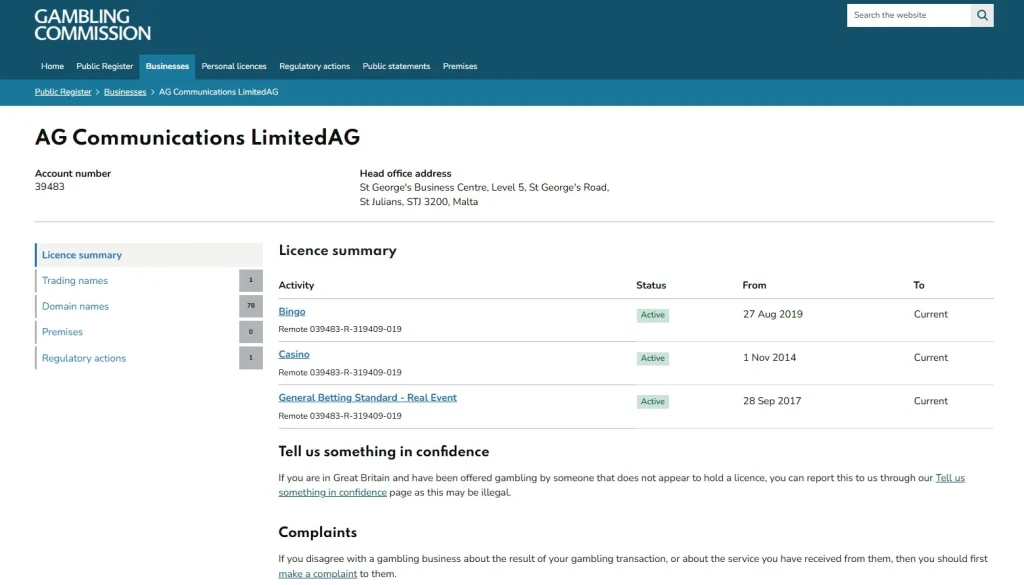
The strongest current evidence is mixed but not contradictory once operator and brand are separated. AG Communications Limited, the company historically associated with Playluck in Great Britain, currently holds an active UK Gambling Commission remote casino licence under account 39483. However, the Commission’s domain register marks www.playluck.com as Inactive. That means an active operator licence is not evidence that the Playluck domain itself is currently an active UKGC-listed gambling site. UK players should verify the operator, the domain and the live account journey separately before treating Playluck as a current service.
Table of Contents
- The current UKGC record: active operator, inactive Playluck domain
- Why an operator licence is not the same as a live Playluck casino
- What the 2025 UKGC action says about AG Communications Limited
- GAMSTOP is an operator-level UK requirement, not proof of current Playluck activity
- Does “inactive” mean Playluck is permanently closed?
- A five-step way to verify Playluck before depositing
- What the register can and cannot tell you about player safety
- How much weight should the 2025 settlement carry?
- What to do if a Playluck-looking site is live today
- Why old licence images cannot establish current status
- What would materially improve the current Playluck evidence
- The evidence UK players should use to decide whether Playluck is currently trustworthy
- Is Playluck Legit? UKGC Licence, Operator and Current Brand Status
The current UKGC record: active operator, inactive Playluck domain
The UK Gambling Commission public register lists AG Communications Limited under account 39483. Its Casino Remote activity is shown as Active and Current. The same account has a separate domain-name register, and that list currently marks www.playluck.com as Inactive.
Those two facts answer different questions. The operator record answers whether AG Communications Limited currently holds permission for remote casino activity. The domain record answers whether a particular web address is presently recorded as active under that account. A trust assessment that reports only the active licence omits the most important brand-specific detail.
| Evidence | Current record | What it establishes | What it does not establish |
|---|---|---|---|
| AG Communications Limited account | 39483 | Identifies the regulated business | That every historical brand of the business is active |
| Casino Remote activity | Active / Current | The operator currently has remote casino permission | That www.playluck.com is an active listed domain |
| www.playluck.com | Inactive | The Playluck domain is not currently active in this operator’s UKGC domain list | Why the domain became inactive or whether a future relaunch will occur |
Why an operator licence is not the same as a live Playluck casino
Large gambling groups can hold one operating account while running, closing or changing multiple brands and domains over time. The licence attaches to the legal operator and licensed activities; a brand or web domain must still be reconciled with the current public record.
That distinction matters because historical Playluck material can remain visible long after a product journey changes. Old reviews may show games, bonus terms, archived page images or registration instructions that were accurate at the time but do not prove the same service exists today. For a broader historical overview, start with the Playluck UK review, then compare it with the current regulator record.
What the 2025 UKGC action says about AG Communications Limited
Trust also requires looking at enforcement history, not just current licence status. On 4 March 2025 the Gambling Commission announced that AG Communications Limited would make a £1,407,834 payment as part of a regulatory settlement. The regulator said its review identified anti-money-laundering and social-responsibility failures during periods between 2022 and 2024, depending on the requirement involved.
The public statement describes issues including customer interaction, identification of individual customers, disclosure requirements and self-exclusion controls. The existence of the settlement should not be hidden, but it should also not be exaggerated into a claim that the operator’s licence was revoked. The current register still shows its remote casino activity as Active.
This is a useful example of why binary labels such as “safe” or “scam” are too crude. Regulatory history can contain serious findings while the licensed operator remains authorised. The decision for a player is therefore evidence-based: what is licensed now, what enforcement occurred, which domain is active, and what current terms are actually presented?
GAMSTOP is an operator-level UK requirement, not proof of current Playluck activity
Licensed online gambling businesses serving Great Britain are required to participate in GAMSTOP. That requirement is relevant when assessing a genuinely active UK-licensed online service. It does not convert an inactive domain entry into an active one.
If a site presents itself as Playluck and claims to serve UK customers, the correct sequence is to identify the legal operator shown in its current terms, match that operator to the UKGC register, and then check whether the exact domain is associated with the licence. A familiar logo, historical association or GAMSTOP reference is not a substitute for that reconciliation.
Does “inactive” mean Playluck is permanently closed?
No. The UKGC register supports a narrower statement: www.playluck.com is currently marked Inactive under AG Communications Limited. That is enough to reject the claim that the domain is presently an active UKGC-listed domain under that account. It does not by itself explain the commercial reason, prove permanent closure, or rule out a future change.
Public web material has described Playluck as closed or no longer taking new players, but those third-party statements do not establish the current commercial position on their own. The current regulator record is the strongest public status evidence: active operator licence, inactive Playluck domain.
If you are trying to open an account, the Playluck registration guide explains why a live signup path needs to be verified rather than reconstructed from old registration images.
A five-step way to verify Playluck before depositing
- Identify the legal operator. Read the current site’s terms or footer and note the company name exactly.
- Search the UKGC business register. Confirm the company account and the status of the relevant remote casino activity.
- Check the exact domain. Make sure the web address you are using appears as an active domain for that operator, rather than relying on an operator licence alone.
- Read current terms and payment rules. Deposit methods, withdrawal rules and verification requirements should come from the live service. The Playluck payments guide separates historical evidence from current unknowns.
- Test the account journey before funding it. A genuine current registration flow should clearly identify the operator, age rules, privacy information and account controls. Do not send documents or money to a site whose domain and operator cannot be reconciled.
This sequence takes slightly longer than checking a licence badge, but it is much harder for an outdated review, mirror domain or copied footer to mislead you.
What the register can and cannot tell you about player safety
A UKGC licence matters because it places the operator inside a regulatory framework covering areas such as customer interaction, identity checks, self-exclusion and anti-money-laundering controls. It also creates an official record of sanctions and licence status. Those are meaningful protections and evidence sources.
But a register does not predict whether an individual player will like the interface, receive fast support or have a frictionless withdrawal. Nor does it certify that every old brand attached to the operator is currently active. That is why reputation evidence belongs in a separate layer. The Playluck complaints and player feedback guide shows how to read anecdotal reports without turning them into regulatory facts.
How much weight should the 2025 settlement carry?
It should carry real weight because it is a formal regulator finding, not an anonymous review. The Commission identified failings and imposed a substantial settlement. For a risk-conscious player, that history is relevant to the operator’s control record.
At the same time, the action should be read with its date and outcome. The decision related to failures found over earlier periods, while the licence register now shows the remote casino licence as active. A balanced assessment records both facts. Saying only “UKGC licensed” is incomplete; saying the operator is unlicensed because it had a settlement would also be inaccurate.
What to do if a Playluck-looking site is live today
If you encounter a page using the Playluck name, do not assume it is the same regulated product described in old reviews. Check the full URL, legal footer, terms, privacy notice and operator name. Then compare those details with the Commission register. A small spelling change or different domain can matter.
Do not deposit merely because a page displays a UKGC logo or account number. Regulator details can be copied. The verification value comes from independently opening the public register and matching the operator and exact domain yourself. If the domain is absent or inactive, treat that mismatch as a reason to stop and investigate before sharing payment or identity information.
Why old licence images cannot establish current status
A historical image of a register can show that a licence or domain relationship existed at that time, but it cannot establish today’s status. Licences can be varied, domains can be added or removed, and operator portfolios can change while old review pages remain indexed for years.
For that reason, the date of the evidence matters almost as much as the evidence itself. A current UKGC register entry should outrank an undated badge, an archived footer or an old regulator image embedded in an affiliate review. If those sources disagree, use the live register as the starting point and then investigate why the older material differs.
What would materially improve the current Playluck evidence
The clearest upgrade would be a live Playluck account journey whose legal footer identifies AG Communications Limited, whose exact domain is active in the UKGC register, and whose current terms, privacy notice and payment information can be matched to that operator. Those pieces would connect the brand name to the current licensed service rather than relying on historical association.
Until that connection is visible, the prudent wording is narrow: the operator licence is active, the Playluck domain entry is inactive, and the 2025 regulatory action forms part of the operator’s record. That is enough for a useful trust assessment without guessing at a current commercial status the public evidence does not establish.
The evidence UK players should use to decide whether Playluck is currently trustworthy
The current evidence supports a precise conclusion rather than a blanket trust label: AG Communications Limited has an active UKGC remote casino licence, while www.playluck.com is marked Inactive in that operator’s domain register. The same operator also has a significant 2025 UKGC regulatory settlement in its history.
For a UK player, that means historical Playluck/operator licensing should not be confused with proof of a currently active Playluck service. Verify the legal operator, exact domain, live terms, signup path and payment information in that order. Use formal regulator evidence for licence and enforcement questions, and keep anecdotal player feedback in its proper supporting role.