
Playluck Games: Slots, Providers and Casino Range
 Available in GB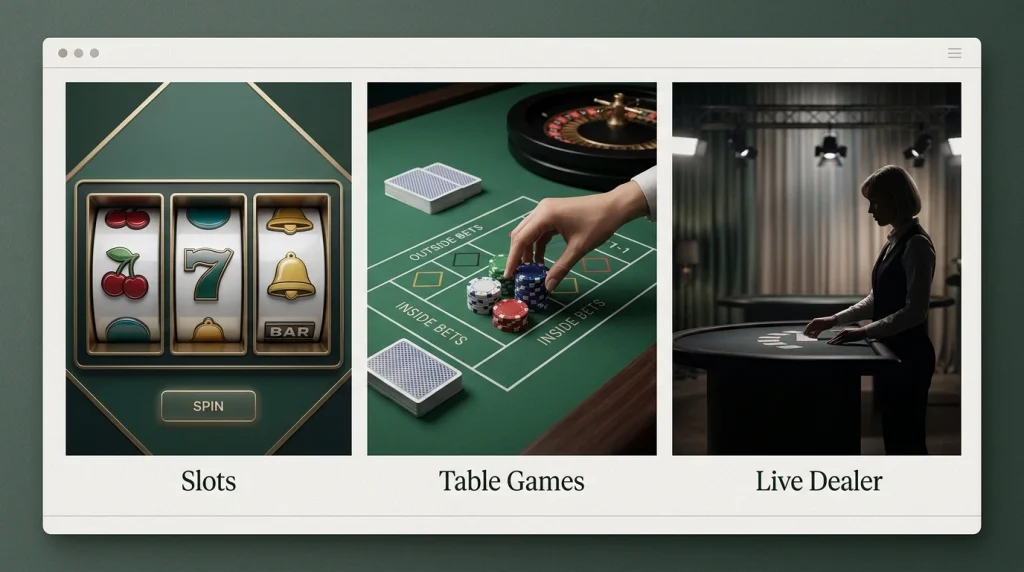
Historical multi-source evidence supports a Playluck catalogue built around slots and live casino games, with providers including NetEnt, Play’n GO, Pragmatic Play and Evolution. Those names describe the documented historical range, not a verified live 2026 lobby. Current title counts and current provider availability need a fresh lobby check, and there is no reliable basis here for publishing an up-to-date number of games.
For UK players, the game catalogue also has to be read alongside current slot rules. Online slot stakes are capped at £2 per game cycle for customers aged 18 to 24 and £5 for customers aged 25 or over. Those caps apply to online slots, not to roulette, blackjack or other casino games.
Table of Contents
- What the historical Playluck game catalogue contained
- Provider breadth was one of Playluck’s stronger catalogue signals
- Slots: what matters beyond the number of titles
- Live casino belongs in a separate depth check
- Why old game counts age faster than provider-level evidence
- How to check a Playluck lobby if it becomes active again
- Mobile access changes how a large catalogue feels
- Do historical provider names imply current UK availability?
- Game selection and bonus eligibility are different questions
- What to compare instead of a headline game count
- What the Playluck game mix means for UK slot and casino players
- Playluck Games: Slots, Providers and Casino Range
What the historical Playluck game catalogue contained
Across several historical reviews, Playluck is consistently described as offering both slots and live casino games. That tells us the casino was not a slots-only product: the catalogue was designed to cover conventional video slots plus streamed dealer tables. Provider evidence also points to a multi-supplier model rather than a lobby built around a single studio.
The safest way to use that evidence is category-first. It is reasonable to say that the historical Playluck catalogue included slots and live casino. It is also reasonable to name providers repeatedly documented across independent sources. It is not reasonable to turn a historical game-count figure into a current total, because casino lobbies change constantly as studios, jurisdictions and contracts change.
| Catalogue area | Historical evidence | Current-use rule |
|---|---|---|
| Slots | Core part of the historical catalogue. | Current titles require a fresh lobby check. |
| Live casino | Historical Playluck included live dealer content. | See the Playluck live casino guide for depth without assuming the old studio mix is unchanged. |
| Providers | NetEnt, Play’n GO, Pragmatic Play and Evolution are supported by historical sources. | Treat the names as historical unless the live lobby confirms them. |
| Game count | Legacy reviews give catalogue-size claims. | Do not publish a current number without fresh evidence. |
Provider breadth was one of Playluck’s stronger catalogue signals
Historical provider coverage included NetEnt, Play’n GO, Pragmatic Play and Evolution. That mix matters because the suppliers represent different parts of the casino experience. NetEnt, Play’n GO and Pragmatic Play are strongly associated with video slots, while Evolution is a major live-casino supplier. Together, they support the historical picture of a lobby spanning both RNG slots and streamed dealer products.
Provider breadth is more decision-useful than an inflated game total. A casino can advertise thousands of titles but still feel repetitive if much of the library comes from a narrow set of studios. Conversely, a smaller multi-provider lobby may offer more meaningful variation in volatility, mechanics, visual style and table formats. For Playluck, the documented supplier mix suggests variety was part of the proposition.
That conclusion still needs a date label. It should not be rewritten as “Playluck currently offers NetEnt, Play’n GO, Pragmatic Play and Evolution” unless a current lobby shows those studios. The Playluck overview explains why current brand status needs its own check before historical product facts are treated as live features.
Slots: what matters beyond the number of titles
A useful slot assessment looks at provider diversity, mechanics and player controls, not just raw quantity. Historical Playluck coverage supports a broad slot category, but it does not establish a live 2026 count or a current list of individual titles. Naming a few old games would add false precision because titles can disappear while the general category remains.
For a UK player, stake limits are now part of the product experience. The maximum stake per online slot game cycle is £2 for customers aged 18 to 24 and £5 for customers aged 25 or over. These are regulatory limits attached to remote casino operating licences in Great Britain. They are not Playluck-specific limits and should not be confused with an operator’s optional account controls.
The current UKGC online slots stake-limit guidance confirms the £5 limit for customers aged 25 and over and the £2 limit for customers aged 18 to 24.
Live casino belongs in a separate depth check
Historical sources support live casino availability at Playluck, and Evolution appears in the documented provider set. That is enough to establish that streamed dealer gaming formed part of the historical product. It is not enough to state that a particular table, studio, language or stake range is currently available.
The dedicated Playluck live casino page handles that narrower intent. Separating it from the main games page prevents the catalogue overview from turning into a stale list of individual tables. For a current check, the live lobby should be checked for roulette, blackjack, baccarat and game-show categories as they actually appear, plus table limits and language filters where those details are visible.
Why old game counts age faster than provider-level evidence
A quoted total game count is one of the most fragile facts in an online casino review. Libraries move as providers add releases, retire titles, change distribution rights or alter availability by market. Even an accurate number can become wrong quickly. Provider-level evidence tends to be more durable because a studio relationship can span many individual titles, but it still needs a fresh check before being described as current.
Historical evidence is strong enough to describe the documented categories and supplier mix, but not to support a current Playluck game total or a 2026 inventory. A fresh lobby check is needed for current counts.
How to check a Playluck lobby if it becomes active again
A current game-lobby check should be reproducible. Rather than sampling the first screen and guessing the total, record the visible filters and verify the categories systematically.
- Start with category navigation. Note whether slots, live casino and table games have distinct sections.
- Check provider filters. Confirm whether historically documented studios are still present instead of assuming continuity.
- Search representative titles. Use a small sample across several studios to test whether the provider filter reflects actually playable games.
- Record jurisdiction-specific gaps. A provider can exist globally while a title is unavailable to UK players.
- Avoid a total unless the lobby itself provides one. Infinite scroll and duplicated categories can make manual counts misleading.
- Separate live dealer from RNG tables. A digital blackjack game and a streamed blackjack table answer different user intents.
Mobile access changes how a large catalogue feels
Historical Playluck evidence supports a mobile-optimised website. That matters for games because a catalogue that is easy to browse on desktop can be cumbersome on a phone if filters, favourites and search do not translate well to a small screen. The historical fact is browser-based mobile support; it is not proof of a current native app.
The Playluck mobile casino guide covers the browser experience separately. For game selection, the key current checks would be whether category filters work cleanly on mobile, whether portrait play is supported where relevant, and whether live tables expose the same useful filtering as desktop.
Do historical provider names imply current UK availability?
No. A historical provider name shows that a studio formed part of the documented Playluck catalogue at that time. It does not establish that the provider is currently distributed through Playluck, that every title from the provider is available in Great Britain, or that a specific game remains playable.
This matters because provider availability is affected by both commercial and regulatory factors. A current UK lobby can differ from another country’s lobby even when the casino brand is the same. The correct wording is therefore historical unless a fresh UK-facing lobby confirms current availability.
Game selection and bonus eligibility are different questions
A game can exist in a lobby but contribute differently to a promotion, or be excluded from wagering altogether. That detail belongs to the current promotion terms, not to a general games catalogue. The Playluck bonus guide explains why current bonus eligibility, wagering and free-spin details need live terms rather than assumptions based on the historical library.
Keeping the two questions separate also improves comparisons. First decide whether the game mix itself suits you. Then, if a live promotion exists, check whether the games you would actually play are eligible. A large catalogue does not improve a bonus if the relevant titles do not contribute as expected.
What to compare instead of a headline game count
For decision-making, four measures are more useful than a single total: category coverage, provider diversity, the quality of search and filters, and UK-specific availability. Historical Playluck evidence scores well enough on the first two to show that it was designed as a broad casino rather than a one-category site. The last two require a live product check.
| Comparison measure | Why it matters | Playluck evidence |
|---|---|---|
| Category coverage | Shows whether the casino serves slots-only or broader casino intent. | Historical slots and live casino are verified. |
| Provider diversity | Suggests variation in mechanics and content styles. | Multiple major providers are historically documented. |
| Search and filters | Determines whether a large lobby is actually usable. | Needs a current interface check. |
| UK availability | Prevents global catalogues being mistaken for the GB lobby. | Needs fresh UK-facing evidence. |
What the Playluck game mix means for UK slot and casino players
The strongest supported conclusion is about structure, not scale. Playluck historically combined slots and live casino content and used a multi-provider catalogue that included NetEnt, Play’n GO, Pragmatic Play and Evolution. That gives a credible picture of a broad casino lobby, but it does not justify a current title count or a claim that every historical provider remains available.
For UK slot players, today’s regulatory baseline also matters: £2 per online slot game cycle for ages 18 to 24 and £5 for ages 25 and over. For live-casino players, provider and table availability must be checked separately. If Playluck becomes actively available again, the next useful step is a fresh lobby check rather than recycling an old game total. For the operator/domain evidence behind that caution, see the Playluck licence and trust guide.